Archive for November, 2008

Tamil League proposed by MIC Youth

November 20th, 2008
|  Subscribe in a reader | Subscribe to poobalan.com by Email


I vaguely remember reading somewhere that Vel Paari is the advisor for MIC Youth. According to him, he has been the advisor since 2004. Well, good for MIC Youth. I’m sure they have strong and valid reason for the appointment. Anyway, what’s the role of MIC Youth Advisory Council headed by Ramis? Maybe they should other advisors as well – those that have some sort of academic and social standing, with more experience.

Now, for the proposal by MIC Youth. Good idea indeed. This will enhance the link between Tamil Nadu and MIC especially. Even though the current focus would be Sri Lanka situation, in the long term it can encompass all areas of cooperation among members. I’m not sure if any such groups exist solely for Tamils.

The MIC Youth has proposed the setting up of a Tamil League in a move to attract international attention to the plight of Tamils in Sri Lanka.

Adviser S. Vell Paari said the league should be a United Nations-recognised body, similar to the Organisa- tion of the Islamic Conference (OIC).

“I believe a new league of Tamils representing their resident country should be established in Tamil Nadu to diligently and vigilantly guard over the political, economic and social agenda of Tamils living all over the world,” he said in a statement.

Vell Paari said the Tamil League should have a similar framework and diplomatic status like that of the UN and each Tamil representative from member countries should be given an ambassadorship entitling them to diplomatic immunity.

“I say this to sanction a valid representation from the Liberation Tigers of Tamil Eelam (LTTE), who can also sit within this Tamil League to voice its concerns and grievances without the fear of being detained,” he said.

Vell Paari said the Tamil League can set up a committee to discuss and negotiate with the Sri Lankan Government for a peaceful solution.

For details, please e-mail Vell Paari at tamilleague@gmail.com.
Can we play a role in determining our deputy prime minister

November 20th, 2008
|  Subscribe in a reader | Subscribe to poobalan.com by Email


As readers may know, 3 people are fighting for the Deputy President position of UMNO. That person will become the next Deputy Prime Minister of Malaysia, barring any moves by opposition to peacefully take over the Dewan Rakyat with the consent of the King (or something like that).

Those three candidates are Muhyiddin Yassin, Ali Rustam and Muhammad Muhammad Taib.

Now, it makes me wonder if a person like Ali Rustam or Muhammad Muhammad Taib becomes the Deputy President, what can we do to reject them as Deputy PM in the future? One issues threats (humiliated PPP at their own AGM!) and racists statements all the time. Another is well known for his $1.7 million story (and RM17 million worth of properties). There’s no election in the near future, so we can’t do much.

I’m not supporting Muhyiddin for the matter. UMNO’s elections is their own internal matter. If the members practice bribery (also known as money politics in UMNO-speak), that’s their problem. But what worries me is that the future Deputy PM is chosen by being virtue of Deputy President of UMNO. Meaning those few thousand people in UMNO who is less that few percent of the country’s population is going to make the decision.

So where does that leave people like you and me who are not in UMNO? If someone don’t like the future Deputy PM, can he/she not vote for BN regardless of who campaigns in that person’s area? Would that Deputy be a bigger liability to BN coalition partners? Can the coalition members oppose the appointment of Deputy President of UMNO as Deputy PM? Would UMNO members consider this while voting?

Indians earn only 14 percent more than Malays

November 20th, 2008
|  Subscribe in a reader | Subscribe to poobalan.com by Email


I’m sure the public is well aware of statistics on income according to races as revealed in Mid Term review of 9th Malaysian Plan. Specifically the average income for Malays and Indians were listed as below:

  • Bumiputera’s mean income
    increased by 5.2% to RM3,156 in 2007 from RM2,711 in 2004.
  • Indians’ income rose 3.2% to RM3,799 from RM3.456

That means the Indians on average earned 20 percent more than the Bumiputras in 2007 (RM3,799 versus RM3,156). The acceleration rate is 5.2 percent for Bumiputra against 3.2% for Bumiputras. If this continues, its possible that in next 5 years, the Bumiputras will earn more than the Indians, on average.

I’ve always asking why the term Bumiputra (and not Malay) is used. What would the statistics be like?

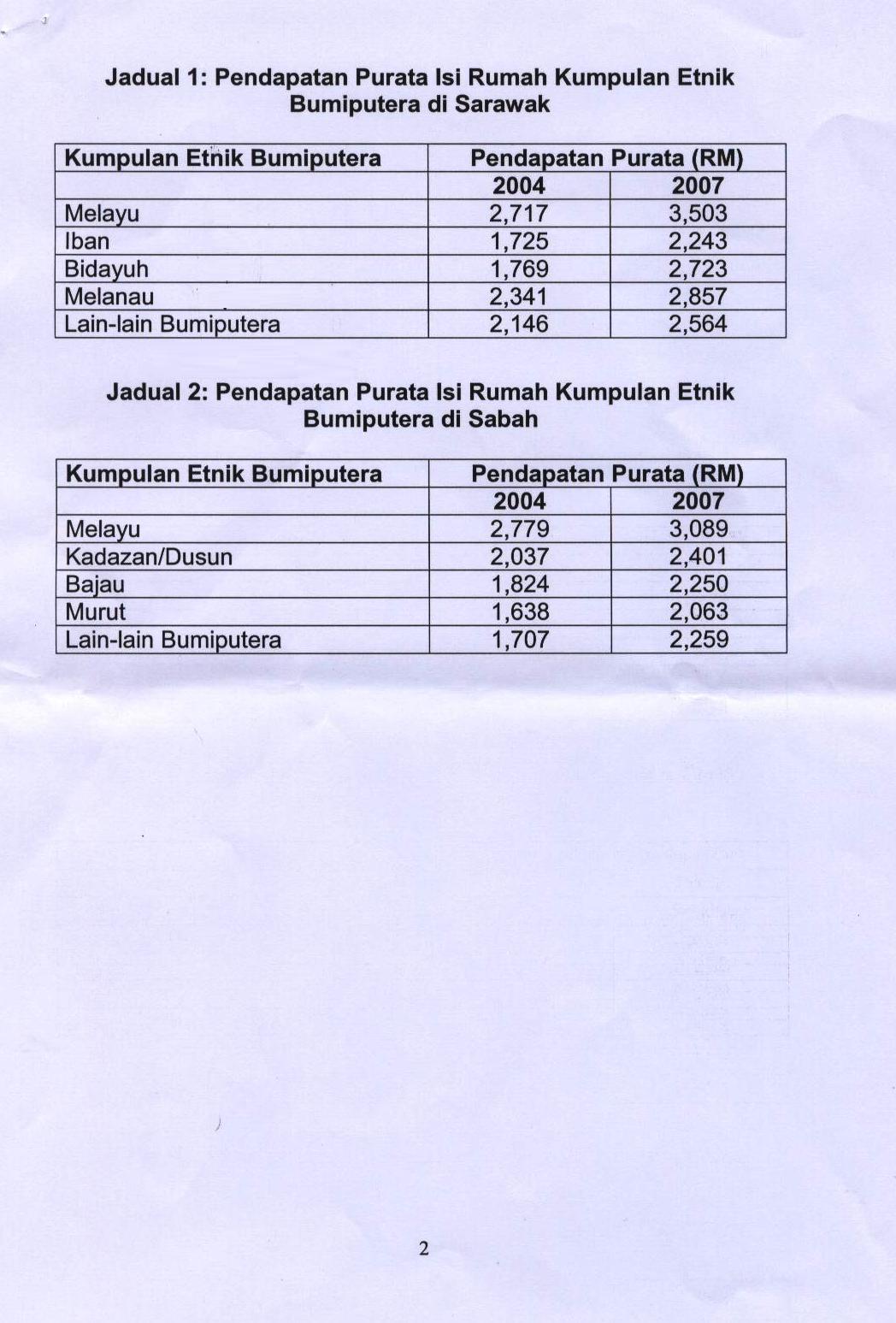
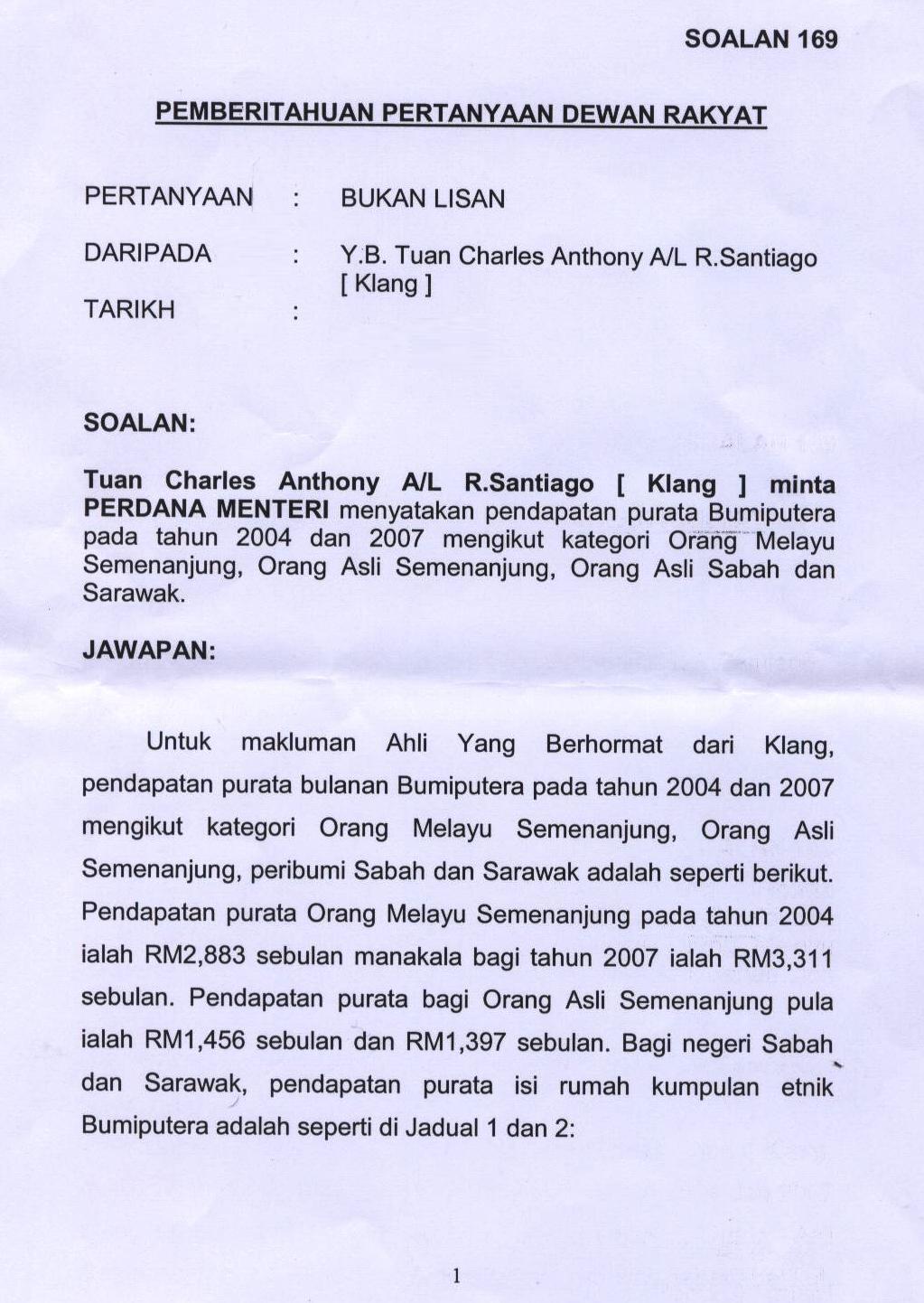
Thanks to MP Charles Santiago’s question in the Parliament, we get more details as below. It makes me think why those fellows in MIC never asked for such details before in the last decade (at least to my knowledge).

The statement and tables below show that the Malays in Peninsular earned RM3,311 on average in 2007 while those in Sarawak Rm3,503 and Sabah RM3,089. That means it doesn’t a genius to know that actual poverty is among the real Bumiputras (averagebetween RM2,063 and RM2,857). Orang Asli in Peninsular Malaysia are the worst with income around RM1,397.

That means, in 2007 the Indians earn on average only 14 percent more than Malays in Peninsular Malaysia (Its a fairer comparison as most Indians live in the Peninsular). Given the benefits and privileges the Malays get, is it fair to say that Indians are doing better than Malays? Shouldn’t the non-privileged communities be given handicap?

Reply on Average Income Breakdown

Reply on Average Income Breakdown

Reply on Average Income Breakdown 2

Reply on Average Income Breakdown 2

Complaints against civil service increases

November 20th, 2008
|  Subscribe in a reader | Subscribe to poobalan.com by Email


As more people become aware of their rights and multiple channels for complaints are created, its bound to happen. Due to things like HINDRAF rally, more Indians dare to stand up for their rights. The wins by opposition parties in some states also provides another voice for public to highlight their grievances.  The Internet through forums, blogs and websites provides more motivation and information for people to complain. Add to that the gun ho antics of Deputy Minister Murugiah who oversees the public complaints bureau, we have a spike on complaints received.

We have a civil service populated and ran mainly by people purportedly strong on religious values (praying 5 times a day should make me more God-fearing). So, what went wrong? Is it the system? Is it the employees? Is it isolated cases? Is it just a sign of times where people complain at the slightest excuse? Or is it that the civil service need to be revamped?

Complaints on public services have more than doubled in the past three years, especially those pertaining to abuse of power, corrupt practices and late or non-action by the officers concerned.

Public Service Department director-general Tan Sri Ismail Adam said the Public Complaints Bureau received 5,347 complaints last year, a big increase compared with 2,707 in 2005 and 3,397 in 2006.

“For the first nine months of this year, 6,059 complaints have been recorded,” he said in his speech at the opening of the Public Service national Quality Control Circle convention at Crowne Plaza Riverside Hotel here yesterday. Ismail’s speech was read out by his deputy Datuk Dr Ismail Alias.

Ismail expressed concern over the increasing trend of customers being dissatisfied, which marred the image and reputation of the public service.

Should Syariah and Civil laws merge?

November 20th, 2008
|  Subscribe in a reader | Subscribe to poobalan.com by Email


There’s suggestion by retired Chief Justice:

On Nov 6, retired Chief Justice Tun Abdul Hamid Mohamad said he foresaw that the combination of the two courts would harmonise common law and Syariah law principles in dealing with issues of conflicting laws and jurisdiction during his lecture at the Harvard Law School in the United States.

This is comment from Syariah Court Judge and Syariah Judicial Department director-general Datuk Ibrahim Lembut:

Islam will defend everybody. The impression that merging the two court systems will override the rights of the non-Muslims is wrong, he said.

Syariah laws and Islam will think of every religion and race, he told reporters after attending the International Seminar on Comparative Law at Marriott Hotel here yesterday.

However, we still have a long way to go before we can merge the two court systems although we have held talks between civil and Syariah lawyers on the possibility of harmonising the laws, he said, adding that Attorney-General Tan Sri Abdul Gani Patail had also given his views on the matter during the meeting.

Ibrahim said some civil lawyers attending such talks had refused to even consider harmonising the laws between the two systems.

He was commenting on a statement by MCA legal bureau chairman Datuk Leong Tang Chong that any merger would subject non-Muslims to Syariah jurisdiction on all legal matters, including inter-faith cases relating to marriage and divorce.

What do you think?

I think rather than merging both sets of laws, there should be some sort of bridge to link them both. Why should one be tried under a religious law which one does not profess to be part of? I think this idea may be construed as part of a long term strategy to Islamise the country. nearly 50 percent of the country’s population are not Muslims. Thus it is not wise to impose a law that does not relate to them in any way.

It would be better to study the overlapping laws, holes, and gray areas between two laws and clear them up. No one likes to see spouses make use of laws to manipulate children, nor do public like to read that families fighting over properties of the deceased, or bodies being snatched by religious department officers.

For those cases involving marriages being dissolved due to one party converting, then the marriage dissolution should follow civil law. Clear the slate, each person go on his own way. This is only natural as the marriage was done under civil law. So, BEFORE the person want to convert, divorce first.

Same goes for conversion. Those who are married must start fresh by divorcing their spouses and declaring their assets which are divided accordingly. For those who are single, the next-of-kin must acknowledge that he/she has been informed of the impending conversion. NOTE that its not an approval, but an acknowledgment so that family members are aware BEFORE conversion, and not after. The next-of-kin then knows that the body of the convert will end up in Muslim graveyard. No confusion.

For me, the problem is clear. Issues only arise when a party converts. Solve the problem at the root. Setup up proper documentation and procedures.

Your religion onto you … my religion unto mine ….