|
 Subscribe in a reader
 |
Subscribe to poobalan.com by Email
Oxford University and CISCO conducted this survey somewhere between May and July this year. The results seem to prove what many of us already know.
first some definitions: Refer to the diagram below to understand the requirements of broadband for “today” and for “tomorrow”. “Today” means download speed of 3.75Mbps, upload speed 1Mbps, and latency of 95ms. (in simple words, latency means time taken to travel from source to destination). “Tomorrow” means download of 11.25Mbps, upload 5Mbps and latency 60ms. “Tomorrow”s speed is expected to be in full service by 2015, and already in place in few countries. Applications in use now, like Facebook, YouTube, file sharing, etc requires “today” speed, while HD video streaming, large file sharing etc will require “tomorrow” speed.
The study uses a formula to calculate Broadband Quality Score (BQS):
BQS (today) = 55% Download + 23% Upload + 22%Latency
BQS (tomorrow) = 45% Download + 32% Upload + 23%Latency
BQS is then used to rate the 66 countries, using 24 million records of Speedtest results.
So, we want to see where countries stand if based on this two categorization of broadband service.
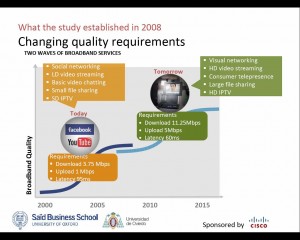
Last year, the university did a similar research (refer diagram below). Malaysia was located in the yellow band which states “below today’s application threshold”. In other words, our current broadband speed is insufficient to surf “today”s applications. Do note that the survey only covers about a third of the total countries in the world, so the ranking doesn’t bother me much. The absolute value of speed is the horror element here, as it has major social and economic impact later.

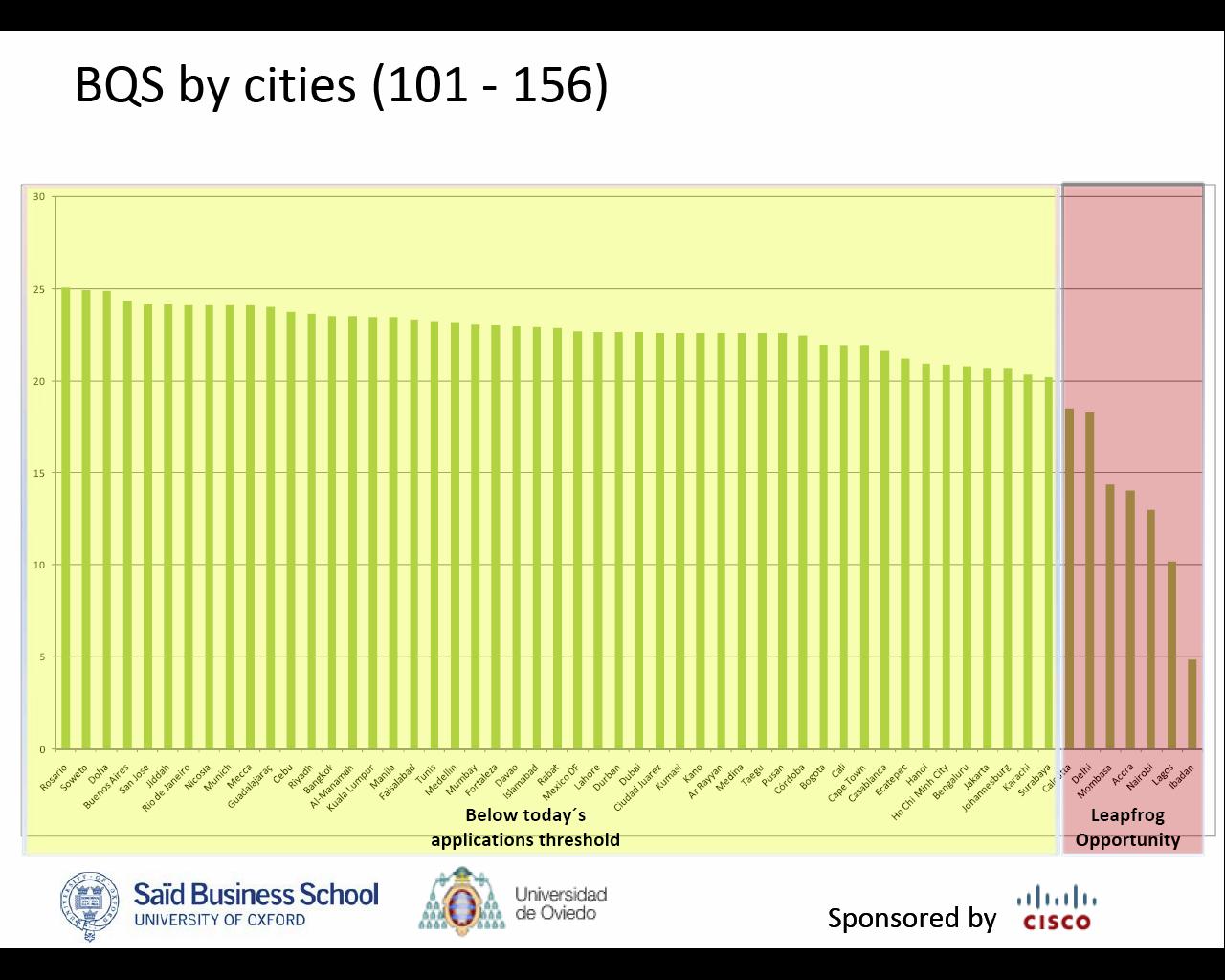
OK, if that was last year, how about this year? Refer diagram below. We are still in yellow band category – “below today’s application threshold”.

Malaysia has a BQS score of 23 and Penetration value of 30 (refer below) for 2009. Penetration for 2008 was 26%:

In terms of relating the BQS to GDP, Malaysia’s USD39,900 GDP/Capita is comparable to Belgium, Australia, Canada, UK, Sweden, Denmark, France, Netherlands, Germany, Austria and Iceland. (Confused on what’s GDP/Capital? It means: an approximation of the value of goods produced per person in the country, equal to the country’s GDP (Gross Domestic Product) divided by the total number of people in the country). The BQS/100,000 GDP per capita for Malaysia gives it a value of 58, meaning that our country’s GDP is not much affected by the Internet network capability. On the other hand, having a “today” or “tomorrow” speed network can help to improve the economy, and make us less labor intensive (at least that’s what I understand as a layman).

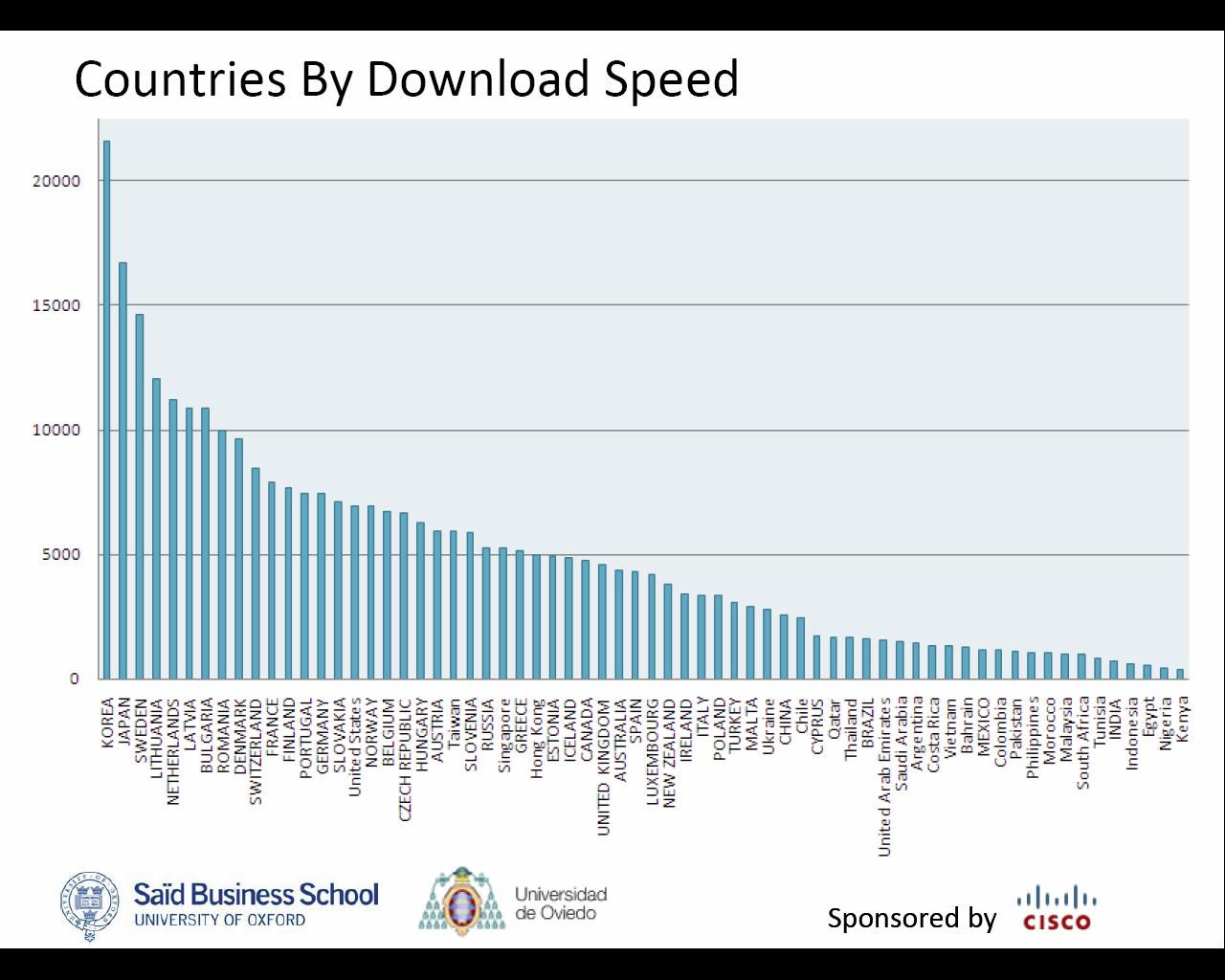
More statistics as the next three figures show Malaysia’s position in terms of download speed (barely 1Mbps), upload speed (about 512kbps) and latency (about 110ms). Not nice to look at!


In terms of broadband penetration (coverage), we are hovering in the 30% area:

And the final figure in this article shows that Kuala Lumpur has the potential to improve as we are in the Yellow band.

Overall, about 93% of the countries improved in areas of BQS, download speed and upload speed, while about 84.8% improved in the area of latency. In the 15 Asia Pacific countries evaluated, there was a collective improvement of 18.3%. The top country, South Korea, improved its BQS by 27.7!, not really resting on its laurels. while 15th top BQS increase was Hong Kong at 6.6 scores.
some interesting stats from official website:
- Overall average broadband quality increased across the globe:
– Global average download throughput increased by 49% to 4.75 Megabits per second (Mbps)
– Global average upload throughput increased by 69% to 1.3 Mbps
– Global average latency decreased by 21% to 170 milliseconds
- South Korea tops the 2009 Broadband Leadership table.
- South Korea rose just above last year’s broadband quality leader Japan with a 72% improvement in its Broadband Quality Score (BQS). This improvement has been driven by continuous efforts by the government to strengthen the country’s position as one of the world’s ICT leaders. Combined with higher broadband penetration, South Korea rises above Japan in the global Broadband Leadership rankings.
- Japan stands out as having the cities with the highest BQS in the world, with Yokohama and Nagoya leading the BQS rankings and Sapporo not far behind.
- Sweden has the highest quality broadband in Europe. It is rapidly catching up with Japan and South Korea as its BQS improves 38% from 2008. Sweden is the most successful country in closing the broadband quality gap with residents outside the most populated cities enjoying better quality than those in the cities.
- Lithuania, Bulgaria and Latvia come just behind Sweden in quality boosted by recent city-based fibre rollouts and cable improvements but low broadband penetration means these countries have yet to break into the broadband leaders’ category.
- 39 countries have a BQS above the threshold required to deliver a consistent quality of experience for the most common web applications today, such as social networking, streaming low-definition video, web communications and sharing small files such as photos and music.
- Nine countries, South Korea, Japan, Sweden, Lithuania, Bulgaria, Latvia, The Netherlands, Denmark and Romania, were found to have the broadband quality required for future web applications, such as high definition Internet TV viewing and high-quality video communications (such as home telepresence) that will become mainstream in the next 3 to 5 years. In 2008, only Japan exceeded this threshold.
- The research compares countries according to their stage of economic development :
– Amongst the developed, innovation-driven economies, South Korea achieved the greatest improvement in broadband quality over the past year with a 73% increase in BQS. Sweden, the USA and the Czech Republic also saw significant above average improvements.
– Amongst efficiency-driven economies, Bulgaria topped the most improved list with a 57% increase in BQS from 2009. Lithuania, Romania and Latvia also achieved above average improvements.
– Amongst factor-driven economies, Kenya actually trebled its BQS but the overall score for Kenya remains well below the threshold required for today’s applications. Vietnam and Qatar followed Kenya as having made the most progress in broadband quality for countries in this stage of economic development.
- The research team compared the difference between the BQS in the most populated cities with the BQS in the rest of the country. Although a digital quality divide was found in the majority of countries, 13 countries showed significant differences in BQS between its major cities and the rest of the country. Lithuania, Russia and Latvia had the biggest digital quality divide, while rural residents in Sweden, United Arab Emirates and Iceland enjoyed similar, if not slightly higher quality broadband services than their city counterparts.
- The country with the highest broadband quality outside of its major cities was Japan, followed by Korea and Sweden.
- The study also included data on the quality of mobile broadband services for the first time. On average, mobile devices connecting to WiFi services meet the broadband quality threshold required for today’s mobile Internet applications. The average BQS of 3G and 3G+ technologies do not currently meet the threshold due to low upload throughput.
The PDF file of the survey summary is here -> BroadbandQualityStudy2009PressPresentationfinal [pdf 908kB]. you can also download the appendix file [pdf 647kB] from the official website.
Obviously, nothing appeared on the official news channels, but Malaysian Insider carried the news on October 3rd:
KUALA LUMPUR, Oct 2 – Malaysia was ranked a poor 48 out of 66 countries for Internet broadband quality in a study conducted by Oxford University and sponsored by Cisco.
The global study on broadband quality conducted by Oxford’s Said Business School listed Malaysia among countries which had Internet speeds which were “below today’s applications threshold.”
Malaysia is listed in the same category but above countries like the United Arab Emirates, Philippines, Pakistan, Morocco, Vietnam and Indonesia. China, Malta, Brazil and Thailand are among countries just ahead of Malaysia in broadband quality but still in the same low category.
Countries like Singapore, Britain, Australia, Spain, Turkey and the Ukraine were listed above Malaysia as having Internet speeds “meeting needs of today’s applications.”
Switzerland, the United States, Russia, Taiwan and Hong Kong “comfortably enjoy today’s applications. Crucially, Korea, Japan, Sweden, Lithuania, Bulgaria, Latvia, Netherlands, Denmark and Romania were identified as countries with broadband speeds that were “ready for tomorrow.”
The study was conducted between May and July this year and Broadband Quality Scores (BQS) were awarded based on 24 million records sourced from speed tests.
A similar study conducted last year established that download speeds of 3.75 Mbps and upload of 1 Mbps was the quality requirement needed for today’s applications such as social networking, video steaming, video chatting and file sharing.
For what was classified as “tomorrow’s requirements” speeds of 11.25 Mbps for downloads and 5 Mbps for uploads was needed for visual networking, HD video streaming, consumer telepresence, large file sharing and HD IPTV applications.
According to the study, the research team had found that broadband quality was linked to social and economic benefits and that countries with high broadband quality have broadband on their national agenda.
In a statement earlier today, the DAP’s Lim Kit Siang described the study as confirmation of Malaysia’s unchecked plunge in international IT competitiveness.
“Internationally, broadband quality has moved from one of penetration, i.e. who had broadband connection and who did not, to broadband speed but Malaysia is till bogged down in the initial stage.
“Some six months ago, when Datuk Dr Rais Yatim was also appointed Communications Minister apart from his other portfolios of Information, Culture and Arts, I had called on him to give top priority to turn Malaysia into a broadband power, both in broadband penetration rate as well as in broadband speed if Malaysia is to enhance its competitiveness to take its rightful place in the global arena.
“I had asked what Malaysia’s national average broadband speed was, because nobody was talking about 2Mbps – we are lucky if we get 512 or 256kbps without disruption!”
Malaysians in selected areas will get access to high-speed broadband only by the first quarter of next year.
Residents of Taman Tun Dr Ismail, Bangsar, both in Kuala Lumpur, Subang Jaya and Shah Alam have been promised broadband speeds of 10 Mbps and above under the High-Speed Broadband (HSBB) project.
Residents in high-worth economic zones such as the rest of the Klang Valley and Iskandar Malaysia are expected to get the service later with 1.3 million households expected to have access by 2012.
The HSBB project is a public-private partnership between Telekom Malaysia and the government. Telekom is expected to invest RM8.9 billion of its own funds while the government will put in RM2.4 billion.
Telekom has so far claimed RM290 million from the government for work done.
Malaysia currently lags behind advanced countries in terms of quality and affordability of its broadband offerings, which has been confirmed by the Oxford University study.
While some countries such as Japan, Hong Kong, South Korea, Sweden and Finland have been enjoying speeds up to 100 Mbps for several years now, most Malaysian still make do with speeds of 1 Mbps or less.
Recently, Singapore, China and Australia have also upped the stakes in this strategic sector and announced massive initiatives to wire up their countries with fibre optics.