
Author Archive

Uthaya being treated at hospital says minister

March 2nd, 2009
|  Subscribe in a reader | Subscribe to poobalan.com by Email


Two questions here:

1. If Uthaya is being treated at Teluk Intan hospital, why wasn’t it announced earlier before the gathering to do mass police report?

2. Is the treatment suitable and sufficient, with independent observers being present? I think to avoid any misconception and unnecessary anger of the community against the government, there should be some independent verification.

Perhaps Dr S Subra should follow up on Syed Hamid’s information to verify if indeed Uthaya is being given appropriate treatment for his complications.

Internal Security Act detainee P. Uthayakumar is being treated for his illness at a government hospital, Human Resources Minister Datuk Dr S. Subramaniam said yesterday.

He was speaking after receiving RM170,000 from donors for the purchase of a building that will house an education centre under the administration of the Malacca Indians Development Association.

“It is the right of each and every Malaysian to be treated at the government hospital and in Uthayakumar’s case, I was informed by Home Minister Datuk Seri Syed Hamid Albar that he has been receiving treatment at the Teluk Intan Hospital,” he said.

Dr Subramaniam said he hoped that the government would make arrangements should Uthayakumar need specialist treatment for his diabetes-afflicted foot.

He was commenting on Uthayakumar’s supporters lodging police reports over alleged improper medical treatment for his diabetic complications and the use of water cannon to disperse about 200 of them near the Brickfields police station on Saturday.

Dr Subramaniam said: “I just want the public to be aware that the government is giving medical treatment to Uthayakumar. If the need arises, I hope that the government will grant him permission to seek treatment at a specialist centre.”
Muthu cries foul over nomination threats

March 2nd, 2009
|  Subscribe in a reader | Subscribe to poobalan.com by Email


With less than 3 weeks to nomination day, MIC president hopeful Muthupalaniappan is having problems getting nominations.  He claims that branch chairpersons were being threatened not to nominate him.  However he aims to persevere and hopes to be nominated. We wonder if his wishes will come true…

He said some leaders in the party were threatening the branch chairpersons not to nominate him for the top post or their branches would face closure for various reasons.

“All sorts of threats are being used. These underhand tactics are to ensure that I do not receive enough number of nominations to fight for the president’s post. If the election is not fair, then there is no point in contesting,” he told Bernama.

Under the party constitution, a presidential aspirant needs to obtain 50 nominations, and each nomination must have one proposer and five seconders, to be eligible to contest. All proposers and seconders must be branch chairpersons.

The MIC president will be picked by some 3,700 branch chairpersons nationwide. The party has fixed March 22 for the presidential nomination while polling is slated for April 12.

Quashing speculation that he would pull out of the contest, Muthupalaniappan said: “There is a lot of speculation that I will not stand but I will and shall contest.”

“They are trying to stop me by stopping people from nominating me,” he said, without disclosing any names.

“There is no level playing field. They have postponed the annual general meetings of some branches that supported me, especially in Negeri Sembilan, so that my supporters would be ineligible to vote.

“But there are branch leaders who are signing nominations for me…although many are scared of repercussions from the powers that be,” Muthupalaniappan said.

The 68-year-old politician from Seremban hoped that the branch leaders would act according to the aspirations of the 600,000 MIC members and the community, which wanted to see change in the MIC top leadership.

He also claimed that some MIC division leaders and state chairpersons, who were supposed to be returning officers in the presidential elections, were involved in campaigning.

“Under the party constitution, division leaders and state chairmen are returning officers of the presidential election.

“If they are returning officers, they should not be allowed to campaign in the election. It is like the Election Commission campaigning in an election. That is wrong,” he added.

I always wondered how long….

March 2nd, 2009
|  Subscribe in a reader | Subscribe to poobalan.com by Email


Blog had some problem today. Not sure why but could not view the pages since morning till evening. Must be some corrupted file. Anyway, its back to normal by itself now.

Coming back to the topic of this posting, I read an interesting article last Thursday. You know, I always wondered how long should one keep their shares (as in share market shares). My question was answered by investment advisor Ooi Kok Hwa via his article “How Long Should Investors Hold Their Stock Investments?”  The article is below:

OFTEN we hear some financial experts say we need to hold stocks long term, especially during the weak stock market situation like what we are experiencing currently.

Some gurus say the “buy and hold” strategy is the best investment strategy. However, some retail investors may argue that “buy and hold” is not suitable in Malaysia because if they pick the wrong stocks, some companies might even get delisted after a while.

The question of how long to hold has always been on the mind of investors when they purchase any stocks. Given the present weak economic and stock market conditions, some investors may lose patience as they do not know when the market will recover again.

In this article, we will look at the number of years that we need to hold our stock investments in Malaysia. We use the KL Composite Index average daily indices to compute the stock returns.

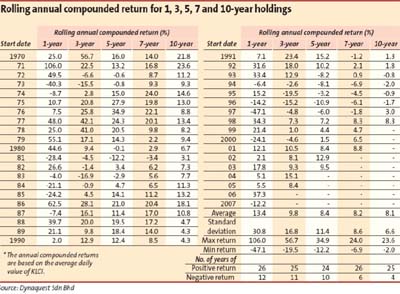
The following data was provided by Dynaquest Sdn Bhd. With its permission, we will provide the historical rolling annual compounded returns from 1970 to 2008.

The table shows the rolling historical annual compounded returns for holding the stocks for one, three, five, seven and 10 years.

It shows the average annual compounded returns and risks (measured by standard deviation) regardless of any starting or ending dates.

For example, the 25% returns in the second row and the second column of the table was the annual compounded returns of investing for one year from 1970 to 1971. The three-year returns of 56.7% was what you would’ve got if you started your investment in 1970 and ended in 1973.

If you started investing in 1970 and held it for five years (up to 1975), seven years (up to 1977) and 10 years (up to 1980), your annual compounded returns will be 16%, 14% and 21.8% respectively.

In terms of the overall average returns, except for one-year and three-year holding periods of 13.4% and 9.8% respectively, we notice that the annual compounded returns for five-year, seven-year and 10-year holding periods were almost the same, about 8% per annum.

However, the longer we hold our investment, the lower the risks that we face, which are measured by using standard deviations.

For example, if we hold our investment for one year, the standard deviation is 30.8%.

However, if we hold it a bit longer to three, five and seven years, the standard deviation will drop to 16.8%, 11.4% and 8.6% respectively.

For 10-year holding, the standard deviation is 6.6%. Based on two standard deviations, we are 95% confident that our returns will range from -5.1% (8.1% – 2 x 6.6%) to 21.3% (8.1% + 2 x 6.6%).

This is supported by the minimum returns of -2% and the maximum return of 23.6% for 10-year holding periods.

In conclusion, we need to hold stocks long term. We may not need to hold them up to 10 years.

However, we need to understand that we will face very high volatility on returns if we invest only for one year.

Besides, we need to make sure that we are buying good fundamental stocks in order to avoid poor quality stocks that are not suitable for long-term investment.

how-long-to-keep-stocks

Defining Poverty

March 1st, 2009
|  Subscribe in a reader | Subscribe to poobalan.com by Email


Adam Smith himself closely embraced a relative definition of poverty, arguing that to be poor was to have to go without what was needed to be a “creditable” member of society. He noted that, in his day and age, a man needed a linen shirt if he was to appear in public “without shame.” What defines being poor is not just being without a shirt (any shirt), but being without the means to be minimally respected in a particular society at a particular time.

Poverty is not only about money. It goes beyond that. Its about respect as well.

Contender for Malaysian word of the year

March 1st, 2009
|  Subscribe in a reader | Subscribe to poobalan.com by Email


I think “derhaka” is the popular word around in recent times. Even today Syed Hamid’s action on gazetting the use of Allah can be considered derhaka, said a guy. Derhaka means treason.