 |
|  Subscribe in a reader | Subscribe to poobalan.com by Email
 ex-DCM Fairuz quits his state assemblyman post, thus there will be a by-election for the state seat of Penanti in Penang.
| Subscribe in a reader | Subscribe to poobalan.com by Email ex-DCM Fairuz quits his state assemblyman post, thus there will be a by-election for the state seat of Penanti in Penang.
| Subscribe in a reader | Subscribe to poobalan.com by Email Well, “sympathy marks”, “marks for attendance”, “make-up tests/assignments”, “remarking” etc is quite common to pump up the marks. Which college/uni would like to be known as the place that fails students? Even students ask about passing rates before taking up courses. Some even admit that they enrol in certain colleges because easy to graduate.
Lecturers also will have to face the students next semester if they fail this semester. So, why waste time failing students, just pass them with minimum marks and send them off.
In the end, students want a scroll. College want money. Staff want salary.
But, if only 4 out 157 students passed as in the case below, then something seriously wrong. I have friends and contacts in education industry, but yet to hear of such poor passing rates from any of them. Its possible that the lecturer set too high a standard, or the quality of students are very poor. Being an Islamic university, attendance or discipline should not been an issue.
A UNIVERSITI Sains Islam Malaysia lecturer who passed only four out of 157 of her law students claims she was forced to resign so that the university could protect its reputation, Kosmo! reported.
Nor (not her real name) said the reason she left was because she could not stand the pressure from the university management on her to give “sympathy marks.”
“How am I to give extra marks if the marks they got is what they should be getting?” she said, adding that her downfall started when she received a show-cause letter on why so many students had failed.
She was then criticised by her superiors, who also wanted her to add marks based on attendance so as to reduce the number of failures.
“I stood my ground. How could I give them marks for that when it is their responsibility to show up for classes?” she added.
The university declined to comment.
| Subscribe in a reader | Subscribe to poobalan.com by Email Well, this is indeed a good move by BPA. I think T. Murugiah will have a bright future if continue to do good moves like this.
PCB office is being set up in KL and the public is invited to attend every Tuesday from morning 9am. There will be meals served as well for those coming from outstation! It seems the office in Putrajaya is very inconvenient for the public as it is costly and time consuming to travel there.
The new office will be open from 21st April and the address is:
Pusat Kegiatan Kemas Wilayah Persekutuan is located at Lot 48565 Jalan 2/12D, Kg. Seri Batu, Batu 4 1/2, 51200 Kuala Lumpur.
For details, call 03-6251 0218.
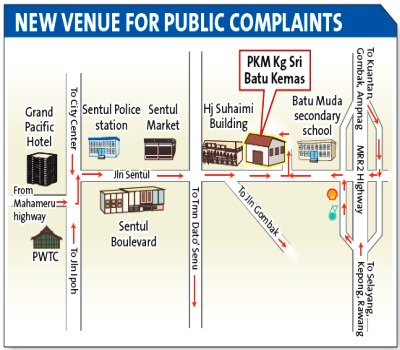
map of venue:
According to NST:
The Public Complaints Bureau (PCB) has introduced an “instant problem-solving system” to handle public issues in a more organised and efficient manner.
The bureau under the Prime Minister’s Department has pledged to look into public complaints of all sorts every Tuesday.
Deputy Minister in the Prime Minister’s Department Senator T. Murugiah said a complainant could expect his issues to be settled between one and five working days.
The bureau has been moved from Putrajaya to the Kemas Community Centre at Kg Sri Batu, Jalan Ipoh for easier access.
“We will start our meetings at 9am every Tuesday and will not stop until we have seen each complainant through his or her problem, even if it drags on till midnight.”
“We welcome any issues ranging from drainage to abandoned housing projects to citizenship issues but do not come to us if you are expecting a solution to financial problems,” said Murugiah, adding that the PCB will not entertain debt problems, including those relating to loan sharks.
The PCB managed to solve 90 per cent of the 8,066 complaints lodged last year.
It had seen a maximum of 300 people a day.
Types of complaints lodged include delay in action, lack of public amenities, poor implementation of policies and law, abuse of power, misconduct of public officials, failure of enforcement and poor service quality.
Murugiah expects the number of complainants visiting the bureau to increase because of the relocation.
“We will see each one of them. There will be a waiting room and rest area for those coming from out of state. Meals will also be provided.”
The Star provided more info:
FOR better accessibility and convenience, the venue for the Public Complaints Bureau’s (BPA) public meeting sessions has been changed from Putrajaya to Kuala Lumpur.
The weekly meeting that takes place every Tuesday will now be held at Pusat Kegiatan Kemas Wilayah Persekutuan in Kg. Seri Batu, Jalan Sentul.
The sessions, which will begin at the new location on April 21, are based on a new system called “Instant Problem Solving System.”
Breakfast, lunch and tea will also be provided during the meet.
Public Complaints Bureau chairman Senator T. Murugiah said through the system, public meeting sessions would have a representative from every ministry and government agencies to make problem solving easier and faster.
He added that the change in venue was to make it more convenient for the public.
“This way, more people will come forward and voice out their problems. With the presence of representatives from agencies and ministries, we can solve problems faster and more efficiently.
“We have received about 300 cases in a day’s meeting. With the change in location, we can expect more,” he said.
Currently, most public complaints are related to local councils, drainage and road works, abandoned projects and the registration department.
Murugiah, however, discouraged those with financial problems to attend the sessions.
“Complaints bureau is a place for those who are unhappy about certain things to do with the government. They can come forward and complain and we will try to do the necessary.
“It is not a place to seek financial aid,” he said.
Pusat Kegiatan Kemas Wilayah Persekutuan is located at Lot 48565 Jalan 2/12D, Kg. Seri Batu, Batu 4 1/2, 51200 Kuala Lumpur. For details, call 03-6251 0218.
| Subscribe in a reader | Subscribe to poobalan.com by Email This the excerpt from Mingguan Malaysia interview with DPM Muhyiddin:
Kalau melihat kepada keputusan pilihan raya kecil baru-baru ini terutamanya di Bukit Gantang dan Bukit Selambau, ia seolah-olah menampakkan laluan BN masih sukar untuk mendapat sokongan rakyat, apa pandangan Tan Sri?
MUHYIDDIN: Saya fikir paling jelas terbukti masyarakat Cina dan India belum bersedia menerima apa-apa bentuk pimpinan kerajaan yang seperti ada sekarang ini, lebih lagi agak terlalu menonjol ialah terhadap apa yang berlaku di Perak itu sendiri. Sesetengah masyarakat di sana, melihat ia dari sudut yang rasis, kerajaan orang Cina ditumbangkan oleh kerajaan orang Melayu walaupun tanggapan itu tidak betul.
Mungkin mereka tidak berapa jelas cara dari sudut Perlembagaan dan peraturan, maka mereka melihat apa yang berlaku sebagai satu bentuk menolak hak majoriti rakyat, mereka mahu kerajaan dipilih seperti pilihan raya lepas.
Komplikasi ini menyebabkan rasa marah di kalangan orang Cina dan juga masyarakat India, jadi bagi saya itu agak menjadi faktor utama di Bukit Gantang dan kesannya sampai ke Bukit Selambau. Ini jelas apabila ada masyarakat Cina di Bukit Selambau ramai yang tidak keluar mengundi, kita tidak pasti sama ada mereka memboikot atau tidak mahu menyatakan pendirian.
Bagaimanapun petanda lain, kita melihat sokongan orang Melayu meningkat, jadi dari satu sudut ada faktor yang positif kerana masyarakat Melayu mungkin lebih yakin apabila melihat angin perubahan dalam kepimpinan negara, kepulangan Tun Dr.Mahathir Mohamad ke dalam UMNO dan lain-lain usaha yang kita buat untuk menjelaskan isu yang berlaku di Perak sebab itu mereka membantu kita.
Saya fikir ada juga faktor-faktor lain yang menyumbang kepada kekalahan seperti pembangunan, faktor tidak ada keputusan yang dibuat oleh kerajaan yang menyenangkan rakyat, isu tanah dibangkitkan dan mungkin dari segi bantuan sekolah-sekolah bukan kebangsaan, jadi sama ada faktor ini menggambarkan senario nasional atau pun lokal, kita akan ketahui selepas kita membuat satu kajian oleh badan bebas nanti. Di Bukit Selambau pun tidak banyak bezanya, mungkin ‘angin’ yang sama ‘bertiup’ ke sana dan kesannya hampir serupa, faktor sokongan Melayu hampir positif, kaum India sedikit ada penambah baikan tetapi tidak banyak berubah, jadi ini satu perkara yang perlu kita kaji dan teliti. Tetapi macam di Sarawak, di Batang Air, mungkin disebabkan ia jauh di pedalaman mereka melihat soal pembangunan, jadi mereka melihat kerajaan sebagai satu tempat yang mereka harapkan sangat.
Di Semenanjung pembangunan tidak menjadi isu, mereka melihat kepada isu-isu yang lebih nasional apa lagi dibebankan dengan apa yang dibuat oleh parti pembangkang. Mungkin methodologi yang kita guna masih lama sedangkan mindset baru. Ini kita akan ambil iktibar daripada itu, bagaimana kita hendak mengubah methodologi kepada suatu yang lebih sesuai dengan keadaan dan masa.
Tetapi bukankah setiap kali pilihan raya kecil, permintaan kaum bukan Melayu dipenuhi, malah di Bukit Gantang walaupun peruntukan RM1juta diberikan tetapi kaum Cina tidak juga menyokong BN? [this is the tricky question asked by the interviewer]
MUHYIDDIN: Ya, kadang-kadang kita berasa terpedaya juga kerana zahirnya nampak macam ‘ok’, sambutan dengan tepukan gemuruh tetapi mungkin sudah ada tertanam dalam hati iaitu sesuatu tidak mudah hendak berubah, pokoknya masalah isu Perak terutamanya di kalangan masyarakat Cina yang mungkin telah dipengaruhi dengan sentimen simpati kepada Datuk Seri Ir.Mohamad Nizar Jamaluddin, kononnya dia ‘dijatuhkan’, lepas itu kononnya dasar memberi pegangan tanah selama 99 tahun dilihat dasar yang menguntungkan.
Ini yang mungkin menyebabkan sukar BN mendapat sokongan walaupun kita fikir bila mereka hendak sekolah Cina dibantu, kita bantu, sepatutnya mereka membalas budi. Pada waktu itu, kita pun tidak berharap sokongan kaum Cina akan meningkat 40 peratus dan sebagainya cuma kita berharap ada peningkatan sedikit tetapi apa yang berlaku ia mencatatkan penurunan, macam tidak ada penghargaan terhadap apa yang kita lakukan.
Oleh itu kita kena kaji psikologi apa yang menyebabkan masyarakat Cina tidak bersedia untuk berubah, pada zaman dahulu tidak begitu.
Persoalannya apakah mereka melihat dalam konteks senario politik baru ini, selepas kerajaan BN tumbang di lima buah negeri, mereka sudah menjadi kuasa penentu? Orang Cina rasa sekarang, walaupun mereka kumpulan minoriti, merekalah menentukan kerana kelompok masyarakat Melayu sudah berpecah tiga kumpulan. Masyarakat Cina tidak berpecah mereka bersatu, setidak-tidaknya dari segi semangat apabila bersama-sama membuat sesuatu keputusan.
Dalam keadaan ini, mereka boleh menentukan keputusan sesuatu pilihan raya dan apabila kesan itu dapat dilihat dalam pilihan raya umum lalu dan beberapa pilihan raya kecil, mereka fikir sekarang mereka lebih ada kuasa penentu, bukan sahaja Cina malah masyarakat India pun begitu, apa tah lagi apabila mendapat kedudukan dalam kerajaan yang ditubuhkan pakatan pembangkang dengan menjadi Timbalan Ketua Menteri, Speaker dan exco kerajaan negeri, jadi ini bagi mereka seolah-olah tawaran yang diberikan oleh pihak sana lebih baik daripada kita pernah tawarkan dalam konteks BN, jadi ini kita harus teliti.
Apakah situasi ini yang mendorong Tan Sri membuat seruan supaya semua orang Melayu bersatu kembali di bawah UMNO?
MUHYIDDIN: Saya membuat seruan itu kerana saya berpendapat dalam situasi sekarang ini, orang Melayu sudah banyak berpecah, faktor antara lain apakah kerana ia kelemahan UMNO yang tidak memahami cita rasa orang Melayu atau kerana ia perbuatan yang dilakukan oleh sesetengah kelompok contohnya Anwar Ibrahim yang memberikan kononnya satu gagasan baru atas dasar keadilan dan kesamarataan, ada sesetengah kelompok yang terpedaya, jadi dengan sebab itu selagi Melayu berpecah, saya bimbang kelompok majoriti akan menjadi minoriti.
Teras pembangunan negara kita adalah berasaskan kepada suatu jumlah masyarakat Melayu yang agak besar tetapi terpisah atau dipecahkan oleh perbezaan politik yang begitu ketara, dalam masa yang sama di pihak sana pula bukan Melayu menjadi penentu, inilah yang saya kata sudah berubah landskap politik negara kita, dan kalau hal sebegini berterusan apakah ia akan menguntungkan Melayu?
Bila saya berkata demikian bukanlah bermakna bukan Melayu akan rugi, orang bukan Melayu tidak akan rugi kerana mereka sudah maju, berjaya menguasai bidang ilmu dan ekonomi dan sebagainya. Bagaimana dengan masa depan orang Melayu? Apakah orang Melayu akan terjamin dengan situasi sebegini? Saya sudah mendapat banyak maklum balas bahawa orang Melayu berasa bimbang, mereka memikirkan soal generasi Melayu akan datang, macam mana nasib anak cucu kita. Perasaan ini wujud kerana mereka merasakan kedudukan orang Melayu sudah mula tergugat, kuasa politik Melayu melalui UMNO sudah tergugat, sedangkan dahulu kita jadi teras kita adil, saksama dan kita bantu semua kaum.
Kita menolong orang Melayu lebih kerana orang Melayu miskin, orang Melayu belum ada banyak harta dan orang Melayu belum menguasai kekayaan ekonomi dan sebagainya, jadi kita bantu beri pendidikan, biasiswa dan bantuan macam-macam lagi. Sebenarnya agenda pembangunan umat Melayu belum beres, sekarang tercabar dengan sebab berbeza politik menyebabkan orang Melayu berpuak-puak.
He says that his words were twisted and misintepreted, especially by the Chinese newspapers until it sounded as if he called the Chinese as “ungrateful”.
From what I understand, he starts by saying that the Chinese and Indian are not ready to accept any type of government leadership as it is now, especially after what happened in Perak. Some people there think that the Chinese government have been toppled by the Malay government, even though that is wrong assumption, says Muhyiddin. Its possible that the people in Bukit Gantang are unhappy at the way the majority choice is rejected, because they want a government chosen after elections. He thinks the same issues affected the Chinese in Bukit Selambau, perhaps that’s why many of them did not turn up to vote (either they want to boycott or did not want to make a stand). He also mentioned that other factors like development, no populist decision by government, help for land titles, and issues related to national type schools.
However, the next question by the interviewer is very dangerous one – the interviewers asks as follows: Is it not that for every by elections, the requests of non Malays are fulfilled, even in Bukit Gantang an allocation of RM1 million was given, yet the Chinese did not support BN?
Now, how is one supposed to answer this question? Let’s see how newly minted DPM answers (I translated the relevant paragraphs from above):
Yes, sometimes we feel cheated because on face value it looks “ok”, reception with loud claps, but maybe deep in the heart its already planted that not easy to change, issues like sympathy sentiment for Nizar and land lease of 99 years which is seen as beneficial.
This is perhaps that make it difficult for BN to get support because even if we think they want Chinese schools to be helped, we help, they should repay the kindness (membalas budi?). At that time, we do not expect the support from Chinese to increase 40% or so, but we hope at least a small increment, but what happens is a reduction, as if there’s no appreciation (penghargaan) of what we have done.
So, we have to study what pyschology makes the Chinese community not ready to change, it was not so those days.
The question is do they see, in the current political scenario context, after BN fell in five states, themselves as determining power? The Chinese now, even though are minority, they are the deciders because the Malay community has split into three groups. The Chinese community did not spilt, they are united, at least in spirit when they make a decision together.
In this situation, they can decide the decision of a election, and when the effect is seen in the last general election and past few by-elections, they think they have more deciding power now, now only the Chinese but also the Indians, what more when get positions in the governments formed by opposition coalition by becoming deputy chief minister, speaker and state exco, so this, for them, makes the offer made by the other party better than what we have ever offered in BN, so this we have to study.
Well, did DPM insult the Chinese community? Is what he said a fact? I think he is voicing his frustration because their prediction of small increase in support did not materialise, in fact, it went the other way. Regardless of that MCA and Gerakan benefitted from cabinet revamp, so maybe the Chinese community will show their appreciation in the next elections.
As for the Indians, they got a better deal under Pakatan states as mentioned by DPM – deputy chief minister post, more exco seats, speaker post and so on. Something that never happened in last 51 years. Of course some may argue – these few posts, does it translate to overall improvement of the community or merely symbolic. Sometimes actions speak louder than words. BN has lots of promises for the community over the 50 years, and the report card have many red marks. Just look at Tamil schools, intake in public service, number of students in IPTA, number of entrepreneurs, income imbalance, asset ownership, and equity in shares, among others. Pakatan just into second year, so still got long way to go before we can compare on equal footing.
For me, if you are taken for a ride, its your foolishness that plays a major role. One thing for sure, the Chinese really make use of MCA/Gerakan/DAP etc to achieve many things. They are a lot more politically savvy than the Indian. Definitely its not the place of any minister to teach or advise the community on how to show appreciation or to repay gratitude. There’s a saying that goes like this – “don’t expect gratitude” and “do good without expecting anything in return”. But in politics, its always a trade, a busines transaction. Thus in the recent cases, its seems that one party refuses to honor the deal, as implied in the interview.
As some quarters asked – whose money is that RM 1 million? Did it come out of someone’s pocket? Then the recipients should thank those people.
MCA and Gerakan are quick to point out that piecemeal actions and last minute work would not guarantee the support of the community. Just RM1 million will not sway the votes, when there are many other outstanding issues still unsolved.
| Subscribe in a reader | Subscribe to poobalan.com by Email This doesn’t really surprise many of us. We have seen the impact of Internet in highlighting social issues,elections, e-commerce, and even crime. The survey by Synovate had the following to report:
– about 45 percent of the Malaysian youth interviewed in the survey said they planned to use the Internet more than other media.
– young Malaysians were active bloggers with close to half (48 percent) spending a portion of their time blogging.
– a total of 21 percent of Malaysian youngsters create and update their blogs regularly and this figure is expected to rise
– young Malaysians aged eight to 24 spend an average of 1.2 hours a day on email, one hour and thirty-six minutes a day as part of online communities, two hours and 48 minutes on instant messaging and two hours and 36 minutes on other Internet activities.
“Young Malaysians are definitely turning to the Internet more for their information and entertainment needs and it’s not surprising that the Internet is slowly becoming the medium of choice,” said managing director of Synovate in Malaysia, Steve Murphy.
The survey covers 12 markets across Asia, including Japan and Vietnam for the first time. Besides Malaysia, the other markets were China, Hong Kong, India, Indonesia, South Korea, the Philippines, Singapore, Taiwan and Thailand.
You are currently browsing the archives for the BornInMalaysia category.


© 2026 poobalan.com · Proudly powered by WordPress & Green Park 2 by Cordobo.
Valid XHTML 1.0 Transitional | Valid CSS 3

