Archive for the ‘BornInMalaysia’ category

We lost because of him!

September 18th, 2009
|  Subscribe in a reader | Subscribe to poobalan.com by Email


One should not believe a word ex-PM Mahathir says on face value. There’s always a hidden agenda somewhere. So, if he says Samy Vellu should go (short of harakiri-ing), or that Nazri should be dropped from Cabinet, or Isa Samad is not fit to be a candidate, there’s something else happening behind the scenes. Let’s look at his comments (also available in Malaysiakini):

“If we look at other countries, whenever a leader fails, he resigns. In Japan he commits harakiri. We’re not asking him (Samy Vellu) to commit harakiri.

You (Samy Vellu) have failed to lead the MIC until you yourself lost,” he said.

Citing the example of former prime minsiter Tun Abdullah Ahmad Badawi who resigned after his poor performance, Tun Dr Mahathir said: “Samy Vellu performed worse than Pak Lah (Abdullah) but he did not want to relinquish the post.

“He should have resigned before things got to this stage.”

He said he had a right to criticise anyone for the sake of the Barisan, and added: “I’ve criticised Pak Lah, who’s Samy Vellu that I cannot criticise?” [Where is Samy going to hide after this? Does this mean more MIC staunch supporters will propose or even garland Mahathir’s pictures with slippers? Anyone supporter will self-immolate like in Tamil Nadu? I don’t think so 🙂 ]

» Read more: We lost because of him!

The poor remain poorer

September 18th, 2009
|  Subscribe in a reader | Subscribe to poobalan.com by Email


Low wage earners will be looking forward to the festive season(s) with dread. With meager income in the ever-escalating cost of living cities, its hard to make ends meet. And the alternatives are practically non-existent. Those working as cleaners, security guards, drivers, cashiers, sales persons, etc, especially in small establishments or those that don’t really bother about employee welfare will be hard pressed to celebrate festivals with pomp.

I was surprised to hear that at some organization, the lower level staff ‘s overtime payments were held back.  The workers don’t have much choice as jobs are not easy to find. Make some noise, and you’ll find a foreign worker taking your place.  Not sure if in these kind of  cases, the top management or owners are aware of the predicament of their staff in the lowest rungs. Maybe its some mid-level management or even contract manager who is doing all this. I’m also wondering how much the top management and directors take home, as comparison to the executives and workers in an organization. What’s the point of winning awards and plaudits when own backyard tells a stinking story.

I hope the Human Resource Ministry will conduct spot checks on companies (hint: try the  dozens of IPTS, private  healthcare facilities, etc in Klang Valley) and check their payrolls. Need to be proactive instead of waiting for complaints to fall on their laps.

» Read more: The poor remain poorer

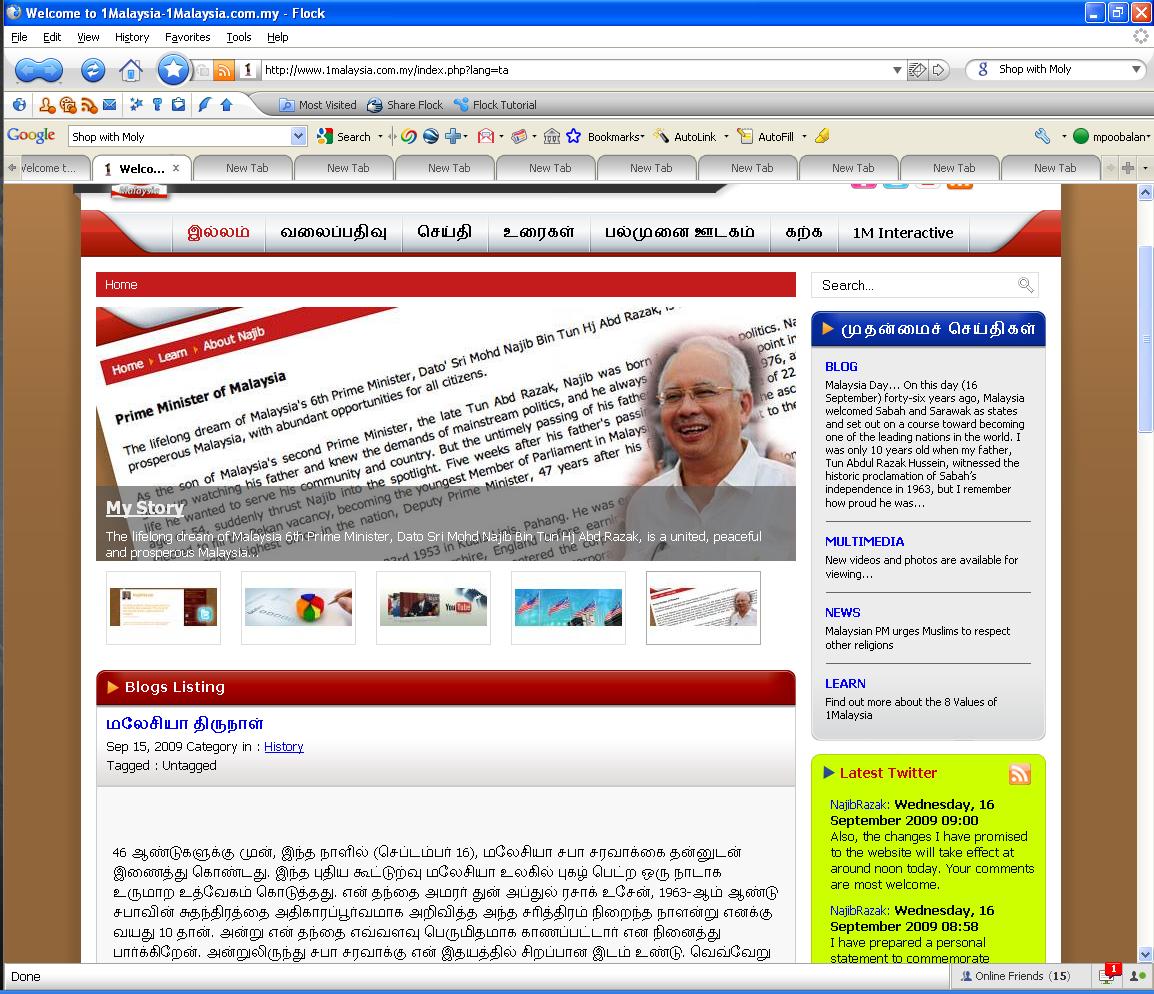
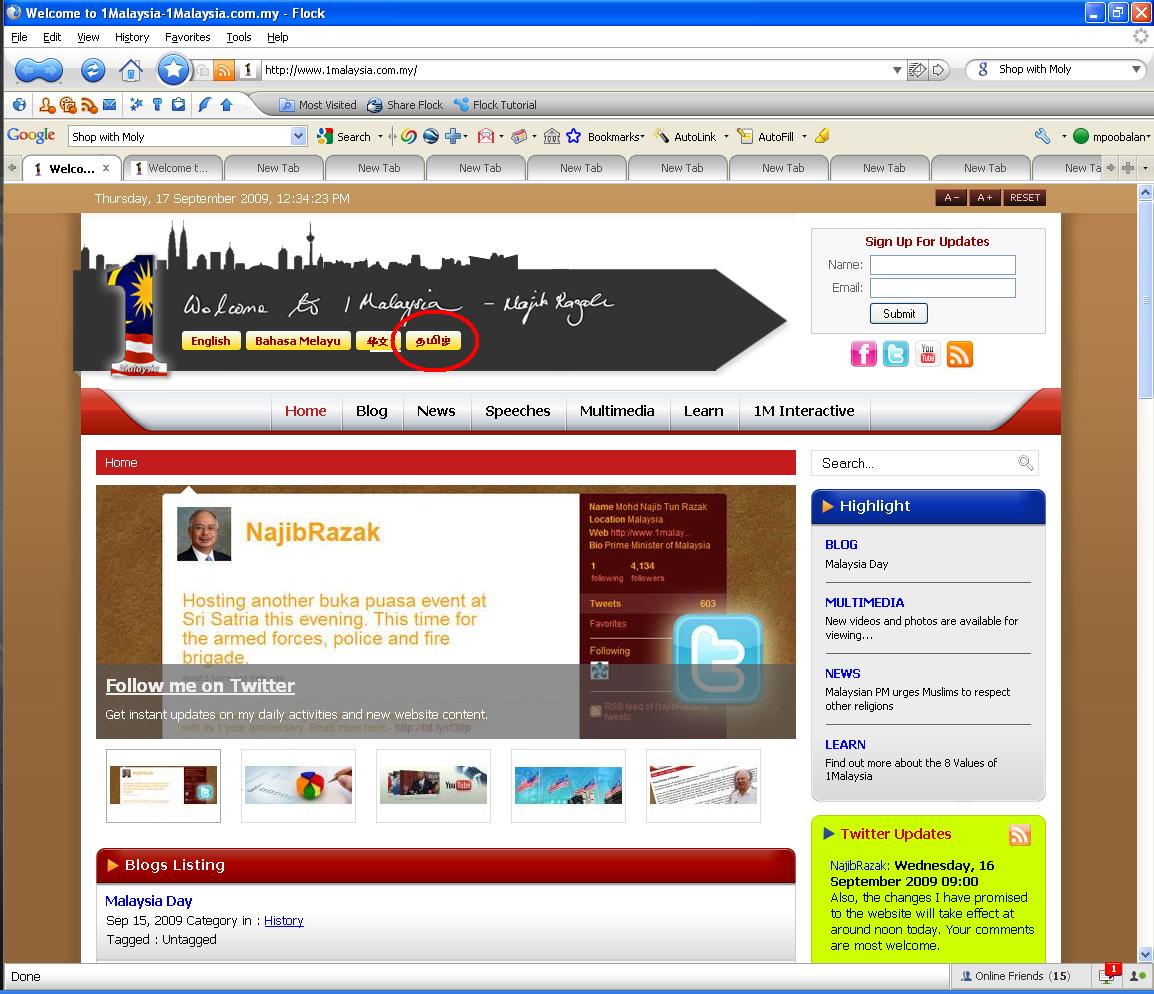
1Malaysia website in Tamil

September 17th, 2009
|  Subscribe in a reader | Subscribe to poobalan.com by Email


Its finally here folks! After one year of waiting, the Tamil version of PM Najib’s 1Malaysia website has gone live from yesterday (psst..does it mean we get things one year after everyone else? 🙂 ) :

1Malaysia-tamil-01

1Malaysia-tamil-02

However, the comments are shared, so you can read all the comments for a particular post, regardless of which language you choose.

The changes are part of the 1st year anniversary of the 1Malaysia website.

family laws and conversion problem

September 14th, 2009
|  Subscribe in a reader | Subscribe to poobalan.com by Email


Earlier IKIM article talked about child conversion, while the one below focuses on the two set of laws that govern family/marital matters. The main point is the inability of the converting spouse to initiate divorce proceedings in civil court. I think it should be done before the person converts, not while/after converting. Get a clean slate and then continue with life. Or just set up a marriage dissolution tribunal, for example, to make the separation process easier and faster. The convert-t0-be can also be made to provide proof of divorce to the relevant state Islamic religious departments before he is processed for conversion.

Conversion and the family

IKIM VIEWS
By PROFESSOR DATUK DR ZALEHA KAMARUDDIN
DEPUTY DIRECTOR-GENERAL

Various legal hurdles still stand in the way of a dissolution of the marriage and custody of the children where only one spouse embraces Islam.AS DIFFERENT family laws apply to different communities within the same national legal system, by right, there should be minimal inter-relationship. However, on the few occasions that they intersect, there is much confusion and tension is created.

Family law in Malaysia now consists of Islamic law for all Muslims — contained in state legislation comprising administrative provisions and the substantive law based on the Quran and Sunnah (the primary sources) and authoritative interpretations (fiqh) and — since 1976, the Law Reform (Marriage and Divorce) Act (hereafter the Act) for all non-Muslims.

The separation extends to the courts: Syariah courts for Muslim family matters, which is the substantial part of its jurisdiction anyway, and a state entity, and the civil court, a Federal entity, for non-Muslim families. The Syariah court is prohibited by the Federal Consti­tution from assuming jurisdiction over non-Muslims.

Notwithstanding the same provision spelling out that the matters listed in it (mainly family matters) are within the jurisdiction of the Syariah court, the civil courts have encroached on the remit of the Syariah courts, in some instances, even in the same case.

To overcome this problem, the Constitution was amended to provide that the civil court will not encroach on matters within the jurisdiction of the Syariah court. However, the separation is still not complete.

The legal issues and problems that may arise upon conversion may be adumbrated as follows:

First, in Muslim family law a Muslim cannot marry a non-Muslim. So upon conversion, the marriage becomes invalid after a fixed period; the Act requires that it be formally dissolved.

Second, the Act recognises conversion to Islam as a ground for divorce (Sec. 51) and an imperative one at that; the two-year minimum period of marriage that must lapse before a petition may be presented is dispensed with [Sec. 51 (3)].

Third, the converting spouse is not allowed to petition for divorce; he or she may appear in the civil court only in response to the proceedings initiated by the non-Muslim spouse [Sec. 51 (1) of the Act]. [so, it means the non-converting spouse has to start the divorce process]

Fourth, if the non-Muslim spouse does not petition for divorce, is he or she entitled to the estate of the Muslim spouse, and what are the rights of the Muslim who has married the converting spouse? [These are the problems being faced]

Fifth, which law is to apply, the Act or Syariah, to the dissolution of the marriage and the custody of the children? [major problem here]

Sixth, which court is to decide? Strictly speaking, this is not a substantive family law question, but experience has shown that it has complicated matters with the civil and Syariah courts making conflicting, pre-emptive decisions.

For these complex questions to be resolved, there should, to begin with, be only one forum for both parties to go to as of right. [yeah, good idea]

The Royal Commission on Non-Muslim Family Law Reform (hereafter the Ong Commission), which drafted the Act, took the view, as it said so in its report, that married individuals, nearly always men, converted to Islam only to escape their obligations under their existing marriages, which is of course insulting to Islam and Muslims.

The failure to amend Section 51 of the Act is all the more difficult to understand as other provisions have been amended to ensure that the non-Muslim wife’s rights are not affected by the other spouse’s conversion to Islam, and should discourage conversion to Islam for the perceived purpose of avoiding marital obligations.

The position taken by the Ong Com­mission is also incompatible with its avowed aim to do away with “fault” in the sense of matrimonial misconduct as the basis for divorce, and to replace this with the modern concept of “breakdown” of the marriage: whether, taking the relationship in totality, the marriage could be said to have broken down irretrievably.

Conversion to Islam though a right under Islamic law and the Federal Constitution is, as far as the Act is concerned, to be seen as a matrimonial offence for which the converting spouse has to be put at a considerable disadvantage.

In providing that the Muslim spouse should remain trapped in a marriage that has broken down, the legislation goes against one of the principal considerations of the Ong Commission, that estranged spouses should be given an expeditious dissolution of their marriages.

Authoritative Muslim and non-Muslim family law scholars and lawyers are of the view that the Act should be amended to allow the Muslim spouse to go to the civil court on his/her own initiative as the marriage was at its inception a civil law marriage. [yes, this should be allowed!]

Since 2007, the Attorney-General has organised a series of face-to-face meetings between Muslim and non-Muslim groups to arrive at fair, practically negotiated solutions to all questions of ancillary relief consequential upon divorce.

To both Muslims and non-Muslims the discussions have been salutary; they had to think not only in terms of what was demanded by their side only but also to think in terms of what was and fair and acceptable to both sides.

And Muslim representatives ex­hausted the whole range of interpretations of Islamic law to find solutions rather than relying on some basic propositions. However, they had to be extra careful, not only taking into account that the Sultans are heads of religion in their respective states but also that observing Islamic law and teachings in all aspects of life is the main Islamic duty of all Muslims, as encompassed in the concept of tauhid.

It is expected that the earlier provisions having been accepted by both sides (without any further interventions from unseen hands), will be an interesting instance of harmon­isation of Malaysian civil law and Islamic law, and will be a truly Malaysian contribution to the resolution of conflict of laws within a national legal system.

So, has it been accepted or not? I still remember the ex-PM Badawi saying there’s some sort of team set up to settle the inconsistencies in the laws so that problems related to conversion can be sorted out. Until now no news. Another case will come up, we make more noise. Then quiet again. Till another case. The cycle continues, but no solution in sight.

Village in Sentul depends on well for water!

September 13th, 2009
|  Subscribe in a reader | Subscribe to poobalan.com by Email

Update on 11.39am 18 sept:

According to follow-up report on Star, the problem with water supply to the village is related to land problem. Batu MP Tian Chua said just received application forms and will meet the villagers “soon”.

So, who is the land owners? Are these people “squatting” on other people’s land or staying with permission? Is it the fault of the land owner now? Why all these while nothing much was done by previous MPs, landowners and the villagers?

SYARIKAT Bekalan Air Selangor (Syabas) said some of the families in Kampung Sekma Sentul who are still using well water could not apply for piped water because of the land status.

In fact, the private company took it upon themselves to fix a 75mm HDE pipe from Jalan Sentul to Kampung Sekma in 2007 after they took over the water supply distribution.

“The pipe is 850 metres long from the Jalan Sentul Pasar junction till Kampung Sek Mah. The cost of the installation is RM80,000 and it was fully borne by Syabas to ensure the 25 families have clean water,” said Syabas’ corporate coommunications and public affairs general manager Abdul Halem Mat Som.

Syabas was responding to a StarMetro article headlined “Century-old village still waiting for water” on Sept 11 regarding Kampung Sekma folk in Sentul who are still using well water.

However, Halem said out of the 25 families, only 13 have applied for clean water supply while the rest cannot do so due to the land status.

“Most of them cannot apply for their water supply as the land does not belong to them and they need to get the permission of the owner to apply,” he added.

In July 2008, Syabas once again distributed forms to the 12 residents through the MP of the Batu area, Tian Chua. However, they did not receive any reply from the residents and new applications have not been made.

Syabas employees also visit the area on a regular basis and will continue to do so. According to Halem, Syabas was willing to meet the residents once again to sort out the problem.

“The reason they do not have water supply is because they never applied for it, we sincerely ask all residents to apply for clean piped water,” he added.

Halem also urged residents to get approval from their land owners before applying for water supply.

Meanwhile Batu MP, Tian Chua said he received the application forms earlier this week and would meet with the residents soon to resolve the problems.

————————————-

What a pity in the city! This is Sentul where we have mega projects like Sentul East, West etc.  Still have villagers who depend on wells for water. Really shame on city council and the parliamentarians for not being able to work out a solution for last 50 years.

SENTUL is now a booming area with posh condominiums, schools and fast food outlets aplenty but nestled a few hundred metres from the hustle and bustle of the main road lies a century-old village with a sad story to tell.

More than three generations have lived in the old wooden houses of Kampung Sekma, which is home to Chinese and Indians.

The land belongs to an unknown individual and there are about 200 houses in the village. On the surface, it looks like any other urban village but listen closely to the conversations of the residents and one will hear the word ‘well’ used often.

Going deep: When the electricity fails, the villagers have to resort to drawing the water by hand.

First timers would be shocked to learn that the village, which is in the heart of Kuala Lumpur, is still reliant on wells as a source of water.

Most houses have two or three wells that are filled by the rain while other houses share wells that are hidden in the bushes.

Several years ago, the villagers were forced to carry buckets of water from the wells but they recently installed a pump to draw the water from the wells to their homes.

However, the villagers’ troubles are far from over.

“Since we installed the pump, it has been easier for us but if there is no electricity then there is no water and we have to resort to drawing the water by hand once again,” V. Nithiyananthan, 41, said.

The water from the wells is only used for washing and the residents travel more than 500 metres to buy fresh, potable water from nearby vending machines.

Dark at night: Even though there is electricity in the village, there are only a few streetlights.

The wells are not well-maintained and the water is murky and filled with algae making it difficult for it to be used for any other purpose.

Nithiyananthan’s sister, V. Yogeswary, 44, who cares for her nieces and nephews, said the children had been admitted to the hospital in the past for food poisoning.

“When it rains, the water is stirred up and this affects the children. My brother’s two-year-old child was admitted to hospital because of this,” she added.

According to her, the doctor treating the children confirmed the cause of the illness was the unhygienic well water.

She added after the incident, they began buying water from the nearby grocery shops. They also boil large pots of water and keep them for a rainy day or a cut in electricity supply.

Cleaning up: Nithiyananthan, 41 using well water to wash his face after a long day’s work

The villages spend about RM5 each day buying water which amounts to RM1,800 a year, which leaves a big dent in their pockets.

Resident Tan Tow See, 70, who has lived in the village since she was born, said it was difficult for her to draw water from the well.

“I’m too old for this. My knees are giving way so it is difficult for me to bend and draw water. I have given up hope on the government,” she said.

According to the residents, they did not have electricity for many years but, in 1982, their pleas were finally heard.

“Once in five years we have visitors. The candidates for the Batu seat come and promise many things but three political parties have come and gone and we still do not have piped in water,” Ng Ho Huat, 62, said.

Ng said even the roads in the village had not been maintained in the 10 years since they were made.

Only for washing: Yogeswary said the water from the wells was used for domestic purposes only.

To make matters worse, the villagers do not have a proper irrigation system and sewerage maintenance, which in turn causes more pollution to the wells.

The drains, which are shallow depressions on the ground, are filled with filth and rubbish.

Even though each house is has electricity supply, there are not many street lights in the area causing difficulty for the villagers.

“We are just a stone’s throw away from the main road but here we are living in prehistoric times,” Nithiyananthan said.

He added their requests were simple. All they want is the basic necessities a human being should have access to.

“All we want is clean water, a basic necessity for human life,” he said.