
Archive for the ‘BornInMalaysia’ category

7As UPSR result in SRJKT Ladang Escot after 64 years

May 16th, 2011
|  Subscribe in a reader | Subscribe to poobalan.com by Email


With today being Teachers Day, I wonder how a school’s condition affects teachers as well. Just take example of SRJKT Ladang Escot which ran on diesel generator and water from mountain area until last year. Thanks to the by-election in Hulu Selangor, they managed to see some good things happening at the school. Of course, one can ask, what was being done after all the previous elections….

There are many more schools in dire conditions, in rural areas, in towns. Hope these basic problems can be fixed.


TWO students of SRJK(T) Ladang Escot made their school proud when they scored straight As in the UPSR examinations last year, a breakthrough for the 65-year-old school.

Parents and teachers of the Tamil primary school firmly believe that a more conducive school environment has helped pupils in their studies.

Headmistress P. Murugayee said the school’s overall passing rate for the examinations for Year Six pupils also improved significantly from about 40% in the previous years to 50% last year.

The school set up in 1946, has been without electricity supply for a long time. It finally received electricity and clean water supply during the Hulu Selangor by-election in April last year.

The school, which has 60 pupils currently, was running on a generator with the diesel supplied by the parent-teacher association (PTA) and raw water channelled from the nearby mountain water.

All smiles: Students studying in a more comfortable classroom, which is equipped with fan, lights and projector.

“We are pleased to see this improvement, it is our best achievement so far.

“The children can learn in brighter and cooler classrooms without the noise from the generator,” she said.

Since having electricity and water supply, Murugayee said the school managed to have longer classes and more activities involving parents and pupils.

Many pupils come from poor families with little awareness about the importance of education and we have organised a few motivation and education awareness sessions in school,” she said.

She added that with donations from the private sector and allocation from the Education Ministry, the school was able to conduct some renovations in 2009 when a proper canteen was built and some classrooms extended.

“We also have computers, photocopy machine, projectors and other multimedia facilities now to help motivate the children and allow more activities in the classroom,” she said.

P. Vijaya, 48, a mother of one of the UPSR top scorers and a Year Three pupil, said the school environment was now more conducive to learning.

“It used to be very warm in the classroom and my children always complained to me. Water and electricity supply are important for the school,” she said.

Year Six pupil S. Elvis Anderson said he was glad the school finally had electricity and water supply as their classrooms were more comfortable and they could have many activities in the school now.

Meanwhile, Kuala Kubu Baru assemblyman Wong Koon Mun, who visited the school said education was important for every child and no one should be deprived of a quality education in an encouraging environment.

source: http://thestar.com.my/metro/story.asp?file=/2011/5/16/central/8657133&sec=central

Shrine demolition protest at Kg Baru Air Panas flats

May 12th, 2011
|  Subscribe in a reader | Subscribe to poobalan.com by Email


Not sure if there are other temples within close vicinity of the area. If have, can consider relocate the shrine to the nearby location (for me nearby means <1km).

How about the request for wedding hall and area for funeral services? Since its a low cost flat area, I don’t think got land for this kind of facilities, since this area was developed sometime ago.


If not, then someone has to answer why one community was left out in the planning. Is it due to the rules/guidelines about number of residents needed to allocate land for place of worship?


The Human Rights Party (HRP) and Indian residents of Kampong Baru Air Panas, Setapak today threatened to hold a mass protest if DBKL continues with plans to demolish two shrines at the low-cost flats.

NONEHRP pro tem central executive committee member S Thiagarajan (centre in picture) said the demolishment order is unjust as the roughly 1,000 Hindu families living in the area were not given a proper place to set up a temple.

In a memorandum handed over to DBKL, the protestors said the government had built a mosque and a Chinese temple in or near the low-cost flats area but appeared to have neglected to provide the same for the spiritual needs of the Indians.

With no place to set up their temple, HRP and the residents argued that they had no choice but to build their shrines between blocks G and H of the low-cost flats.

Despite this, eight DBKL enforcement officers came to demolish their temple last Monday, following up on two demolishment notices dated May 2, 2011 and Dec 2, 2009.

HRP and the residents argued that the order to tear down the shrines violates Article 11 of the federal constitution, which allows citizens the right to profess and practice their religion of choice.

They added that the Hindus in the area have not been given equal treatment as demanded for under Article 8 of the same constitution, where land was set aside for a mosque and Chinese temple but nothing was set aside for the Hindus living in Air Panas.

The protestors demanded that both demolishment orders be revoked, and that at least one acre of land be allocated as a Hindu temple reserve for the existing Hindu shrines so it can be expanded to include a wedding hall and space for funeral services.

The memorandum was received by Asnan Zain, a special officer to DBKL mayor Ahmad Fuad Ismail, at their office today. Thiagarajan claimed that Asnan gave his “personal assurance” that no action will be taken until DBKL completes a review of the memorandum.

Thiagarajan, who accompanied some 30 Air Panas residents at the minor protest, later said that he will follow up on the issue two weeks from now, adding that DBKL have one month to come up with a decision.

“The message we want to give is don’t bully Indians. Just because we are dark, just because we are powerless, does not mean you can bully Indians. If DBKL does not consider our demands, we will hold a big demonstration in front of their office,” he said.

source: http://www.malaysiakini.com/news/163934

Wellness Survey shows 83 percent of Malaysians are struggling or suffering

May 10th, 2011
|  Subscribe in a reader | Subscribe to poobalan.com by Email


The Gallup Wellness Survey report is at:

http://www.gallup.com/poll/147167/High-Wellbeing-Eludes-Masses-Countries-Worldwide.aspx

Below is the result of the 124 countries.

And this is an interesting opinion based on the survey above:

The Gallup survey of 124 countries sought to categorise people into three groups — those who were thriving, struggling or suffering.

The survey found that majorities in only 19 out of 124 countries considered themselves thriving. Unsurprisingly, more people in the developed world felt that they were doing well compared to those from the developing world.

Income levels are, of course, a key determinant of wellness. Countries with higher per capita incomes invariably tend to have better healthcare, social safety nets and opportunities for advancement.

As well, developed countries tend to have a better overall environment for the pursuit of wellness. An independent judiciary, a responsible police force, less corruption, and equitable laws that level the playing field for all citizens facilitate wellness.

In short, political systems that are accountable to their citizenry and responsive to their needs generally provide for a better quality of life, and that is the key.

Denmark, Sweden, Canada, Australia and Finland were among the top five countries in the world where the majority of people felt good about their lives. In Denmark, 72% considered themselves as thriving.

And what of Malaysia? The survey revealed that Malaysians are an unhappy lot. Seventy-nine per cent of the population considered themselves to be struggling.

To put this in a wider context, Malay­sia fared worse than Lebanon or Russia but did better than Mon­golia, Uganda and Mali, if that is any con­solation.

In high-income Sin­ga­pore, 61% considered themselves as struggling, suggesting that the quality of life there is not as great as its leaders think it is. Perhaps the restrictive political environment in the island republic might have something to do with it.

The world wellness survey tends to correspond with the data contained in the World Bank’s Migration and Remittances Factbook 2011 (MRF2011) which came out in February. It must come as no surprise that people who are struggling or suffering usually vote with their feet and flee for greener pastures.

Torrents of people from Asia, Africa, the Middle East and Latin America are moving, legally or illegally, to the developed world. Third World nationalists, dictators and mullahs might inveigh against the West but many of their own people are risking life and limb to head West. Those that can’t make it to their preferred Western destinations end up in the relatively more prosperous developing countries like Malaysia.

Thousands of people from all over Asia and Africa now live in Malaysia, legally or otherwise. In fact, according to the MRF2011, Malaysia has become one of the top destinations for Asian migrants who already account for 8.4% of our population. The remittances from these migrants amounted to more than US$ 6.8bil (RM 20.3bil) in 2009.

And while poor unskilled migrants flood into Malaysia, skilled Malaysians are leaving in greater and greater numbers.

The MRF2011 data indicates that more than 1.4 million Malaysians, or 5.3% of our population, have already left. Included in this figure are 1,727 locally trained physicians.

The US, Britain, Australia, New Zealand, Canada and Singapore were the main destinations.

The continuing outflow of skilled Malaysians, coupled with the rising inflow of unskilled migrants, cannot be good news for the long-term future of our nation.

Cheap labour might boost our industries in the short-term but will do nothing to help us in the critical areas of innovation, research and entrepreneurship that is vital for our future prosperity.

The other thing about unhappy people is that they tend to send their money abroad because they lack confidence in the future of their own countries.

Here again, Malaysia is one of the chart toppers with more than US$ 8bil (RM 23.8bil) going abroad last year. How long can we continue to bleed this way?

What all these say is that Malaysians are not happy with the way things are going and with the overall quality of life they now experience. It suggests, as well, that they have no confidence that things are going to improve anytime soon. It also means that our present efforts to persuade talented and skilled Malaysians to return home are unlikely to be successful.

Offering tax incentives and better remuneration alone are not going to cut it with people whose priority is a better quality of life for themselves and their families.

The message that the Gallup Wellness Survey sends to many Third World governments, including our own, is that they need to do a better job in improving the quality of life of their citizens.

For us, that means seriously tackling the growing racial and religious divide, significantly improving our education system, providing equal opportunities for all Malaysians to prosper, and being attentive to the plea for better governance.

Prime Minister Datuk Seri Najib Tun Razak appears to be acutely aware of the challenges that Malaysia faces. Let us hope that the government’s plans to improve the wellness of all Malaysians bear fruit.

In the meantime, we will continue to hear that sucking sound of men and money moving abroad much to our detriment.

Datuk Dennis Ignatius is a 36-year veteran of the Malaysian foreign service. He has served in London, Beijing and Washington and was ambassador to Chile and Argentina. He was twice Undersecretary for American Affairs. He retired as High Commissioner to Canada in July 2008.


55 seek asylum in UK in 2010

May 6th, 2011
|  Subscribe in a reader | Subscribe to poobalan.com by Email


I do receive comments from readers asking about converting back to original religion after making hasty/ill-advised decision earlier to convert out. Well, I guess one way is to seek asylum in foreign country, if you got the cash to go there. But if you don’t even have a proper birth certificate or MyKad, can’t use this option.

China Press reported that 55 Malaysians sought asylum in Britain last year, citing reasons which touched on their religion, sexual orientation and political freedom.

Five of them said that they were seeking religious freedom, six said they wanted to escape prosecution for being homosexuals while three sought political asylum.

– from http://thestar.com.my/news/story.asp?file=/2011/5/6/nation/8615967&sec=nation


Cost of living and purchasing power

April 28th, 2011
|  Subscribe in a reader | Subscribe to poobalan.com by Email


Forget about buying luxury or branded item. Even basic stuff cost has increased.

I used to have breakfast (2 set roti bakar and tea) at small chinese shop near the house for last 3 years. It costs RM2.80 for last 1 year. After Chinese New Year, it costs Rm3.20 (40 sen increase = 14%)

Go to hypermarket or supermarket or the minimarket chain stores, can find prices increased.

Among the prices before and after:

Dutch Lady chocolate drink 6-pack: RM5 to now RM7

5kg Fab: Rm18 to now RM23

Egg (in 12 or 18 pack): 25 t0 30 sen to now 33-40 sen

That’s just 3 products that came to my mind. The list is much longer: chicken, fish, Chipsmore cookies, bread, cooking oil, Maggi mee, tissue paper (!), sardine, Ridsect, and the list can go on. From “branded” name like Maggi, Dutch Lady, Ayam’s, Fab, Premier,  etc. we now have to consider buying in-house brands like Tesco or Jusco products.

I can say that household expenses (groceries and stuff) has increased nearly two-fold.

Forget about KFC, Secret Recipe etc.  Even eating in Indian restaurant costs much more. 10 years ago, a good meal (rice, vege, chicken) can cost about Rm5 to Rm6, now can easily cost RM8 to Rm12.

Of course, price of food increasing due to various factors like global climate, lack of agricultural land, increased consumption and population, increasing cost of raw material, and so on.  But problem is, the income is not increasing in tandem. Rm3000 five years ago is not same as RM3000 now.

Yeah, easy for politicians to say that we have to buckle up, spend smart, be thrifty, buy non-branded products etc. But for how long this strategy can work? Another 5 years? 2 years?

Let’s not even talk about houses and cars.


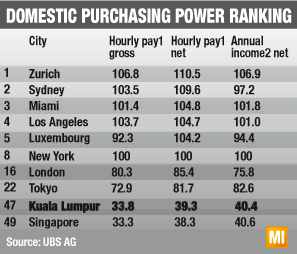
Malaysians who find themselves affording less than their contemporaries overseas have distorted and inefficient markets, lack of competition, low wages and a weak ringgit to thank for their poor purchasing power, which in the case of KL, is only 34 per cent that of New York.

Despite government assurances stating that inflation is under control, Malaysians are becoming increasingly restive over the cost of goods in relation to wages, especially those who are able to compare the corresponding price-to-wage ratios in developed economies.

Malaysians who have experienced working and living abroad often experience sticker shock when they come back and see prices in KL.

“Oh my God, a Tiramisu is RM15!” said Calvin Lee, a Malaysian who has lived in Sydney, Singapore and now London, referring to what cafes in KL are charging for a slice of cake as compared to about GBP5 (RM25) in London.

Aidi Zalman, a consultant who studied in the UK, told The Malaysian Insider that salaries in London could go much further than KL.

He had worked part-time as a waiter in London and noted that a single day’s wages of about GBP50-60 was already enough for him to buy a pair of branded shoes and even a low-end iPod, a concept unthinkable for local waiters.

“GBP100 can feed two apartments of students for a week,” he said. “Here you can spend RM100 and get hardly anything.”

“I hate it when politicians make stupid statements like Malaysia is cheap,” said Edward Seah, an engineer who has previously worked in Singapore and the US. “Prices might seem cheap when you convert it to US dollars yes, but then we should also convert our salaries to US dollars.”

Victor Wong, a Malaysian expat in Sydney, said that Australians get more mileage out of their money.
He gave the example of clothes where he said he can get a good quality shirt for about AUD100 but would need to spend about RM200 to get similar quality in KL.

Wong pointed out that even Asian food could be more affordable for those living in Sydney than KL.

“You pay RM15 for a bowl of soup noodles in KL shopping centres but only AUD10 in Sydney shopping centres,” he said.

The 2010 Prices and Wages report by Swiss bank UBS AG show that residents in KL have only 33.8 per cent the purchasing power of their counterparts in New York, 42 per cent that of London, 33.7 per cent that of Sydney, 32.6 per cent that of Los Angeles and 31.6 per cent that of Zurich.

The same study showed that on average, KL residents have to work 22 minutes to afford a loaf of bread as compared with 18 minutes in Los Angeles, 16 minutes in Sydney, 15 minutes in Tokyo and 12 minutes in Zurich.

The figures grow much worse for imported items. To buy an iPod Nano, a KL worker would have to labour a whopping 52 hours as compared with just 9.5 hours in Los Angeles and Sydney, 12 hours in Tokyo and nine hours in Zurich.

A check on salaries and prices in selected developed country cities by The Malaysian Insidershowed that despite being touted as one of the world’s least expensive cities, KL residents pay as much or even more for chicken, broadband, cars and mobile phones as a percentage of their income.

Communications, for example, is one area where Malaysians are paying notably more than residents in developed countries even after currency conversion.

A 5Mbps broadband package costs RM149 in KL while in London, a 10Mbps package would cost GBP13.50, in Melbourne a 5-8Mbps package costs AUD40 and in New York, a 7Mbps service costs USD41.95.

Those who want to buy an iPhone 4 in KL, meanwhile, would have to pay RM1990 with a basic 24-month contract while in London, residents can get an iPhone 4 for just GBP199 with a basic 24-month contract and in Singapore, it costs just SGD210 with a basic contract.

Maybank Investment Bank chief economist Suhaimi Ilias said that what is important is local perception and not official inflation figures which claimed that the inflation rate in Malaysia was only 1.7 per cent last year.

“I think on the ground, not many people feel we are cheap,” said Suhaimi. “They feel that the cost of living is high regardless of what the inflation figures are.”

He added that inefficiency and lack of competition are contributing to the higher prices in Malaysia.

“I can’t understand why a motorcycle should have to cost RM6,000-7,000 and a car like the Perodua Viva should cost over RM30,000,” he said.

RAM Holdings chief economist Dr Yeah Kim Leng said that cars are one of the sectors where the Malaysian market suffers the heaviest distortion.

A Honda Civic in KL costs about RM115,000, or 20 times the average monthly salary of an auditor.

In Melbourne and London by comparison, a Honda Civic costs AUD25,000 and GBP19,000 respectively, or only about three times the average salary of an auditor in those cities.

The high cost of cars is part of the reason that Malaysians have leveraged themselves to a record 76 per cent of the country’s GDP.

Bank Negara statistics show that at the end of last year, 20 per cent of Malaysian household debt was due to cars, an asset which depreciates over time.

Yeah also said that the ringgit is undervalued and distorts the country’s purchasing power for imported goods.

“We need to ensure prices are right and that there are no market distortions, no subsidies and allow market prices,” he said.

But even if the ringgit is allowed to rise, there is no guarantee that savings would be passed on to consumers. The ringgit is now hovering at RM3.02 to the US dollar but Goldman Sachs predicated yesterday the currency could hit RM2.98 to the US dollar in the next three months.

When The Malaysian Insider contacted the director of wholesale and retail at government think tank Performance Management and Delivery Unit (Pemandu), Ravidran Devagunam about the higher prices Malaysians pay for branded goods, he acknowledged that some retailers will maximise profits on luxury items not readily available in Malaysia but said that the government is “unable” to compel them to discount their prices even after the abolishment of import duties as luxury goods and apparel are not controlled items.

“However, we believe that market forces and consumer education will eventually force a price reduction of these goods over time,” he said.

The Federation of Malaysian Consumers Associations Secretary General Mohd Shaani Abdullah said people should question the prices that they are currently paying.

“Consumer protection will only come about when people make noise,” he told The Malaysian Insider when contacted. “Only then will politicians act.”


source: http://themalaysianinsider.com/malaysia/article/malaysians-plagued-by-poor-purchasing-power/