Siamese Malaysians are also bumiputras

/* July 2nd, 2010 by poobalan | View blog reactions No comments »
 Subscribe in a reader | Subscribe to poobalan.com by Email


This news came out few weeks ago. Gerakan’s Tan voices out what I think many of us feel deep in our hearts – to be treated equally. I don’t think this equality will happen in my lifetime. Maybe the future generation will be equals in the eyes of the law.

Oh, and hopefully PERKASA won’t ask Tan to be charged under Sedition Act or ISA!

Kedah Gerakan youth chief Tan Ken Liang applauded Minister in the Prime Minister’s Department Mohamed Nazri Aziz’s statement on Saturday, for recognising the rights and status of local Siamese in the country. 

Tan (right), in a statement yesterday, also called on the government to consider categorising all Malaysians as bumiputera in the near future, without regard to their ancestors’ country of origin. 

He said this is especially important for non-Malays who are born in Malaysia, or whose parents and grandparents are Malaysians.

“Many Malaysian families, such as Chinese and Indians, have lived in the country for more than 100 years and contributed to the country’s development,” he said.

Tan said this recognition of the non-Malays’ status will truly reflect the spirit of Prime Minister Najib Abdul Razak’s 1Malaysia concept. 

The move will also reflect the BN government’s recognition of non-Malay contribution to the country’s development.

On June 12, Nazri announced that some 60,000 Siamese in the peninsula, who are categorised as bumiputeras, enjoy special rights like the Malays. 

He urged all quarters to understand the citizenship status of the Siamese and recognise their bumiputera rights.

Malaysia population to be young and poor in next 20 years

/* July 2nd, 2010 by poobalan | View blog reactions No comments »
 Subscribe in a reader | Subscribe to poobalan.com by Email


An analysis by Bank of America Merrill Lynch on the impact of demographic trends on investment opportunities revealed that Malaysian population in the next 15 to 20 years will be young but poor, due to relatively higher population growth rate and inability of the economic growth to keep up with population growth.

If I’m not mistaken, the birth rate for Indian and Chinese is dropping faster than the Malays, so I guess most problems will be among the Malay community since need to support more children while economy growth hovers around 6-7%.  But in urban settings, I can see more and more families having less kids (4 or less). Even though government support is there in terms of the privileges, it won’t be enough, as we can see even now. Hmm…maybe its possible to go bankrupt after all….

With current income, its difficult to maintain own family and also take care of elderly parents. Some people even use bulk of their income to pay for parents medical fees, and end up living a frugal life.

Images and article excerpts are from Malaysian Insider.

Malaysia’s relatively high population growth rate will see the country remain comparatively young over the next two decades but economic growth is not expected to keep pace with population expansion, according to a report by Bank of America Merril Lynch.

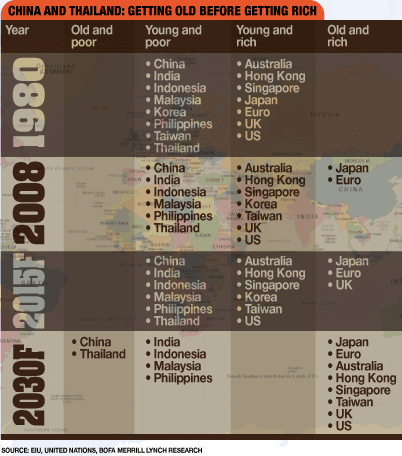
Most developed countries experience lower population growth than developing countries and thus become older as they grow richer but China and Thailand however, are forecast to grow old before they can become rich with more than 15 per cent of the population aged above 65 years in the next 15-20 years.

The forecasts are part of an analysis by Bank of America Merrill Lynch on the impact of demographic trends on investment opportunities.

It also found that the population in Hong Kong, Korea, Singapore, Taiwan and Australia are growing old fast but they are expected to remain among the wealthiest in the world.

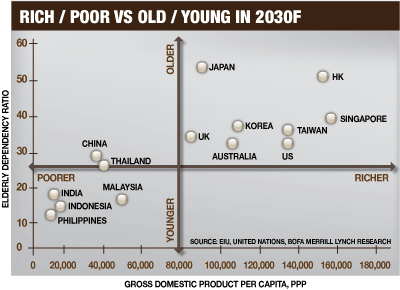
By 2015, Malaysia is forecast to have an elderly dependency ratio (EDR) — population aged above 64 divided by population aged between 15 and 64 — of 10 with a GDP per capita calculated on purchasing power parity (PPP) basis of US$20,000 (RM64,950). Current young and rich countries such as Australia, Singapore and the US have EDR’s of between 15 and 25 with a GDP per capita of between US$50,000 to US$70,000.

By 2030, Malaysia’s EDR is expected to be about 15 with a GDP per capita of about US$50,000 while Australia, Singapore and the US are expected to have an EDR of between 30 and 40 and per capita GDPs of US$110,000 and US$160,000.

The report also suggested however that based solely on the ratio of prime savers — defined as population aged between 40 and 64 — to the rest of the population, the stock markets of China, India, Indonesia, Malaysia and Philippines are expected to outperform those of Australia, Hong Kong, Korea, Singapore, Taiwan and Thailand in the next 20 years.

It added that in advanced economies such as the US and the UK, the stock market “can rationally factor in the demographic trend, usually a few years ahead”. It said that there is a risk of that relationship becoming “self-fulfilling” leading to decades of bear markets in those countries.

“The stock markets and financial assets are arguably most influenced by the mid-aged people,” said the report. “Hence, it is not surprising that the correlation between Mid-Young ratio and the aggregate value of stocks traded is quite high for most Asian countries.”

The report said that there were investment opportunities in the education sector in China, India and the Philippines unlike Australia and Korea which have the most highly education labour force.

It also said that Australia and Thailand have room for development in the private healthcare sector and that India, Philippines and Singapore lag in terms of public spending on healthcare.

SJKT Kulai Besar to be rebuilt but still partially-aided

/* July 2nd, 2010 by poobalan | View blog reactions No comments »
 Subscribe in a reader | Subscribe to poobalan.com by Email


The school (one of the top performing schools in UPSR) was partially burnt down recently on June 19th, and nearly half the students end up studying in tents. 7 classrooms and 6 other roooms (living skills, sports, remedial, counselling, textbook and special pupils’ rooms) were destroyed with the loss estimated at RM436,902.

The good news:

the DPM who is also the Education Minister, has instructed that the new school be built here immediately for the benefit of its 1,258 pupils. The new school building will have 25 classroom, an increase from the earlier plan of 18 proposed by PWD (JKR).  Also, RM100,000 has been allocated for the construction of cabins for temporary use.

“We want the new school to be ready within 12 months,” he said at a meeting with the Parent-Teacher’s Association (PTA) of the school, here Saturday.

He had instructed the Public Works Department to issue a Letter of Acceptance immediately so that construction work on the school costing more than RM3 million on a 2.19-hectare site contributed by Asiatic Development Berhad, the developer for Asiatic Indahpura, could begin next month.

A bit of background on the school:

The Star on Friday had highlighted that pupils in Year 3, 4 and special needs classes had to rough it out in both the morning and afternoon sessions since the fire on June 19.

The school, which is more than 60 years old, has 1,246 students and 74 teachers.

The losses sustained in the fire is estimated to be around RM436,000.

When asked at a dialogue with parents about the delay and the many promises that were made in the past about the relocation of the school, Muhyiddin replied that he was the Education Minister and work on the new school would start by next month and it was expected to be completed within one year.

The school’s PTA chairman K. Sree Thren said the parents and the Indian community in the area were elated as this put to rest a problem that had been plaguing the community for the past 14 to 15 years.

“In 2008, we found a piece of land about 1km away for the relocation of the school but unfortunately the project never got off the ground,” he said.

Now for the part that pisses me off (if indeed its true):

He (DPM) brushed aside another request from a parent who wanted the school to be turned into a fully aided school, saying, “It is all the same as presently, the salaries of all the teachers here together with new buildings and cabins are being paid for by the Government.

Doesn’t make sense at all right? If its “all the same”, then why bother having two categories or why don’t want to convert the school into full-aided? There’s a difference between being fully-aided and partially-aided, and I think its unbecoming and misleading to say otherwise.

In fact,  since the new school building will be on land donated by the private sector, it will be easy to convert to fully-aided status. So, what gives?

Ration Cards for the poor?

/* July 2nd, 2010 by poobalan | View blog reactions No comments »
 Subscribe in a reader | Subscribe to poobalan.com by Email


Those who are familiar with India will know about ration cards (or ration stamps). Its a method whereby folks can buy essential items at controlled prices.

The MHS (Penang Branch) is proposing a similar system in Malaysia.

Maybe in Malaysia, can implement using our MyKads. Set up “ration offices” or counters” at strategic location or make use of the existing shops by equipping them with MyKad readers.

The Penang branch of the Malaysian Hindu Sangam (MHS) wants the government to issue ration cards for essential commodities for the hardcore poor to help them cope with the rapidly rising cost of living.

Association deputy chairperson cum its social and welfare sub-committee chairperson P Murugiah told Malaysiakini that prices of essential foods items like rice, cooking oil , sugar and milk have jumped a mind-boggling 200 percent compared to 10 years ago.

He cited cases of mothers who, unable to breastfeed their new-born babies, opt for water mixed with sugar or condensed milk; young children dropping out of schools to work to help the family and those unable to settle their electricity and water bills, turning to oil lamps.

The hardcore poor survive on only one meal a day and that too non-nutritious food of either roti canai or nasi lemak.

He claimed that a some single mothers have been driven by financial desperation to vice to support their children .

He quoted the prices of some food like cheap fish which used to be between 30 sen to 50 sen per 600 gms about 10 years ago, now go for RM2 per 600 gms, ikan billis price has soared 300 percent, a loaf of bread once RM1, is now RM3 , eggs that cost 10 sen each now go for between 25-30 sen.

Murugiah (left) said the government should consider emulating measures taken by India to alleviate the plight of the poorest through ration cards.

The BPL or below the poverty line ration card is issued to the head of an Indian family whose total earnings is below Rs10,000 per annum (RM700) while those categorised above the poverty line (APL) with a total family income of more than Rs10,000 are each issued a white ration card annually.

A ration card is a very useful document as it helps save money by aiding in the procurement of essential commodities at subsidised rates.

According to Murugiah, the hardcore poor in India are entitled to free essential items every month.

On the government’s plan to phase out all subsidies because of depleting public funds, Murugiah criticised Putrayaja for wasting public funds on mega projects that brought little benefit to the public, especially those in the lower income group.

“The government’s top priority should be to ensure a social safety net for its citizens rather than building public monuments which are a waste of tax-payers’ money.

On its part the Penang MHS, through public donations, is providing monthly food rations to poor families comprising 32 Malays, 22 Indians and 10 Chinese.

Darvena and Teoh get PSD scholarship

/* July 2nd, 2010 by poobalan | View blog reactions No comments »
 Subscribe in a reader | Subscribe to poobalan.com by Email


Story of two students (Darvena and Teoh who managed to get PSD scholarships after intervention or appeal.

Having a paralysed mother made top student S. Darvena Pillay want to become a neurosurgeon so she could help other disabled people.

And she is now one step closer to fulfilling her dream thanks to a scholarship from the Public Services Department (PSD).

The 18-year-old, who scored 10As in the SPM, was initially unsuccessful but was awarded a PSD scholarship upon appeal to do a pre-medical foundation programme at the Cyberjaya University College of Medical Sciences and will later pursue a medical degree at a local university.

“After qualifying as a doctor, I will work in Malaysia because it is important that Malaysians serve our country,” she said.

“If we don’t step up to the plate and give back to the country that has given us so much, who will?” she said with a bright smile.

Darvena is an all-rounder who has over 50 certificates of co-curricular participation and achievement.

“I was a state-level debator and had took part in many competitions at school, district, state as well as national level,” she said.

Darvena’s mother became paralysed 11 years ago after giving birth to her youngest child.

Darvena’s father works as a water treatment plant operator and earns just enough to feed their family.

“This scholarship will greatly ease the burden on my family, particularly my dad as he has to take two jobs to support myself, my three schoolgoing siblings and my paralysed mother,” she said.

A student who failed to get a government scholarship twice to pursue higher studies is now rejoicing, thanks to the MCA.

Teoh Bee Kah, 18, who failed to get the scholarship earlier, has been granted a Public Service Department scholarship after she sent an appeal letter to MCA vice-president Datuk Seri Dr Ng Yen Yen.

Teoh, who was born with the nystagmus condition (a form of involuntary eye movement), was awarded a full scholarship for an 18-month Foundation in Business Studies course at the University of Nottingham’s Malaysian campus in Semenyih.

The former Convent Pulau Tikus student, who is now studying in Form Six at St Xavier’s Institution, will start the course on July 8.

“I was verbally guaranteed a National Scholarship on March 19 when I went to Putrajaya to receive an award for being an outstanding student.

“However, the name list came out a week later without my name. So, I thought I would be accepted by the PSD. But my name wasn’t in that list either when it came out on May 21.

“I cried for two days after that because I was so disappointed,” she said after receiving a congratulatory letter from Bagan MCA division Youth chief David Chua on behalf of Dr Ng at the Penang MCA headquarters on Pahang Road here yesterday.

Teoh, who scored 4A+, 3As and 3A- in last year’s SPM examination, said although her first choice was Psychology, she was nevertheless grateful for the scholarship.

She said her nystagmus condition was made difficult with her short-sightedness.

“My eyeballs are constantly moving and it is difficult for me to focus. Doctors told me my condition cannot be corrected with spectacles or surgery,” she said.

Her father, Lye Chuan, 58, said she did not let her condition stand in her way.

“She didn’t attend any tuition classes. Her hearing and memory are excellent too,” said the fisherman.