
Posts Tagged ‘Economy’

Pancakavya helps Sanmargam in farming

March 3rd, 2009
|  Subscribe in a reader | Subscribe to poobalan.com by Email


From The Star:

After discovering the benefits of chemical-free farming, one man passionately shares his experience and knowhow.

PART-TIME farmer Sanmargam Kathiravan often shows his visitors a set of “before and after” photographs of – don’t laugh – a goat.

He had bought the sickly, underweight goat in 2006 for RM250 and nursed it back to health over six months. The “after” picture shows a healthy and fatter goat with a shiny coat of hair.

Sanmargam was doing a little experiment to convince himself of the efficacy of an organic growth promoter called pancakavya that is said to be not only good for plants but also beneficial to animals.

“It works in India but we’re not sure if it will work here. So, I did my own R&D (research and development). Take the goat, for instance. It will require few hundred ringgit of medication to treat its cold and skin rashes. But I did it with very little money. Now I can speak confidently of the effectiveness of pancakavya,” he says with pride.

Pancakavya is made from cow dung, urine and milk, as well as yoghurt, molasses and eggs. It takes 20 days to be ready for spraying on plants. It also acts as a pest repellent.

Sanmargam was among a small group of farmers from the northern region of the peninsula who were taken to India a few years back by the Consumers Association of Penang (CAP) to witness how small farmers have found a way out of agrochemical-based farming.

In 1998, the factory production supervisor was planning a jasmine garden as a social security net for his home-maker wife. He reckoned that jasmine would always be in demand from the Indian community, which uses the fragrant flower for religious purposes. He bought a bungalow lot in a medium-cost housing estate in Lunas, Kedah ,to execute his plan.

“I started growing jasmine. Soon, I faced all the problems common among farmers who rely on synthetic pesticides, herbicides and chemical fertilisers. My plants were attacked by insects, the leaves were eaten by caterpillars and the buds were invaded by bugs.

“Other farmers were not willing to share their knowledge and the Department of Agriculture could only advise me on chemical application. Eventually, I moved from using Class 1 to Class 4 toxic chemicals but that didn’t solve the problems. It seemed that the insects were immune to the chemicals,” recalls the 42-year-old father of three sons.

It wasn’t until 2003 that Sanmargam came across CAP which was promoting sustainable agriculture and had brought in a vermi-compost expert from India, Dr Sultan Ismail, for a workshop in Penang.

There was no turning back after that for Sanmargam. He attended further training in India and became convinced about the principle of organic farming. He started rehabilitating his garden by spraying pancakavya once a week. After three months, the routine was reduced to every fortnight and after six months, he only sprayed once a month.

“It completely eliminated the pest problem. Once you stop applying chemicals, you get help from Mother Nature. The birds will pick off the snails and the insects will control one another,” he enthuses.

Sanmargam’s garden not only thrives with organic jasmine and vegetable plots, it is also a mini-laboratory and factory for growth promoters like pancakavya and effective micro-organisms and fungus repellents. The ingredients are sourced locally at a fraction of the price paid for agro-chemicals.

The four-tank vermi-compost system sits in one corner of the garden and churns out several tonnes of organic compost a year, which is used in the garden as well as sold at RM4 per kg for extra income.

And gone are the days when he had to cajole buyers to take his jasmine blooms. “Now, the retailers tell me not to sell to others. Previously, I had to beg them to take my flowers. I can understand their reluctance because the flowers did not last more than a day.

“The organically-grown jasmine not only lasts a few days, even the fragrance is sweeter. This is the feedback from retailers and customers. There’s a money back guarantee for anyone who finds a bug in my flowers,” quips Sanmargam, adding that he now supplies the flowers to six shops in Penang and two in Lunas.

On high demand days, he gets RM3 per tin of flowers and a minimum of RM2 on slower days. Previously, he got as low as RM1 per tin.

Next, he is planning a dream farm where he can raise livestock like cows and goats, and have more space to grow vegetables and fruits. The livestock will ensure a steady supply of cow dung, urine and milk for producing various organic materials for the farm. Sanmargam now speaks widely and passionately about organic farming to farmers at organised events and to those who have heard of his success and drop by his house.

“I believe in the goodness of this system and I want to share my experiences with anyone who is willing to try,” he adds humbly.
I always wondered how long….

March 2nd, 2009
|  Subscribe in a reader | Subscribe to poobalan.com by Email


Blog had some problem today. Not sure why but could not view the pages since morning till evening. Must be some corrupted file. Anyway, its back to normal by itself now.

Coming back to the topic of this posting, I read an interesting article last Thursday. You know, I always wondered how long should one keep their shares (as in share market shares). My question was answered by investment advisor Ooi Kok Hwa via his article “How Long Should Investors Hold Their Stock Investments?”  The article is below:

OFTEN we hear some financial experts say we need to hold stocks long term, especially during the weak stock market situation like what we are experiencing currently.

Some gurus say the “buy and hold” strategy is the best investment strategy. However, some retail investors may argue that “buy and hold” is not suitable in Malaysia because if they pick the wrong stocks, some companies might even get delisted after a while.

The question of how long to hold has always been on the mind of investors when they purchase any stocks. Given the present weak economic and stock market conditions, some investors may lose patience as they do not know when the market will recover again.

In this article, we will look at the number of years that we need to hold our stock investments in Malaysia. We use the KL Composite Index average daily indices to compute the stock returns.

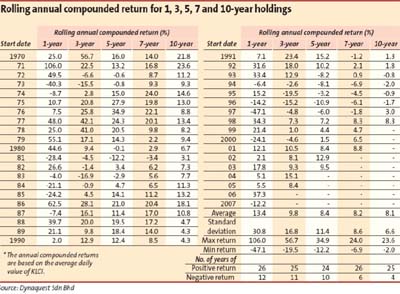
The following data was provided by Dynaquest Sdn Bhd. With its permission, we will provide the historical rolling annual compounded returns from 1970 to 2008.

The table shows the rolling historical annual compounded returns for holding the stocks for one, three, five, seven and 10 years.

It shows the average annual compounded returns and risks (measured by standard deviation) regardless of any starting or ending dates.

For example, the 25% returns in the second row and the second column of the table was the annual compounded returns of investing for one year from 1970 to 1971. The three-year returns of 56.7% was what you would’ve got if you started your investment in 1970 and ended in 1973.

If you started investing in 1970 and held it for five years (up to 1975), seven years (up to 1977) and 10 years (up to 1980), your annual compounded returns will be 16%, 14% and 21.8% respectively.

In terms of the overall average returns, except for one-year and three-year holding periods of 13.4% and 9.8% respectively, we notice that the annual compounded returns for five-year, seven-year and 10-year holding periods were almost the same, about 8% per annum.

However, the longer we hold our investment, the lower the risks that we face, which are measured by using standard deviations.

For example, if we hold our investment for one year, the standard deviation is 30.8%.

However, if we hold it a bit longer to three, five and seven years, the standard deviation will drop to 16.8%, 11.4% and 8.6% respectively.

For 10-year holding, the standard deviation is 6.6%. Based on two standard deviations, we are 95% confident that our returns will range from -5.1% (8.1% – 2 x 6.6%) to 21.3% (8.1% + 2 x 6.6%).

This is supported by the minimum returns of -2% and the maximum return of 23.6% for 10-year holding periods.

In conclusion, we need to hold stocks long term. We may not need to hold them up to 10 years.

However, we need to understand that we will face very high volatility on returns if we invest only for one year.

Besides, we need to make sure that we are buying good fundamental stocks in order to avoid poor quality stocks that are not suitable for long-term investment.

how-long-to-keep-stocks

Toll hike drama

February 27th, 2009
|  Subscribe in a reader | Subscribe to poobalan.com by Email


I think it fits to be part of a mega-serial story. First, the toll price hike was announced after it was supposedly approved weeks ago as mentioned by PM Badawi. He also went on to suggest that the increase should be put off. Now the situation is deemed unsuitable (read: by-elections) and the price hike is being postponed to at least 31 December of this year (well, we know well enough not to trust dates given by politicians!). UPDATE: DPM Najib says its postponed indefinitely! I liked the one with date. Indefinitely sounds bad to me…don’t know why…

It won’t go unnoticed that elections actually spur development and brings forth positive outcome for many people. So, its good if ADUNs/MPs resign/convicted/dies. The rakyat get goodies and need not wait till five years. We “just” sacrifice one human being for the betterment of many others(!!!!).  So, shall we pray for more by-elections?

Who needs Astro if we can get weekly dramas like this 😉

The government has decided to suspend toll hike of up to 33 percent for five major highways in Klang Valley announced yesterday.

MCPX

The decision was made by the cabinet at its weekly meeting today chaired by Deputy Prime Minister Najib Razak.

Outgoing Prime Minister Abdullah Ahmad Badawi had yesterday call for the cabinet to reconsider toll hike of up to 33 percent for five major highways in Klang Valley.

Abdullah, who is attending an Asean defence ministers meeting in Thailand, said he was concerned that public anger over the latest hike could affect BN’s popularity especially ahead of three crucial by-elections.

The five affected highways are North-South Expressway (Plus), Sprint Highway (Sprint), Ampang Elevated Highway (Akleh), Sungai Besi Highway (Besraya) and New Pantai Expressway (NEP).

In an announcement yesterday, Works Minister Mohd Zin Mohamed said that toll rates in these five highways would go up on Sunday.

In a dramatic reversal, Mohd Zin said that the toll hike has been “deferred” in view of the public reaction and the ailing economy at a press conference at 4.30pm today.

“With that, my statement yesterday on the toll hike is cancelled,” he said.

Mohd Zin said that the toll increase will be postponed to after Dec 31 this year.

With the 10-month delay, the government will have to pay RM287 million in compensation to the five toll concessionaires.

Toll prices up in March

February 26th, 2009
|  Subscribe in a reader | Subscribe to poobalan.com by Email


While the public were still rejoicing over the removal of a toll booth each at NPE and Besraya highway, today they were hit with a damaging news – the dreaded “toll price increase”.

Malaysiakini provides the details:

The toll rates for five highways – North-South Expressway, Sprint Highway, Ampang Elevated Highway, Sungai Besi Highway, New Pantai Expressway – will go up this Sunday.

Beginning March 1, road users for Plus will be paying an extra 0.86 sen per kilometre – from 13.60 sen per km to 14.46 sen per km – a hike of 6.3 percent.

The following are the new rates for the other highways:

  • Sprint Highway

Pantai toll plaza – up 50 sen from RM1.50 to RM2 (increase of 33%)

Damansara toll plaza – up 30 sen from RM1 to RM1.30 (increase of 30%)

  • Ampang Elevated Highway

Up 50 sen from RM1.50 to RM2 (an increase of 33%)

  • Sungai Besi Highway

Up 10 sen from RM1.30 to RM1.40 (an increase of 7.7%)

  • New Pantai Expressway

Up 40 sen from RM1.60 to RM2 (an increase of 25%)

‘Marginal increase’

Works Minister Mohd Zin Mohamed, who made the announcement today, said that the government had paid RM245 million in compensation to toll operators to waive the toll hike for last year.

The last major increase in tolls was three years ago when five other highways were hit with an increase of up to 60 percent, sparking major street protests.

There are about 17 toll highways in and around the Klang Valley.

In a statement, the minister said the decision to increase the toll rates was made after the cabinet deliberated on the application by highway concessionaires.

He said the increase was done in accordance with the agreement inked between the government and highway concessionaires.

“These documents are now available to the public and can be studied by everyone,” he added.

Describing it as a ‘marginal increase’, Mohd Zin said Class 1 (private car) users who travel using the Plus highway from Jalan Duta to Bukit Raja (a distance of 34km) will only have to pay an additional 30 sen.

For the Besraya highway, he said, payment is only at the Mines toll plaza because collection at the Salak Jaya toll plaza was stopped on Feb 24.

Similarly, he said while there is an increase in toll rates for the NPE, the government also decided to abolish toll collection at the PJS 2 toll plaza.

Toll hike deferred for one year

“As for the Plus, Sprint and Akleh highways, the toll rate was supposed to have been increased on Jan 1, 2008 but this was deferred leading the government to pay compensation of RM245 million (RM177 million to Plus, RM38 million to Sprint and RM30 million to Akleh).

“The toll rate increase for Sprint and Akleh is minimal given the fact that toll has never been increased for the two highways since they started operating in 2001,” he said.

“The increase should not be seen as burdening the people because the quality of the highways will be ensured,” he added.

I guess most impactful will be the North South Highway toll increase. Actually NKVE and Federal Highway (both under plus) will also see an increase.

I think I’ll be affected by NKVE, Plus and Federal Highway toll increase more than the other highways – I seldom use NPE, Ampang elevated, or Sprint.

Anyway, its a bad news for many many people – expect transportation cost to increase, leading to another round of price increase across the board.

Agro Entrepreneur Seminar in Penang

February 25th, 2009
|  Subscribe in a reader | Subscribe to poobalan.com by Email


Received via email from Prabakaran:

Seminar Keusahawan Agro & Pertanian Anjuran Pejabat YB. Senator Tuan T. Murugiah ( Timbalan Menteri Di Jabatan Perdana Menteri ) DENGAN KERJASAMA Jabatan Pertanian, Jabatan Perikanan, Jabatan Veterinar ( di bawah Kementerian Pertanian Dan Inustri Asas Tani ) dan Kementerian Belia Dan Sukan Malaysia (Bahagian Pembangunan Belia dan Ekonomi ) bersama Bank Bank.

Pada   :   28 Feb 2009 ( Sabtu )

Tempat : Dewan Orang Ramai Taman Chai Leng, Perai, SPT, Penang

Masa   :  7.00pagi ( sarapan pagi )   8.00 pagi hingga  – 5 ptg
( Sijil diberikan selepas seminar )

Jumlah kehadiran peserta dianggarkan 2000 orang.

Pada 25 Jan 2009 seramai 2500 menyertai seminar ini di Sentul dan diikuti dengan 1500 orang di Johor Bahru.

Setakat ini seramai 1956 orang telah mendaftar untuk pelbagai kursus percuma yang akan diberikan melalui YB Senator T Murugiah dan akan dikendalikan oleh Revelation Agro & Farming Industry ( RAFI ) di bengkel Latihan RAFI bertempat di Simpang Ampat, Batu Kawan, Pulau Pinang.

3 pegawai dari Jabatan Pertanian, Perikanan dan Veterinar akan berucap tentang segala produk dan insentif kerajaan untuk usahawan agro tani.

Juga di maklumkan bahawa pegawai dari Agro Bank, Bank Rakyat dan BSN telah dijemput untuk member maklumat tentang pinjaman.

YB Senator T Murugiah yang dipertanggungjawabkan Hal Ehwal Kaum India dibawah Jabatan Perdana Menteri berhasrat untuk membina 10000 peniaga  India sebelum 31-12-2010 dan matlamat ini hanya dapat dicapai dengan bantuan dan jasa baik seluruh masyarakat.

Antara kursus percuma adalah penternakan lintah / ikan keli / kambing boer, penanaman cili merah, nenas tissue, sayur – sayuran dan taklimat pada hari tersebut akan disampaikan oleh wakil Revelation Agro ( RAFI ).

Seminar ini adalah untuk menggalakan lebih ramai orang india untuk menceburkan diri dalam bidang perniagaan. Inisiatif YB Senator Murugiah ini disokong padu oleh RAFI dan akan bertanggungjawab untuk memberi tunjuk ajar kepada mereka yang berminat. Seminar ini nyata telah memberi impak baru
dalam meningkatkan ekonomi belia dan beliwanis India.

Sila datang beramai – ramai. Maklumkan kepada rakan – rakan anda mengenai program ini.

Tel untuk dihubungi :

Mr. K. Praba :      012 – 243 4118

Mr.Selva    :       019-  5578828

Mr. Rajan:          012-  2290009

Mr. Kanesan:        019 – 388 3261

Mr. Vela     :      017 – 542 4118

Mr. Anbu   :        012 – 582 5274

Mr.Nathan:          017-  4776923

” TOGETHER WE CREATE AND BUILD THE ECONOMICAL POWER”
‘MALAYSIAN INDIAN NEW ECONOMICAL WAVE’