Posts Tagged ‘Education’

Effort in Penang to improve Tamil Schools

August 11th, 2011
|  Subscribe in a reader | Subscribe to poobalan.com by Email


If state can find the land (either acquire or get developer/plantation company to provide free),  and then if the federal government can come up with money to build a proper school, we can solve the Tamil school problems in a faster manner. The examples below highlight the very few success cases. Most of the time, its the sad news that hits us via online and print media for example SJKT Ladang Jeram, SJKT Ladang Bukit Jalil, and SJKT Sg Salak to name a few.

In the case below, I think the school cost RM1.8 million to build.

As for the maintenance fund, RM1.75 million for 28 schools is about 60k++ per school. I think this would be insufficient. Should double it.


FOR many years, 11-year-old V. Megasri used to attend her Tamil primary school by walking to a private clubhouse in Penang and going down its steps into a dilapidated basement.

She was among scores of pupils of the SJK(T) Azad which ignominiously conducted its classes in a cramped and decrepit underground space of the Indian Association building at Jalan Bagan Jermal. Conditions were so unusual and bad that snakes were said to enter the classrooms from surrounding drains.

Starting April, the pupils and teachers of the school finally moved into a much more conducive and permanent site they could call their own. This was after the state government had allocated a plot of prime land at nearby Waterfall Road that had come under the Penang Island Municipal Council.

The upshot of it all is that some 84 pupils of Azad are now attending classes at a spanking new two-storey block with a new library and science laboratory. Enrolment is now expected to rise as the building can accommodate some 200 pupils.

Azad is not the only impoverished Tamil school to be given hope for a fresh lease of life. The state government has approved lands for SJK(T) Valdor and SJK(T) Batu Kawan, both located in ramshackle estate areas of mainland Seberang Perai, with a few more cases of schools with similar problems being looked into.

Interestingly, in the case of Batu Kawan, the new land for the school was acquired by the state. “This is the first time in the history of the country that a state government has acquired land for a Tamil school,” said Deputy Chief Minister (II) Prof Dr P. Ramasamy.

Certainly, the controversial issue of lands for Tamil schools has not been an easy one for the state administration. This is because the lands that many of the schools are using are not owned by them. In many cases, the authorities did not even know who the owners were.

Last year, the state appointed a lawyer and a senior official from the property sector into its Special Committee for Tamil Schools to conduct a study to help overcome the problem. Chaired by a respected academic from Universiti Sains Malaysia, Datuk Dr K. Anbalakan, the committee has been wading through records and collecting data to find ways to help all 28 Tamil schools in the state, for long plagued with shortcomings and problems.

One of the main moves undertaken by the state has been to set aside annual funding totalling RM1.75 million for all the Tamil schools, for repair and upgrading of their infrastructure. The allocation programme, which began in 2009 with RM1.5 million before it was raised to the current figure the following year, is also complemented for the first time with funding for two Punjabi schools in the state.

Schools that had been mired in problems for years – from shoddy toilets to poorly-stocked libraries – were suddenly provided with much needed injection of cash to overcome such deficiencies, and upgrade their facilities.

There have also been a few cases of needy Chinese and religious schools that have been similarly allocated state lands.

With such fresh lease of life, an important feature in this affair is also the cooperation of the federal government, which is responsible for building the schools on lands provided by the state.

One may remember that in April 2008, then education minister Datuk Seri Hishammuddin Hussein had challenged the new Pakatan Rakyat state governments to disclose how much land they were setting aside for vernacular, mission and religious schools. Penang Chief Minister Lim Guan Eng responded by writing to Hishammuddin that the state was ready to provide lands for the needy schools.

With new lands now being delivered, the cooperation of both federal and state parties is essential in enabling schools that have been beset with problems for years, to finally have the buildings and lands that they are only entitled to.

source: http://www.thesundaily.my/news/108052


Another source is below.

SJK (T) Azad is anticipating an influx of students after moving from a dilapidated two-room site to a brand new building.

The school, which was operating from the basement of the Indian Association building on Jalan Bagan Jermal, Penang, was moved to a 0.36ha site on nearby Waterfall Road in April.

Special Committee on Tamil Schools in Penang chairman Datuk Dr K. Anbalakan said since the opening of the school building, 10 new students had already joined the school bringing the total number of pupils to 84.

“Before this, the condition of the school was such that no parent would want to sent their students there.

“The school was very noisy and cramped but with the new building, we are expecting many parents from Teluk Bahang and Tanjung Bungah to start sending their children here,” he told reporters during a visit to the school by Penang Chief Minister Lim Guan Engrecently.

Dr Anbalakan said SJK (T) Azad was currently the nearest Tamil school to Tanjung Bungah and the northern tip of the island.

“SJK (T) Ramakrishnan (on Scotland Road) is the next nearest and many parents (living in the northern part of Penang island) send their children there.

“We are expecting that with this new school building, enrolment into SJK(T) Azad will almost double to about 150 students next year,” he said, adding that a kindergarten at the school would also start next year.

Dr Anbalakan said the current capacity of the 13-room school building was 250 students, although the school could fit some 300 pupils if rooms like the resource centre were converted into classrooms.

The school building, reported to cost RM1.81mil, stands on land leased by the Penang Municipal Council (MPPP) at a nominal charge of RM120 per annum.

Lim, who was accompanied by Deputy Chief Minister II Dr P. Ramasamy, said the school was located on prime land.

“We are pleased to see that the land has been put to good use for the students. The land value estimated at RM4.8mil in 2008 and had ballooned to at least RM13mil this year.”

source: http://thestar.com.my/metro/story.asp?file=/2011/8/10/north/9260351&sec=North


award for SJKT Ladang Jeram for 10 years container classroom (and 5 more years added) use

August 8th, 2011
|  Subscribe in a reader | Subscribe to poobalan.com by Email


The school is SJKT Ladang Jeram, Kuantan.

This is a photo of the said container classroom (from HRP website):

The container classroom has been in use for the past DECADE. Not one year, not two year.

I think the company that demolished the place 10 years ago is PASDEC Corporation, based on this reply from MOE:

Ministry of Education (MOE) would like to refer to an article published in THE STAR dated 23 July 2011 on the issue of – School uses container to curb classroom shortage.

Guru Besar memaklumkan bahawa Pengerusi Lembaga Pengelola merangkap Pengerusi PIBG telah mengadakan beberapa pertemuan dengan pihak Pasdec Corporation Sdn. Bhd untuk membincangkan isu tapak SJK (T) Ladang Jeram, Kuantan.

Dalam pertemuan terkini, antara Encik S. Jayakumar, Pengerusi PIBG SJK (T) Ladang Jeram, Kuantan dengan Encik Azhar bin Haji Ibrahim, Pengurus Koordinasi Projek Pasdec Corporation Sdn. Bhd telah memutuskan perkara berikut :

1.    Pihak Pasdec bersetuju memberi tapak  alternatif baru seluas 3 ekar sebagai tapak baru SJK (T) Ladang Jeram, Kuantan.

2.    Lokasi sebenar akan ditentukan kemudian oleh pihak Pasdec. Anggaran lokasi lebih kurang 2 km dari tapak sekolah kabin sekarang.

Pihak Pasdec masih membenarkan sekolah kabin sekarang beroperasi ditempat asal dalam jangkamasa 5 tahun lagi.

source: http://bpa.bernama.com/details.php?id=1944


So, the school will be using the container for another 5 years??? Syabas! Do we deserve this?

A TAMIL school at Ladang Jeram in Kuantan has been using a container as a classroom for the past decade, Tamil Nesan reports.

Beserah and Sungai Karang humanitarian and welfare society (Bakkis) president Wan Azlan Wan Salleh said it was a shame that this was still happening even after 54 years of independence.

He said he had spoken to headmaster P. Ravilogath, who said the school badly needed six classrooms to cater for its students.

Wan Azlan hoped that the visit by Mentri Besar Datuk Seri Adnan Yaakob’s special representative R. Gunasegaran to the school would bring about a solution to the decade-old problem.

The school building was reportedly demolished by a company, which took over the estate for commercial development 10 years ago on the condition it would build a six-classroom building and a temple.

However, there had been no development to date.

source: http://thestar.com.my/news/story.asp?file=/2011/7/23/nation/9156652&sec=nation

2011 IPTA intake statistics

July 21st, 2011
|  Subscribe in a reader | Subscribe to poobalan.com by Email


Below are the statistics obtained from newspaper articles. We assume the figures are correct.

53 new courses introduced.

11 of them are technology based (20.75% of the new courses) and offered at UMP, UTem, UniMaP and UTHO.

41,267 seats offered for 2011 intake (increase of 1.9% compared to 2010).

27,001 females (65.4%) and 14,266 (34.6%) male students make up the 41,267 seats.

There were 64,703 applicants  and 53,216 (82.2%) of them met the minimum requirements of obtaining a CGPA of 2.0 and above. The balance of  11,487 applied even though their CGPA was below 2.0 (trying the luck).

In short, 64,703 applied. 53,216 qualified (82.2% of all applicants) and 41,267 were offered place (77.55% of qualified applicants).

Breakdown of qualified applicants (53,216):

  • 39,998 (75.16% of qualified applicants) Bumiputera
  • 10,677 (20.06% of qualified applicants)  Chinese
  • 1,813 (3.41% of qualified applicants) Indian
  • 728 (1.37% of qualified applicants)  Others.

Breakdown in terms of places offered (41,267)

  • 29,838 (72.30% of places offered) Bumiputera
  • 9,457 (22.92% of places offered) Chinese
  • 1,511 (3.66% of places offered) Indian
  • 461 (1.12% of places offered)  Others
In terms of percentage vs population, the bumiputera were over-represented, while the Indians and Others were under-represented. The Chinese were fairly represented. This based on population ratio of 65% Bumiputera, 23% Chinese, 7% Indians and 5% Others.

Success rate in terms of [place offered] vs [number of applicants]

  • 29,838 out of 39,998 (74.6%) Bumiputera (lower than the average of 77.55%)
  • 9,457 out of 10,677 (88.58%) Chinese (higher than the average of 77.55%)
  • 1,511 out of 1,813 (83.34%) Indian (higher than the average of 77.55%)
  • 461 out of 728 (63.32%) Others (lower than the average of 77.55%)

Breakdown in terms of stream

  • 21, 954 (53.2%) science stream
  • 19,313 (46.8%) arts stream

There were 6,294 excellent candidates (not sure of the definition “excellent) which were offered places for 8 competitive/critical courses. (Note: category “Malay” was provided instead of Bumiputera).

Dentistry had the lowest places allocated (2.765) while Mechanical Engineering had the most (25.44%).

Medicine – 983 places (15.62% of excellent candidates)

  • 581 (59.10%) Malay
  • 339 (34.49%) Chinese
  • 50(5.09%)  Indian
  • 13 (1.32%) Others

Dentistry – 174 places (2.76% of excellent candidates)

  • 91 (52.30%) Malay
  • 77 (44.25%) Chinese
  • 4 (2.3%) Indian
  • 2 (1.15%) Others

Pharmacy – 283 places (4.50% of excellent candidates)

  • 151 (53.36%) Malay
  • 125 (44.17%) Chinese
  • 7 (2.47%) Indian
  • 0 (0.00%) Others

Chemical Engineering – 919 places (14.60% of excellent candidates)

  • 648 (70.51%) Malay
  • 217 (23.61%) Chinese
  • 45 (4.90%) Indian
  • 9 (0.98%) Others

Electrical and Electronic Engineering – 1,163 places (18.48% of excellent candidates)

  • 923 (79.36%) Malay
  • 209 (17.97%) Chinese
  • 18 (1.55%) Indian
  • 13 (1.12%) Others

Mechanical Engineering – 1,601 places (25.44% of excellent candidates)

  • 1251 (78.14%) Malay
  • 311 (19.43%) Chinese
  • 20 (1.25%) Indian
  • 19 (1.19%) Others

Law – 367 places (5.83% of excellent candidates)

  • 221 (60.22%) Malay
  • 105 (28.61%) Chinese
  • 37 (10.08%)  Indian
  • 4 (1.09%) Others

Accounting – 804 places (12.77% of excellent candidates)

  • 509 (63.31%) Malay
  • 269 (33.46%) Chinese
  • 18 (2.24%) Indian
  • 8 (1.00%) Others

Overall breakdown of the excellent students allocated places in critical/competitive courses:

  • 4375 (69.51%) Malay
  • 1652 (26.25%) Chinese
  • 199 (3.16%) Indian
  • 68 (1.08%) Others

Number of Orang Asli candidates = 38

Number of OKUs (Physically disabled) = 49

Number of national/state athletes: 990

3,018 candidates with CGPA 4.0 (assuming this is STPM + matriculation leavers) have been allocated places: 973 in USM (which has its own intake application) and the balance 2,045 in the other IPTAs.

However, no breakdown was given in terms of the intake channels (STPM vs Asasi vs Matriculation). That would be an interesting statistics.

More students will enter university this year with the introduction of 53 new academic programmes.

With this, there will be 41,267 seats offered by 20 public varsities, marking a 1.9% increase from last year’s intake.

Higher Education Department director-general Prof Datuk Dr Rujhan Mustafa said 11 of the new programmes were technology-based.

“The 11 programmes will be offered at Universiti Malaysia Pahang, Universiti Teknikal Melaka, Universiti Malaysia Perlis and Universiti Tun Hussein Onn,” he said in a press conference at the ministry yesterday.

A total of 64,703 applicants applied for the upcoming September intake and from the total, 53,216 (82.2%) met the minimum requirements of obtaining a CGPA of 2.0 and above.

Meanwhile, there will be a staggered intake at public varsities this year from between Sept 3 to Sept 10.

… Applicants can check their application status by visiting the websites of the ministry or the Universities Admissions Unit website.

Alternatively, students can call the ministry’s hotline at 03-8883 5858 or do a status check via SMS by typing UPU RESULT and sending the SMS to 15888.

Public varsities will issue official offer letters to successful applicants from today and applicants are required to confirm their acceptance by July 22.

Applicants who failed to obtain any offer may submit e-appeals at http://upu.mohe.gov.my until July 24.

source: http://thestar.com.my/news/story.asp?file=/2011/7/16/nation/9114501&sec=nation


Another article I referred to is below:

… Seperti tahun sebelumnya, bilangan pelajar perempuan mengatasi bilangan pelajar lelaki, di mana 27,001 calon perempuan iaitu 65.4 peratus berjaya mendapat tempat di IPTA, berbanding 14,266 atau 34.6 peratus pelajar lelaki.

“Dari segi calon yang ditawarkan tempat mengikut kaum, seramai 29,838 daripada 39,998 calon atau 74.6 peratus adalah Bumiputera, 9,457 daripada 10,677 calon atau 88.6 peratus adalah Cina, 1,511 daripada 1,813 calon atau 83.3 peratus India dan 461 daripada 728 calon atau 63.3 peratus dari kaum-kaum lain.

“Dasar pengambilan dan pemilihan kemasukan ke IPTA bagi Program Pengajian Lepasan Sijil Tinggi Persekolahan Malaysia (STPM)/Matrikulasi/Setaraf (Ijazah Pertama) adalah berasaskan prinsip meritokrasi dengan mengguna pakai 90 peratus markah akademik dan 10 peratus markah kokurikulam untuk menentukan nilai merit seseorang calon,” katanya dipetik Bernama Online.

Rujhan berkata, daripada 41,267 calon yang berjaya, seramai 21, 954 (53.2 peratus) adalah calon aliran sains dan 19,313 (46.8 peratus) adalah calon aliran sastera.

Menurutnya, sebanyak 6,294 calon cemerlang ditawarkan untuk mengikuti lapan kursus kompetitif iaitu Perubatan seramai 983 calon (Melayu-581, Cina- 339, India-50 dan kaum-kaum lain-13), Pergigian sebanyak 174 calon (Melayu-91, Cina-77, India-4, kaum-kaum lain-2), Farmasi sebanyak 283 calon (Melayu-151, Cina-125, India-7), Kejuruteraan Kimia sebanyak 919 calon (Melayu-648, Cina-217, India-45, kaum-kaum lain-9).

Kejuruteraan Elektrik & Elektronik sebanyak 1,163 calon (Melayu-923, Cina- 209, India-18, kaum-kaum lain-13), Kejuruteraan Mekanikal sebanyak 1,601 calon (Melayu-1,251, Cina-311, India-20, kaum-kaum lain-19), Undang-undang sebanyak 367 calon (Melayu-221, Cina-105, India-37, kaum-kaum lain- 4) dan Perakaunan sebanyak 804 calon (Melayu-509, Cina-269, India-18, kaum-kaum lain- 8).

Sementara itu, Rujhan berkata seramai 38 Orang Asli, 49 Orang Kelainan Upaya (OKU) dan 990 atlet negeri dan negara turut ditawarkan tempat di IPTA selaras dengan hasrat kerajaan melahirkan graduan holistik yang mampu merealisasikan agenda dan wawasan negara.

Beliau berkata, 3,018 calon cemerlang yang mempunyai Purata Nilai Gred Kumulatif (PNGK) 4.0, sudah pun ditempatkan di 20 IPTA, iaitu seramai 2,045 calon di 19 IPTA manakala bakinya di Universiti Sains Malaysia (USM) yang merupakan universiti APEX.

source: http://www.themalaysianinsider.com/mobile/bahasa/article/41267-ditawar-tempat-ipta-mula-pengajian-september/


PSD PILN scholarship 2011 statistics

July 12th, 2011
|  Subscribe in a reader | Subscribe to poobalan.com by Email


a TOTAL of 4000 scholarships were offered by JPA for this year for the SPM 2010 leavers. According to JPA, 58.8% (882) of overseas scholarships were granted to Bumiputra students while the rest were for non-Bumiputras (41.2% or 618) (refer this article).  A more detailed breakdown:

Minister in the Prime Minister’s Department Datuk Seri Mohamed Nazri Aziz said 882 Bumiputera students and 618 non-Bumiputera students received the scholarships under the PILN.

For the local degree programme this year, 1,301 Bumiputera students and 1,199 non-Bumiputera students received scholarships, he said during the question-and-answer session in the Dewan Rakyat,

source: http://mynewshub.my/2011/06/13/psd-offers-4000-scholarships-to-spm-holders/

1500 were for overseas while the balance 2500 were for local universities. This is excluding the 86 cases who were given local scholarships after appeal, public uproar and intervention by political parties (as per this article). The breakdown of the 86 cases is available here.

Total number of applicants were 16,900 as per stated in this article. Breakdown of the 16,900 applicants:  7,277, or 43.1 per cent, Bumiputeras and 9,623, or 56.9 per cent, non-Bumiputeras. Only 8,857 of the 16,900 (52.4%) made the cut with the minimum academic requirement of straight 9As and above (refer to this link). But since only have 4000 scholarships, the balance had to be satisfied with local matriculation, diploma and foundation programs.

According to this report in The Star, a total of 1,552 of the 4,000 PSD scholarships for this year were given to Chinese students. Of the figure, 466 scholarships were for overseas courses.

And the report below indicates the allocation for Indian students, which states 245 scholarship to Indian were awarded – 137 scholarships were for overseas universities and 108 in local universities.


In summary:

PILN:

58.8% or 882 places for Bumiputra

41.2% or 618 places for non-Bumiputra.

31.07% or 466 places for Chinese students (and this is 75.4% of the places allocate for non-Bumiputra)

9.13% or 137 places for Indian students (and this is 22.17% of the places allocate for non-Bumiputra)

1% or 15 places for “other” students (and this is 2.43% of the places allocate for non-Bumiputra)

Total 1500.

PIDN:

52.04% or 1301 places for Bumiputra

47.96% or 1199 places for non-Bumiputra.

43.44% or 1086 places for Chinese students (and this is 90.56% of the places allocate for non-Bumiputra)

4.32% or 108 places for Indian students (and this is 9.01% of the places allocate for non-Bumiputra)

0.2% or 5 places for “other” students (and this is 0.42% of the places allocate for non-Bumiputra)

Total 2500.

IF combine both of the above, 2,183 spots, or 55 per cent, were snapped up by Bumiputera students and 1,817, or 45 per cent, were offered to the non-Bumiputeras (refer this link).

And this is comments from Deputy Minister SK Devamany (if you are looking to apply for matriculation – refer here):

Indian students currently in Form Five have been urged to apply for the matriculation programme for the year 2012/2013.

MIC vice-president SK Devamany said Education Minister Muhyiddin Yassin has invited the Form Five students to apply for next session.

According to Devamany it is better that the students, who are scheduled to sit for SPM this year apply now and not later.

He said the ministry was offering seats in three streams of accountancy, science and technical (engineering).

“This is a good opportunity and every student should apply for the matriculation programme,” he told FMT.

He added the ministry had extended the registration period until end of October.

Those who are interested have go to http://www.moe.gov.my for further information.

When asked about the Indian students’ involvement in matriculation studies, Devamany, who is also deputy minister in the PM’s Department, said that this year the ministry had allocated 580 seats for Indian students.

But the response, he said, had been poor. Until last month there were only 262 students who registered.

“Since 2009, the government had granted more than 1,000 Indian students the opportunity to study under the matriculation programme but only some 640 accepted the offer,” he said.

Poor response

Meanwhile, he also acknowledged that for the year 2011, the Public Service Department (PSD) has awarded 245 scholarship to Indian.

“From this total,  137 scholarships were for overseas universities and 108 in local universities,” he said.

He added that the government had also awarded Indian students another 100 scholarships under the 1Malaysia Development Board.

He added that since the PSD scholarship became a buzzword, MIC had managed to sort out almost 80% of the cases received.

“MIC studied all the 181 cases received. There were three cases which failed to get scholarships and another 25 who got courses they were not interested in,” he said.

He added that MIC successfully solved 12 of 25 cases of students who wanted to switch courses.

“The balance 13 are still awaiting replies from PSD. I am confident they will get the course of their choice,” he said.

He also said that PSD had already offered scholarships for matriculation courses in public university for the 13 but they refused.

“MIC has put all it’s effort in this scholarship issue and we have already requested the PSD to reconsider the wishes of the 13 for scholarships,” he said.

source: http://www.freemalaysiatoday.com/2011/07/08/indian-students-urged-to-apply-now/

National Science Fair for Young Children Day 2

June 27th, 2011
|  Subscribe in a reader | Subscribe to poobalan.com by Email


Continuing from Day 1 yesterday (BTW, the photos are a bit darker at time due to flash malfunction. The battery leaked).

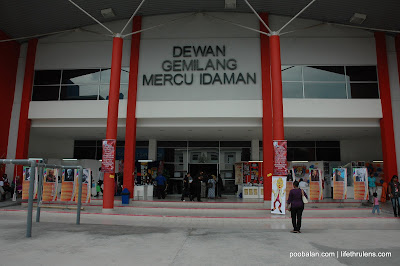
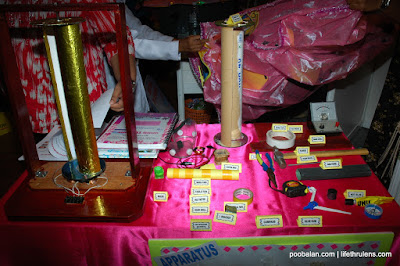
The exhibition hall at GMI:

Today was the big day for the teams. Both students and teacher will know who will be the champions for 2011.

The day started early at 7am with breakfast, followed by preparation for the public viewing session at 10am. So, the booth were a scene of hectic activity as students and teachers toiled to fix torn papers, top up materials, arrange their presentation and so on. In between, there was a talk on the judging process for the teachers in a separate venue.

Head Judge Mr Shan:

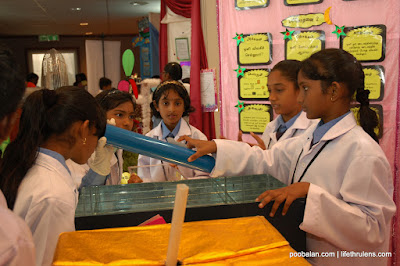
Students testing their equipments:

At 10am, the doors opened for public to enter the exhibition. The public session was until 2.30pm. Personally, I think the crowd was much less as compared to the Selangor/KL region fair held last year (that’s the one I attended, thus able to compare). Maybe because the hall is wider? Or is the location of GMI, which is quite secluded and relatively unknown to the Indian community? Anyway, I estimate about 300 to 500 people attended this fair today (excluding the students and teachers).

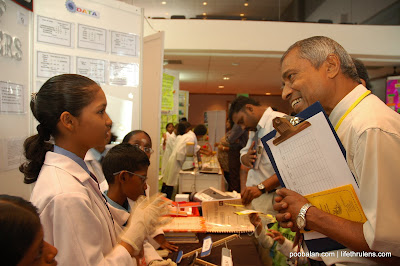
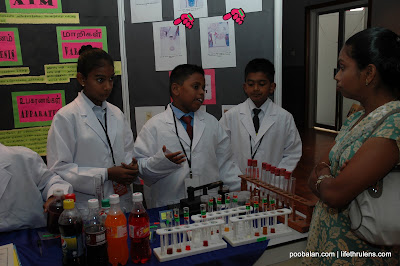
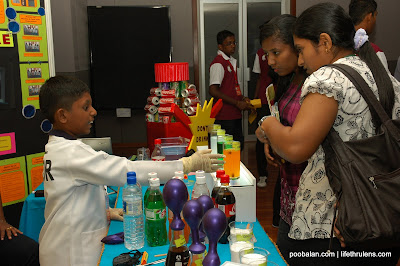
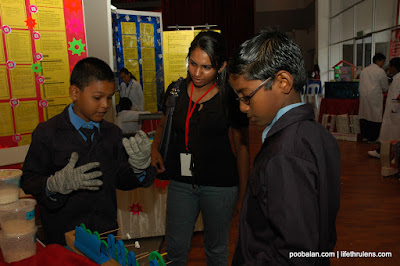
Attending to visitors:

Explaining to visitors:


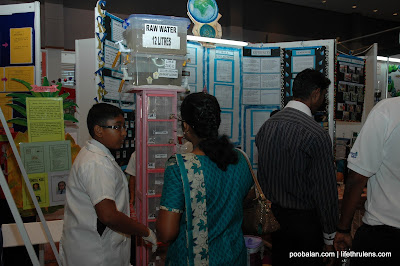
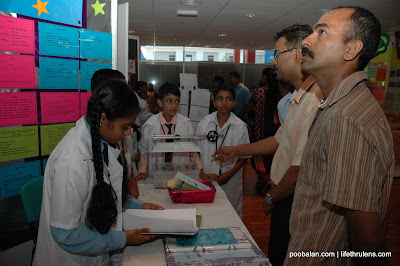
Visitors:


Interested visitors:

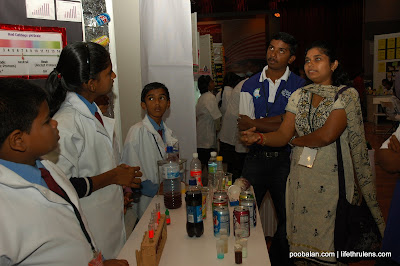
Explaining their work:

Volunteers too are impressed:

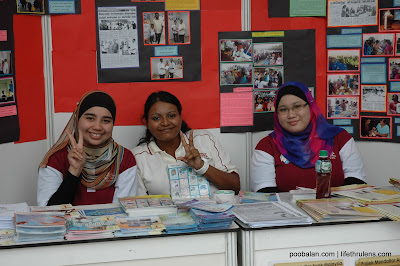
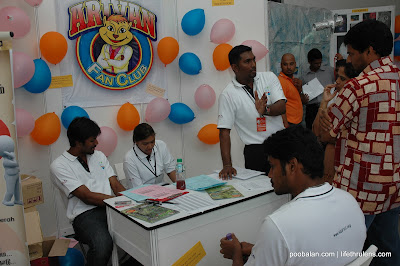
During the public session, few booths were set up at the entrance. Among there are MISI (Malaysian Indian Science Intellectuals) who promoted their educational magazine for kids named Thumbi, DHRRA Malaysia, Arivan Fan Club (where I was on duty), Grolier Books, Tamil Foundation and so on. A few games and quizzes were held for visitor to liven up the environment.

DHRRA Malaysia booth:

Arivan Fan Club booth:

Quiz participants:

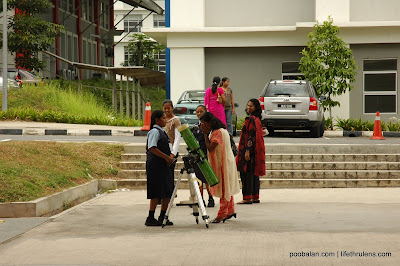
Telescope section:

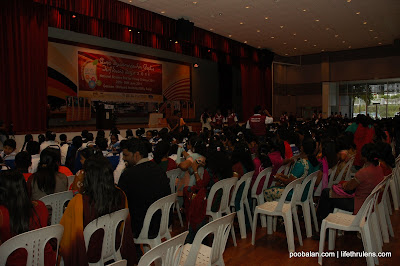
At 3.20pm, the closing ceremony started. VIP was Dato’ Dr Jeyaindran of MyNadi. The crowd numbered about 800 people (including participants).

Participants:

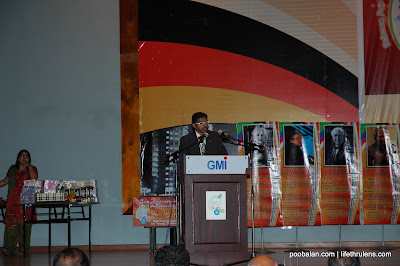
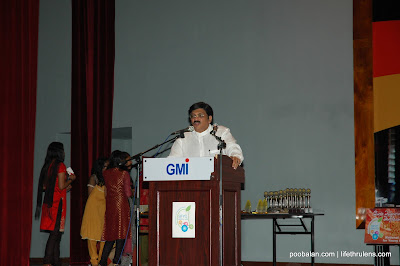
First was speech by project director Capt Dr Viknesvaran. He said that 300 schools took part in the School Fair Roadshow, while the Science Fair saw participation of 274 schools this year.

Capt Dr Vicky:

This was followed by MCEF’s Mr Satish Ramachandran’s speech. He gave some suggestions on how to improve the fair for the coming year, for example focusing on certain theme, and also to compile CDs of the projects.

MCEF director Mr Satish Ramachandran:

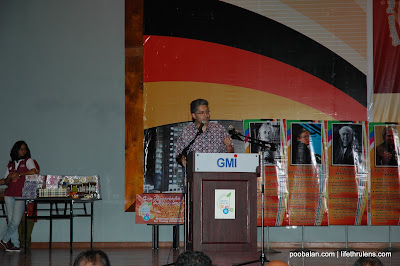
Next to speak was head judge Mr Shanmugam who  mentioned about the judging process. He also mentioned that some of the teams needs to improve in terms of understanding the fundamental principles.

Head Judge Mr Shan:

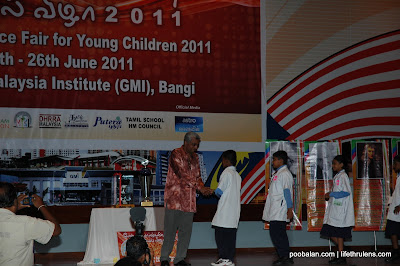
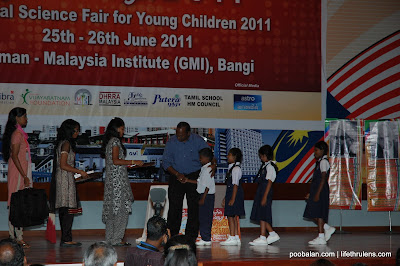
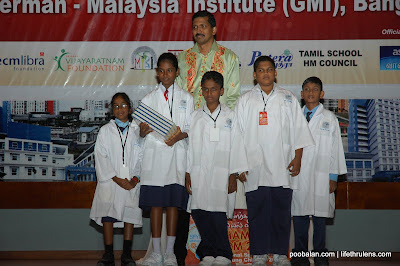
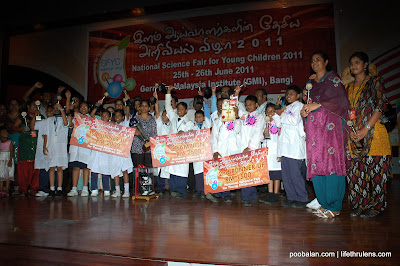
Media appreciation followed, after which all the teams were invited on stage to receive participation certificates along with tokens of appreciation.

Presentation of participation certificates and tokens of appreciation to all the students:

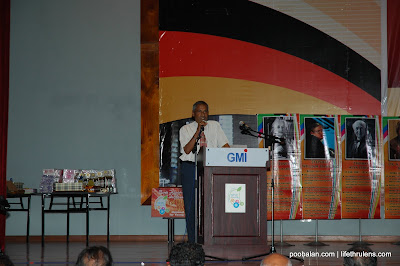
This was then followed by MyNadi’s Dato’ Dr Jeyaindran’s speech. He announced that the top 5 winners will be given a trip to Petrosains KLCC and also to the Perdana University in Serdang. He also sprang a surprise by announcing that the 1st place winners (and the teachers) will be taken on a tour to Indian Space Research Organisation (ISRO) in Bangalore!!! This is in collaboration with Air Asia and Indian High Commission. This is definitely a wonderful surprise for the participants, and added more tension to the tense environment. Everyone was waiting for the announcement.

MyNadi chairman Dato’ Dr Jeyaindran:

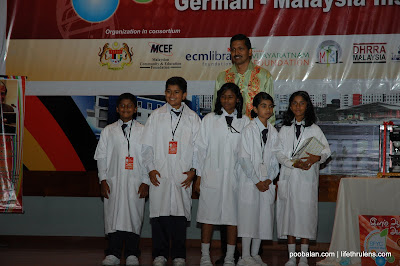
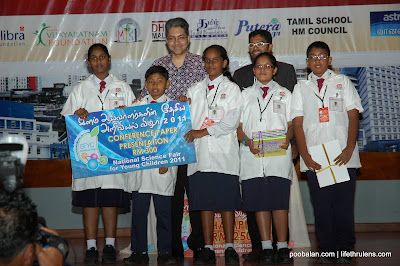
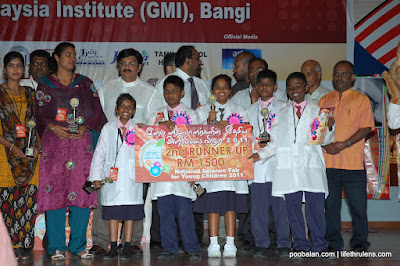
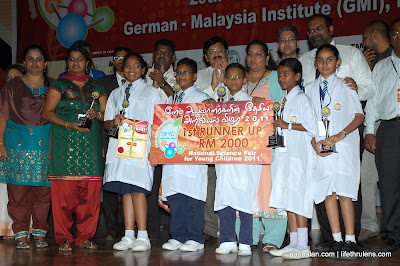
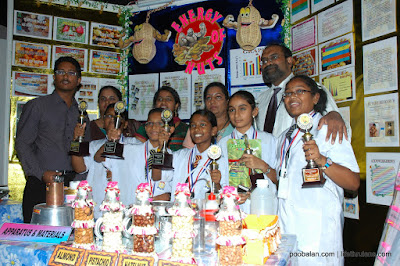
Two new categories were introduced this time: Most Innovative Project and Best Conference Paper. The winners are as below:

Most Innovative Project

Winner: SJKT Kangkar Pulai

2nd: SJKT Ramakrishna

3rd: SJKT Convent Seremban

SJKT Ramakrishna:

SJKT Convent:

Best Conference Paper

Winner: SJKT Kangkar Pulai

2nd: SJKT Sg Tukang

3rd: SJKT Yahya Awal

SJKT Kangkar Pulai:

There was another speech (to add to the tension!), this time by MISI representative Mr Saminathan.

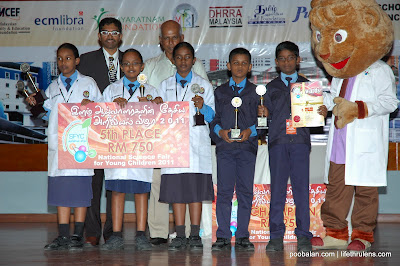
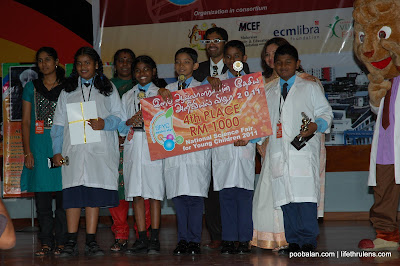
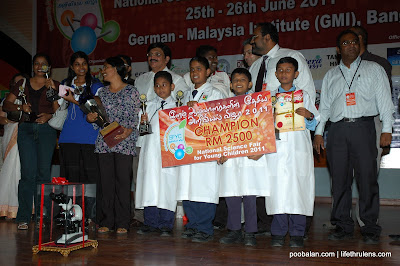
Finally, the moment everyone was waiting for. The winners announcement.

5th place went to SJKT Mukundan

4th place: SJKT Methodist Kapar

3rd place: SJKT Permas Jaya

2nd place: SJKT Tun Aminah

Their booth:

and champions are SJKT Ladang Lanandron!

Their booth:

For the first time, the top three places were swept by schools from the same state, Johor.

The ceremony ended at 5.50pm, and the crowd slowly trickled away.


Photos Slideshow: