
Posts Tagged ‘Politicians’

Dr Subra on PSD scholarship, government jobs and cabinet committee

July 14th, 2008
|  Subscribe in a reader | Subscribe to poobalan.com by Email


Dr. S.Subramaniam suggests that the interview and extra-curricular criteria to be abolished when handing out PSD scholarships. He says:

No matter how good you are at your ECA or your interview performance, you should not be eligible for a scholarship for tertiary education with low academic results

In other words, scholarships awards should be purely on academic results. This may be problematic since generally those from affluent families have better chance of doing better. Why not do it like this – minimum 9A for those family income below RM3000, minimum 12As for those with family income between RM3001 and RM8000, and minimum 14As for those from family earning above RM8001.

However, he goes on to say that all Indians students who score 9As and above in the Sijil Pelajaran Malaysia will be given government scholarships, starting this year, to pursue their studies in local government universities and four local private institutions — Monash, Swinburne, Curtin and Nottingham universities. MIC had also asked the government to include the Asian Institute of Medicine, Science and Technology in this scheme. This was decided during the first meeting of the Special Committee for Indian Related Affairs chaired by Najib. Human Resources Ministry is the secretariat for the committee.

“Deputy Prime Minister Datuk Seri Najib Razak has agreed in terms of policy and we are now in the process of formalising it.”

The problem with this suggestion is that the other communities may demand the same. After all, we are moving towards equal rights. Unless of course, the privileged community gets scholarship for much lower results, in which case they won’t complain. But the Chinese community will be upset that their students who get 9As don’t get similar deal.

Rest of the committee members are: MIC president Datuk Seri S. Samy Vellu, Dr Subramaniam, MIC deputy ministers, finance and education ministers, Public Service Department director-general, representatives from ministries related to problems faced by the Indian community and multi-agency committees.

Some of the outcomes of the first meeting has been highlighted before, but some new ones are below:

– University intake for Indian students in critical courses to be increased. Eight per cent of PSD scholarships were given to
Indians to study medicine and law. The committee was seeking more
places for Indians wishing to pursue programmes in dentistry, pharmacy,
accountancy and architecture

– A relook at the appeal of Indian students who achieved about 3.0 CGPA grading but did not get university places.

But remember, Najib said that university intake for this year will not be reviewed. He advised students to study harder. Not sure which is which now.

Another area Dr. S.Subramaniam ventured is the civil service. He said of the 16,000 Indians who applied for government jobs last year, only 1,500 were offered postings.

“It’s not true that non-Malays are not applying for civil service posts,” he said, adding that the percentage of Indians in the civil service should be increased from the five to eight per cent.

“We want Indians not only in lower-category jobs but also in higher categories. PSD has been cooperative in furnishing the MIC with information on vacancies in the civil service,” said Dr Subramaniam, who is also MIC secretary-general.

Perhaps PSD will publish such statistics – breakdown by job category, state, age, gender etc.

The next statement filled my heart with joy!

Dr Subramaniam said MIC was also working hard to improve Indian equity in the capital market from 1.1 per cent to 1.5 per cent within the next three years.

While the government is aiming for 1.5 percent in 2020, MIC is planning to turbo-boost it in 3 years. That is indeed a great challenge and one that can revive the community’s faith a bit. The easiest way is to get a big allocation from government, like maybe RM5 billion and offer it to the community via PNB. Immediate cash injection and the equity will be boosted. Just left with a small matter of asking for allocation.
Malaysiakini poll on MIC future

July 13th, 2008
|  Subscribe in a reader | Subscribe to poobalan.com by Email


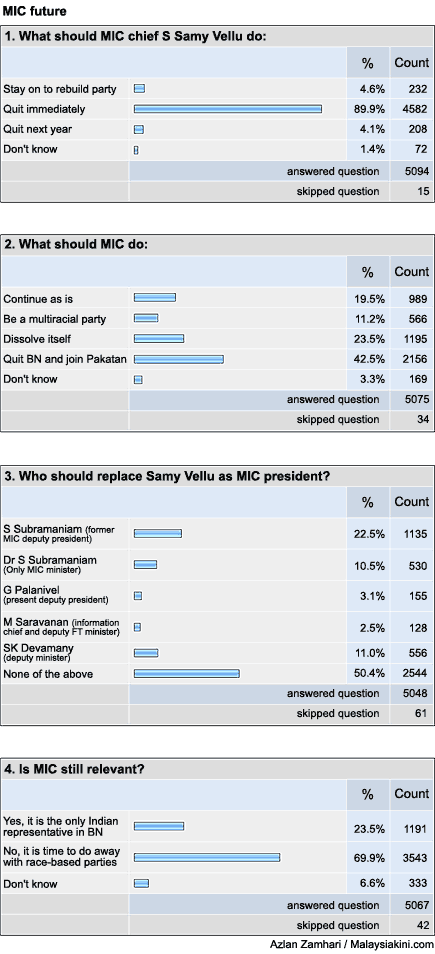
Malaysiakini’s poll results on who should lead MIC after Samy Vellu looks similar to the poll I ran for 20 days in March.Malaysiakini had 5109 respondents while mine had only 138. Theirs ran for a day, while mine for 21 days.

Former deputy president S Subramaniam bagged 22.5 percent of the votes, the highest in the group. This was followed by SK Devamany, the deputy minister with 11 percent, while the sole MIC cabinet minister, Dr S Subramaniam took 10.5 percent. Palanivel was in fourth place at 3.1 percent while information chief M Saravanan picked up 2.5 percent. More significantly, bulk of the votes, 50.4 percent, went to no one in particular – a total of 2,544 Malaysiakini readers said “they did not favour any of the individuals mentioned”.

In my poll, Devamany took first place with 31 percent of the votes, followed by Dr S.Subramaniam with 8 percent, Dato Subra at 6 percent, Samy Vellu (3 percent) and Saravanan last at 2 percent. I did not put up Palanivel. As for those who didn’t want any of them, don’t care, or don’t have any idea, the total is 49 percent!

The similarity in both the polls is that the Devamany is in the top two list, while Saravanan came last. Interestingly, the top three positions in both polls were taken by Dato Subra, Devamany and Dr S.Subramaniam. A more glaring imilarity is that majority of the respondents did not like the choices available!

malaysiakinimicpoll.gif

Malaysiakini asked few more questions as shown in the graphics above. Almost 90 percent wanted Samy, who has helmed the party for almost three decades, to quit “immediately”.

About 70 percent believed that MIC should shed its race-based politics, while 42.5 percent wanted MIC to quit BN and join the opposition Pakatan Rakyat.

Samy at MIC general assembly

July 13th, 2008
|  Subscribe in a reader | Subscribe to poobalan.com by Email


Nope, I was not there 🙂 but it was telecast live on RTM1. When was the last time you saw MIC program live on TV?


Samy Vellu started by ticking off the members for leaving the dinner early, saying that it allowed newspapers to write that he is losing support, and brought shame to the party. Says Samy:

Isn’t this what you all wanted? If you are unhappy, take a vote of no-confidence against me this evening and I’ll walk out of the party.In my entire political life, yesterday’s (Friday’s) event was the biggest blow I’ve suffered so far.

But I won’t keep this to heart and take my revenge against all of you.

He then challenged delegates to move a resolution to remove him, saying that he will walk out of the party if they did. Unfortunately no one dared to take up his challenge.


Samy Vellu said BN must do away with communal politics and become a truly multi-racial party if it wants to regain the support and trust of the people.


He said BN should speak with one voice while ensuring the needs and sensitivities of all races were respected and fulfilled.

I think the time has come for the BN to play a more prominent role as the guardian of multi-racial Malaysia. This will help us to do away with communal politics.

Samy Vellu said the Indian community today viewed and identified the MIC with the government.

As such, whatever that the government does is deemed an action of the MIC.

He said the BN government had the undivided support of the Indian community for the past 50 years.

There is no denying that in the last general election, the support of the Indian community for the BN has dwindled.

This, he said, was because the community felt that many of the issues close to their heart had not been duly addressed by the government.

This perception led to the decline in their support towards us.

However, Samy Vellu said the “past is past” and called on the BN to move forward by taking care of the needs of every community. He said the formation of a cabinet committee headed by Najib to address the problems faced by the Indian community was a step in the right direction.

My hope is that we use this opportunity to bring about policy changes that will have a positive impact on the living standards of the Indians in the country. We in the MIC have every confidence that the Malaysian Indian community will return to give its total and undivided support to the BN government.

Samy also said that the community had not been able to raise its level of participation owing to the lack of opportunities and financial
capacity.

To alleviate the problem, the MIC would like the Government to increase the number of permits and licences to Indians to
participate in the transport sector.

He said the Government should provide all necessary assistance and opportunities for the community to play a substantive role in the growth and development of the small and medium enterprises in the country.


Samy Vellu said the major problem faced by the MIC was that of single mothers who were unable to cope with the cost of living.

The MIC is here because it is easier to call the MIC than anyone else because the MIC cares. We have strived to help the community, even with limited resources.

Goodies during MIC General Assembly

July 13th, 2008
|  Subscribe in a reader | Subscribe to poobalan.com by Email


Unlike previous assemblies which were just rehashing of resolutions (there were five this time), this time there were some goodies announced by the VIP, Prime Minister Badawi and Samy Vellu.As reported in Malaysiakini, Star and NST:

  • convert partially aided schools into fully-aided schools (was decided by the cabinet committee earlier)
  • merge and consolidate Tamils schools that have less that 50 students (also announced earlier by the cabinet committee)
  • students from AIMST can apply for PSD scholarships (one of the five private universities allowed to do so)
  • government will assist AIMST to increase student population in critical fields like medicine and engineering

According to Badawi, government is focusing on “giving emphasis to education in the efforts to help the community because the success of future generation would depend on human capital development through skills enhancement training and education”.

  • RM120 million over four years (RM30 million per year) for helping single mothers, develop youth programmes, and other schemes to help the needy. This allocation was recently approved and is part of the RM300 million asked by MIC earlier in May.

Samy also announced the setting up of a web portal to “feature all their activities and achievements so that anyone in the world could find out what the party was doing”. Not sure if he meant the MIC’s website.

Immigration corruption is just the tip of the iceberg?

July 13th, 2008
|  Subscribe in a reader | Subscribe to poobalan.com by Email


Another off-topic posting.

Ask around your friends, relatives, anyone – what is the perception of corruption in the government departments? Will you be surprised with the reply you get? This is the perception (not necessarily the truth) that people have. Immigration, Road Transport (JPJ), Customs, Police, and even the ACA themselves are viewed with a suspicious eye.

The recent arrest of top two Immigration officers plus another 20 or so people had caught the interest of the nation. Why now? From what I heard, it started with the many stranded Bangladeshi workers in Bangladesh itself who can’t enter the country because the “calling visa” were not issue over here. The reason is because the previous minister (Syed Radzi) is not around anymore (it seems he had authority to issue approval via computerized system) and had been replaced by new minister (Syed Hamid Albar),  after the general elections . Suffice to say that the responsibility of approving these visas were passed around until someone agreed to handle it. In the meantime, the agents and businessmen were stuck because they had taken payment from Bangladeshi counterparts and the workers were not able to come in. (The role of previous minister, government officers etc. is not covered here, but you guys are welcomed to ask any agents or runners that deal with Immigration dept. They have many many stories to tell, without giving proof of course.)

Secondly, when tourists from China were caught with 6 months visa extension during raids in Penang, few months back, the authorities were baffled with the original stamping in the passports. This triggered investigations, and the result is what we read in papers. I saw that Chinese paper splashed photos of the DG and his deputy, while some like NST blurred the pictures.

As of today, I heard that investigation have been expanded to the “pembantu rumah” (domestic help” section and ACA is all over the house of the directors and in HQ. I hope that the ACA is able to track back into the last 10 years, and not just focus on current officers.

I think just by interviewing the runners and agents, ACA can probably arrest a big number of Immigration staff. Just send some guys as undercover for few months to built up the case. If even public like us can get some much information and end up frightened with the size of corruption from the counter services right up to the top person, surely the ACA can do better.

I got this all this information from a guy who is an agent that deals with foreign worker employment. Was talking to him casually today. He had no reason to lie, but maybe he heard the stories from other agents or officers. Not sure how true it is, but “charges” for a calling visa approval is RM350/worker. Renewal of visa application (valid for 4 months) is about RM200.

How can graft be overcome? One way is to automate processes, integrate with systems from other departments/agencies and reduce human intervention. There should be minimal approval power in hands of individuals.

There was an interesting observation in the Star today. Why don’t ministers take responsibility for the mistakes, crime, negligence or shortcomings that happen in the agencies under their portfolio? Instead some government officer is the one who is punished. The writer refers to the Westminister principle of ministerial responsibility:

The Westminster principle of individual ministerial responsibility,
however, is probably of greater concern to Malaysians. It is explained
by Rodney Brazier in his 1997 book, Ministers of the Crown:

“Broadly, each Minister is responsible for

(1) his private conduct,

(2) the general conduct of his department, and

(3) acts done (or left undone) by officials in his department.”

Example of the first case is resignation of Chua Soi Lek over his personal conduct. It seems 125 British minister resigned in the last century, with a dozen for private scandals and two from private financial arrangements.

But case (2) and (3) is more important.

More from the article:

As Noore Alam Siddiquee of South Australia’s Flinders University wrote in 2006 in the International Public Management Review,
“the principle of ministerial responsibility as seen in mature
democracies is either weak or missing in Malaysia. The principle means
that the minister accepts responsibility for any lapses or
irregularities within his ministry and resigns from the office.

“Despite
reports of numerous irregularities in various agencies at different
levels, misappropriation of funds by individuals and groups and
increasing volume of complaints received from the public on the quality
of services and responsiveness, rarely has a minister chosen to accept
responsibility for such irregularities.”

Siddiquee points out
that despite the 2004 public outcry over shoddy construction projects,
the then Works Minister “not only rebuffed calls for him to step down,
he practically took no responsibility for the defective projects and
other anomalies, and has had no problem retaining his ministerial
office.”

But Datuk Seri S. Samy Vellu was able to rebuff those
calls for resignation – which came not just from civil society groups
and Opposition lawmakers, but also from BN backbenchers – in large part
due to the unwillingness of his Cabinet colleagues to apply the
doctrine of individual ministerial responsibility to him, perhaps lest
they themselves be judged by the same standards.

In Cabinet Governing in Malaysia
(2006), Datuk Seri Dr Rais Yatim reveals how they protected Samy Vellu:
“Finally, after what was a prolonged episode that almost cost him his
job, the Cabinet found that he took it upon himself more than he should
have shouldered. The Cabinet session of 20th October 2004, chaired
by Deputy Prime Minister Datuk Sri Mohd Najib Tun Abdul Razak,
discussed at length the background of this public outcry. Datuk Seri
Samy Vellu’s extensive reports to the session were noted by the Cabinet
with the view that the Minister ought not to take it upon himself all
the blame hurled by the public as there were various parties that were
responsible like consultants, contractors, engineers, architects, etc.”

Following
this logic, it would appear that a Minister only need resign if he were
a one-man ministry, doing everything himself. In reality other parties,
whether external or in the civil service, are always there to take the
blame.

Do you remember when was the last time a minister resigned (other that Chua Soi Lek)? Feel free to share.