Posts Tagged ‘Poverty’

Poverty line index to be calculated annually

July 21st, 2008
|  Subscribe in a reader | Subscribe to poobalan.com by Email


The government had decided that the poverty line index (PLI) will be updated annually
instead of every five years. This is due to changes in the spending
habits of consumers affected by the rise in consumer goods prices and
inflation. This news was announced by Minister in the Prime Minister’s Department Tan Sri
Amirsham Abd Aziz in Dewan Negara. The Consumer Price Index will also be recalculated.

Good news indeed as this information can be used to provide suitable assistance to the poor and the middle class. Currently, poverty line is set at RM 691 and hardcore poverty is set at half of that amount (following international standards). Some states had recently revised the poverty rate, like Selangor which set it to RM1500. Poverty line can different among states, and area (urban/rural).

I estimate a ball park figure of at least RM1200 to be the poverty line in urban area, with Klang Valley, Penang, Kuching, Kota Kinabalu and Johor Bahru poverty line set at RM1500. Rural areas may be around RM800 – RM1000.

Semenyih Estate workers plight

July 17th, 2008
|  Subscribe in a reader | Subscribe to poobalan.com by Email


There was a interesting article in Star (Metro section) reproduced below on the plight of the Semenyih estate workers. There were some photos too. Thanks to Then for pointing out.

Few things I want to say:

1. Estate workers must think about owning a house and not be in comfort of living in quarters thinking its free for life. We can’t compare with Malay community who own lands. Thus estate workers have to put in triple or quadraple effort to own a house and provide education for children.

2. Some of the displaced workers, women especially, in Prang Besar and surrounding areas are now working as cleaners in Putrajaya. The maintenance companies hire these local people

3. I wonder who these people voted for, if they could vote.

BEFORE Putrajaya came into existence, there was the Prang Besar Estate.

While the country’s new federal administrative capital was still a design on the drawing board, hundreds of estate workers had toiled daily in Prang Besar. They tapped rubber and worked in the oil palm plantation, savouring the simple life as they knew it. The creation of Putrajaya opened a new chapter in the nation’s history but closed another. The dramatic change in the landscape from that of a rural estate to a modern city with towering structures best embodies the high price we pay for development.

It also acquainted us with the ugly term known as displacement.

According to statistics from the National Union of Plantation Workers (NUPW), the number of estates in Selangor dwindled from 150 in 1986 to 95 in 2006. Besides Putrajaya, former estates converted to mega development projects include Cyberjaya, the KL International Airport (KLIA), Bernam Valley and the Guthrie Corridor.

With Prang Besar Estate no longer in existence, a majority of the former estate workers were relocated to low-cost flats in Dengkil. The estate they had called home for decades was no more and the close community living is all but a fond memory now.

Rubber tapper Subramaniam Munusamy, 45, of Semenyih Estate, firmly believes that they should be compensated with permanent homes. “Semenyih has been my home for nearly three decades. Following the notice of termination of employment from the landowners five years ago, we were offered flats in Nilai,” he told StarMetro during a recent interview at the estate workers quarters. “But this means starting all over again. We have asked for low-cost houses in Semenyih in recognition of our blood, sweat and tears for a commodity which is fetching high prices in the world market,” Subramaniam said.

Since they stopped working for the Semenyih Estate, Subramaniam and his wife Anjalai Devi Chinalagan, 43, have been tapping rubber on a plot of land belonging to a smallholder for daily wages. Their combined monthly income is barely RM1,300. The couple, who have four children, said they could not retire for at least 20 more years. Like everyone else, they hope to enjoy the comforts of living in a house of their own in the near future. The struggle to gain a permanent roof over their heads began five years ago with little progress to show since.

For retirees like Mariayee Palaniappa, 59, and Munichy Muniandy, 53, their meagre incomes come from picking flowers for which they are paid RM8 per tin.

Estate resident Devi Ganie, 30, meanwhile, takes on odd jobs, leaving her five-year-old son B. Mathialagan in the care of neighbours.

Life is hard but the women share some little joy and comfort through communal living.

Back when it was a functioning estate, the Semenyih Estate was home to 100 Indian families. There are only 16 families left now. The others have left to seek their fortunes elsewhere after obtaining their dues from the landowners.

Meanwhile, a looming threat of displacement currently hangs over the Dunedin Estate workers. Dunedin, located 3km from Semenyih town, is still functioning as an oil palm plantation and, like the Semenyih Estate, was established around a century ago.

According to plantation worker Arumugam Subramaniam, 51, and his wife Sarojini Paramasivam, 44, there is talk of the plantation being sold for development but they have yet to receive any notice from the landowners. “There used to be over 100 families here but only a fraction are left now since the rumours began. If the landowners want us to move, we hope to be provided with houses nearby,” Arumugam said.

“As far as income goes, we are paid daily wages, base pay, cost of living allowance (Cola) and other allowances. It is hard to make sense of the pay slip but basically, my wife and I jointly earn around RM1,250 a month,” he said. “In view of the surge in commodity prices and inflation, the Malaysian Agricultural Producers Association (Mapa) should increase the Cola while the NUPW should push for a higher minimum wage,” he said.

Retiree Baby Angamuthu, 57, in reminiscing how life in the estate was 50 years ago, said that little had changed in the estate community all these years. “We are still living in deplorable conditions although oil palm is a priceless commodity. Some of the quarters are infested with termites, the drainage system is poor and dengue is a constant threat,” she said, cuddling her seven-month-old grandson Thinakaran Murugan.

At present, the future looks bleak for the young generation but parents like Subramaniam and Arumugam realize the importance of education and have sent their children to school. They hope that their children, armed with an education, could leave the estates to work, and break the cycle of poverty.

Parti Sosialis Malaysia (PSM) estate liaison officer Ramalingam Thirumalai can identify with the estate workers struggle concerning displacement. “We at the Sungai Rinching Estate fought for 10 years for our houses. The struggle was long and difficult but we emerged victorious and we also realised that it was better to stand together,” he said.

There is strength in numbers which is why PSM secretary-general and Kajang Municipal councillor S. Arutchelvan wants to mobilise together the estate workers of Semenyih, Dunedin, Bangi and Glengowrie to demand for housing. “Breaking up the communities of estate workers leads to a negative impact on their psyche as they already feel neglected and cast aside,” Arutchelvan said. “With a proper area set aside for housing, displace estate workers can ask for a school, hall and places of worship,” he said.

During his recent visits to the estates, Selangor health, plantation workers and caring government committee chairman Dr Xavier Jeyakumar gave the landowners a timely reminder. Land status conversion for estates with 40ha and above will only be approved if the landowners agree to provide housing for displaced estate workers. This is the condition imposed by the state government,” Xavier said. At present, there are 113 estates in Selangor seeking land status conversion. Xavier also urged estate owners to give preference and priority to locals when hiring workers and not only employ foreigners.

Plantation workers earn higher than poverty line

July 17th, 2008
|  Subscribe in a reader | Subscribe to poobalan.com by Email

This is an interesting news because last year May, there was an increment of about 9 percent in the plantation workers’ wage under new collective agreement signed between NUPM and MAPA. The lowest a field worker can earn will be between RM500 and RM600.

Now, senator Kohilan who is the Plantation Industries and Commodities Deputy Minister says, on average an oil palm or rubber plantation general worker now earned RM750 a month while an oil palm harvester about RM1,100 a month, which is above the rural poverty line of RM740.

Actually poverty rate in Peninsular is RM691 and as far as I know have not been reviewed yet. for rural area, poverty line was found to be RM698. There are some others who indicate poverty rate to be about RM680. Some states also calculate their own poverty line, like Selangor who increased it to be RM1500. This means that workers are earning higher than the poverty line of RM691.

He further adds that:

Most plantation workers also do not have to spend on house rental,
medical charges (at the clinics) and pre-school education for their
children as all these facilities are provided by the plantation
management

What he says is true, but plantation workers (locals) have to think about the future – means they have to buy a house and service the loan. Groceries and education cost increases. These workers, like any other, must consider taking insurance for their children. Traveling, clothing, vacation and entertainment cost increases. I consider these new “expenses” as necessity since we are moving towards developed, progressive, and knowledge-based society.

I hope to see poverty line to be increased to a suitable amount that considers the need of 5 family members in current economic and social settings. Maybe to RM1200 or 1800 even.

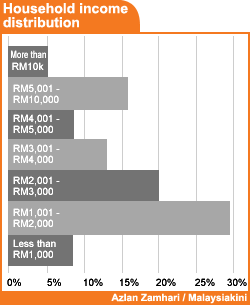
Household income distribution

July 9th, 2008
|  Subscribe in a reader | Subscribe to poobalan.com by Email


Dr Michael J Devaraj (conqueror of Samy Vellu), MP for Sungai Siput was praised by the Assembly Speaker recently as among the MPs who ask good questions. He asked the following today:

My question is, why did the government stress the disparities between ethnic groups while staying silent on the inequalities between the rich and the poor within every ethnic group which contributes by far to inequalities generally?

This was in response to MP Amirsham’s reply on the income distribution for households.

householdincome.gif

Taken from Malaysiakini.
– 8.6 percent of households earn below RM1,000
– 29.4 percent of households earn between RM1,000 and RM2,000
– meaning, 38 percent of households in Malaysia earn RM2,000 and below.

– 19.8 percent of households are in the RM2001-RM3,000 income bracket
– RM3,001-RM4,000 (12.9 percent)
– RM4,001-RM5,000 (8.6 precent)
– meaning, 41.3 percent are in the RM2000-RM5000 bracket

– about 20.7 percent of households earn more than RM5,000 a month
– RM5,001-RM10,000 (15.8 percent)
– above RM10,000 (4.9 percent).

The source and period of the statistics is not provided, but it should be not before 2004 and not later than 2007. The number of households is also not provided.

Looking at the results, we have 38% of household earning RM2000 and below. If a household has 4 people, it will be diffcult to live in urban area. Nearly 58% of the households earn RM3000 and below.

With poverty line set at RM600-RM700 range, we can understand why the poverty rate is low. Unfortunately, the income is always insufficient to match the ever increasing cost of living. If poverty line is increased to RM1000, then 8.6% of the households will be poor. However there have been calls to increase poverty rate to RM1500, which may reveal that up to 24% of the household are poor.

Another issue is that many are resorting to part-time or second (and even third) jobs to supplement income. These are usually not revealed or reported in order to avoid taxation, punishment (by employer), or to purposely show their “poverty”.

Anyway, I’m not sure if household income is a good parameter. Individual income statistics should be tabulated as well.

single mothers forced to put children in orphanages

July 8th, 2008
|  Subscribe in a reader | Subscribe to poobalan.com by Email


More of these cases will come to light soon, not only in Penang but all over the country.  MHS and other organizations will be facing more such requests, and hopefully they will be able to generate more funds. Even the expenses for the family paid for by UMIC has increased quite substantially.

MHS should also provide feedback if they approached the EXCO in charge of welfare and the response. The article states Prof Ramasamy’s reply to MHS’s suggestion to set up ration shops, but no indication if MHS approached him or the media interviewed him separately.

The rising cost of living has forced three single mothers in Penang to find help to place six of their children in orphanages. Last week, the three – two from the island and one from Butterworth – approached the Malaysia Hindu Sangam to find a home for their children.

“Each woman has between three and five children and each is sending two children to an orphanage to lighten her financial burden,” the organisation’s Penang branch Social and Welfare Committee head P. Murugiah told The Star yesterday.  He said one mother was jobless, another was earning RM350 a month doing odd jobs while the third earned RM600 a month as a factory worker.

Murugiah said some heads of hardcore poor families have also approached the association for help to place their parents in old folks home.  “They are having problems providing meals for their parents and taking care of their medical expenses,” he said.

Murugiah said the hardcore poor have been severely affected by the recent hike in fuel and food prices.  Citing examples, he said the price of atta flour has increased from RM1.80 per kilo in December to RM2.80 while cooking oil (2kg bottle) has gone up from RM4.50 to RM6.20.  Murugiah said the price of dhal has increased from RM2.80 to RM4.60 per kilo while a brand of the cheapest milk powder has increased from RM9 in January to RM19.50.

He proposed that the state government open ration shops such as being practised in some countries to lighten the burden of the hardcore poor. “The prices of food items sold in ration shops can be subsidised up to 80% by the government. Penang should set up such outlets in line with the Penang Leads tag,” he said.

Deputy Chief Minister II Dr P. Ramasamy said the state would consider the proposal. “It is a good suggestion but we will have to consider the financial implications.  “The state is already helping hardcore poor families by giving free rice. We are planning to give water rebates to this group and studying other means to help them,” he said.