 Subscribe in a reader | Subscribe by Email
 My question is, why did the government stress the disparities between ethnic groups while staying silent on the inequalities between the rich and the poor within every ethnic group which contributes by far to inequalities generally?
This was in response to MP Amirsham’s reply on the income distribution for households.
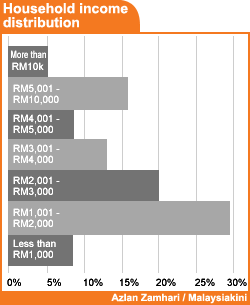
– 29.4 percent of households earn between RM1,000 and RM2,000
– meaning, 38 percent of households in Malaysia earn RM2,000 and below.
– 19.8 percent of households are in the RM2001-RM3,000 income bracket
– RM3,001-RM4,000 (12.9 percent)
– RM4,001-RM5,000 (8.6 precent)
– meaning, 41.3 percent are in the RM2000-RM5000 bracket
– about 20.7 percent of households earn more than RM5,000 a month
– RM5,001-RM10,000 (15.8 percent)
– above RM10,000 (4.9 percent).
The source and period of the statistics is not provided, but it should be not before 2004 and not later than 2007. The number of households is also not provided.
Looking at the results, we have 38% of household earning RM2000 and below. If a household has 4 people, it will be diffcult to live in urban area. Nearly 58% of the households earn RM3000 and below.
With poverty line set at RM600-RM700 range, we can understand why the poverty rate is low. Unfortunately, the income is always insufficient to match the ever increasing cost of living. If poverty line is increased to RM1000, then 8.6% of the households will be poor. However there have been calls to increase poverty rate to RM1500, which may reveal that up to 24% of the household are poor.
Another issue is that many are resorting to part-time or second (and even third) jobs to supplement income. These are usually not revealed or reported in order to avoid taxation, punishment (by employer), or to purposely show their “poverty”.
Anyway, I’m not sure if household income is a good parameter. Individual income statistics should be tabulated as well.

Poobalan
I had heard glowing praises about Dr Micheal Devraj from some of my Chinese staffs based in Penang as well. Apparently he has a very good reputation as a selfless person, being involved in many social activities. Not sure if he is from Penang though.
Yes, this is the kind of question that should be asked in the Parliament instead of the current obession over technicalities, trivial issues and politically loaded questions.
I happpened to catch NTV7’s news last night and witnessed the antics of that Ah Lean MP from Batu Gajah (Fong). She was harassing the 2nd Finance Minister (btw he is half-Indian and one of the smartest person in the parliament, if not the smartest). I just wonder when our MPs (especially the PR ones) would ever grow up. Instead of trying to prove a point and make BN/Speaker look stupid, they should focus on real issues.
BN MPs are onl slightly better…for example witness the BN MP for Kinabatangan’s latest crude behaviour…
Anyway coming back to Dr Devraj’s questions though it is valid, it shows he has not been doing his homework. The gap in income among the population is called as “Gini” co-efficient. Malaysia has the highest Gini “co-efficient” in ASEAN, which is certainly a worry. Though this can be easily explained. However Devraj should have done some research before asking as one of AAB’s key thrusts is the reduction of income gap between regions and rural/urban areas.
Some of the less smart guys here had been accusing the need for the corridor projects. But the key reason behind the Iskandar, NCER, East Coast, Sabah and Sarawak corridors is the need to reduce the imbalance. The govt realised that under TDM too much money went to the mega projects that was centered around KL / Klang valley. As such AAB felt the development now must be spread out all around the country.
As for which data to use, the household income is more accurate. There is a big difference between sole bread winner in a family of 10 vs single-person staying alone. Poverty eradication programs have to look at household programs to be effective.
As for poverty line, a single figure would not do. There has to be different set of numbers for rural, semi-urban and urban areas. Rm 1000 is a sufficient if you live in Kuala Selangor but in Subang Jaya, this would not get you through the 2nd week of the month.
So I hope this explanantion answer your as well as Dr Devraj’s questions.
if i’m not mistaken there are plans to use poverty lines based on region. at the moment, its split into sabah/sarawak/rural peninsular/urban peninsular (check 9MP). My take is that the bar should be raised by 30-50% for all lines. The current poverty lines at RM600++ is laughable to say the least, what more if you have 10 kids and 2 wives.
Household income makes assumption that a house has 4 people in it (in our country’s case). Wouldn’t this distort the statistics? If we generalise that Malays have bigger families, so with lower household income, they are worst off. The Chinese who are “usually” small families have the highest household income, meaning more affluent.
If we take individual earning, then we can compare with per capita average, thus see how many people earning below the average rate, regardless of how many people they are supporting with their income. We then can also see how many citizens are not working (schooling,retired, invalid, infirm, etc).
I think better to have both figures so that it will give a more comprehensive picture.