Posts Tagged ‘Role Model’

Ambiga receives Inter­national Women of Courage Award

March 7th, 2009
|  Subscribe in a reader | Subscribe to poobalan.com by Email


Congratulations to Datuk Ambiga!

PETALING JAYA: Bar Council president Datuk Ambiga Sree­ne­vasan’s courage and leadership have been recognised by the United States.

She will receive the Inter­national Women of Courage Award from US Secretary of State Hillary Clin­ton in Washington on Monday.

Ambiga, who left for the United States last night, was selected for championing the rule of law and for advancing human rights, the status of women and religious tolerance in Malaysia.

She is among eight women to receive the award in celebration of International Women’s Day.

“I’m very honoured and excited that I’ve been selected, yet humbled after reading about the other recipients,” said Ambiga.

“They have indeed done a lot for the society they represent and I look forward to meeting them.”

The other recipients are from Russia, Uzbekistan, Nigeria, Ye­men, Guatemala, Iraq and Afghanistan.

They are recognised for their outstanding contributions on be­­half of women and their societies and for tackling issues such as domestic violence, forced and child marriages, human trafficking, fighting corruption and demanding government transparency; defending access to justice and the rule of law and safeguarding equal rights and opportunities for children.

Pancakavya helps Sanmargam in farming

March 3rd, 2009
|  Subscribe in a reader | Subscribe to poobalan.com by Email


From The Star:

After discovering the benefits of chemical-free farming, one man passionately shares his experience and knowhow.

PART-TIME farmer Sanmargam Kathiravan often shows his visitors a set of “before and after” photographs of – don’t laugh – a goat.

He had bought the sickly, underweight goat in 2006 for RM250 and nursed it back to health over six months. The “after” picture shows a healthy and fatter goat with a shiny coat of hair.

Sanmargam was doing a little experiment to convince himself of the efficacy of an organic growth promoter called pancakavya that is said to be not only good for plants but also beneficial to animals.

“It works in India but we’re not sure if it will work here. So, I did my own R&D (research and development). Take the goat, for instance. It will require few hundred ringgit of medication to treat its cold and skin rashes. But I did it with very little money. Now I can speak confidently of the effectiveness of pancakavya,” he says with pride.

Pancakavya is made from cow dung, urine and milk, as well as yoghurt, molasses and eggs. It takes 20 days to be ready for spraying on plants. It also acts as a pest repellent.

Sanmargam was among a small group of farmers from the northern region of the peninsula who were taken to India a few years back by the Consumers Association of Penang (CAP) to witness how small farmers have found a way out of agrochemical-based farming.

In 1998, the factory production supervisor was planning a jasmine garden as a social security net for his home-maker wife. He reckoned that jasmine would always be in demand from the Indian community, which uses the fragrant flower for religious purposes. He bought a bungalow lot in a medium-cost housing estate in Lunas, Kedah ,to execute his plan.

“I started growing jasmine. Soon, I faced all the problems common among farmers who rely on synthetic pesticides, herbicides and chemical fertilisers. My plants were attacked by insects, the leaves were eaten by caterpillars and the buds were invaded by bugs.

“Other farmers were not willing to share their knowledge and the Department of Agriculture could only advise me on chemical application. Eventually, I moved from using Class 1 to Class 4 toxic chemicals but that didn’t solve the problems. It seemed that the insects were immune to the chemicals,” recalls the 42-year-old father of three sons.

It wasn’t until 2003 that Sanmargam came across CAP which was promoting sustainable agriculture and had brought in a vermi-compost expert from India, Dr Sultan Ismail, for a workshop in Penang.

There was no turning back after that for Sanmargam. He attended further training in India and became convinced about the principle of organic farming. He started rehabilitating his garden by spraying pancakavya once a week. After three months, the routine was reduced to every fortnight and after six months, he only sprayed once a month.

“It completely eliminated the pest problem. Once you stop applying chemicals, you get help from Mother Nature. The birds will pick off the snails and the insects will control one another,” he enthuses.

Sanmargam’s garden not only thrives with organic jasmine and vegetable plots, it is also a mini-laboratory and factory for growth promoters like pancakavya and effective micro-organisms and fungus repellents. The ingredients are sourced locally at a fraction of the price paid for agro-chemicals.

The four-tank vermi-compost system sits in one corner of the garden and churns out several tonnes of organic compost a year, which is used in the garden as well as sold at RM4 per kg for extra income.

And gone are the days when he had to cajole buyers to take his jasmine blooms. “Now, the retailers tell me not to sell to others. Previously, I had to beg them to take my flowers. I can understand their reluctance because the flowers did not last more than a day.

“The organically-grown jasmine not only lasts a few days, even the fragrance is sweeter. This is the feedback from retailers and customers. There’s a money back guarantee for anyone who finds a bug in my flowers,” quips Sanmargam, adding that he now supplies the flowers to six shops in Penang and two in Lunas.

On high demand days, he gets RM3 per tin of flowers and a minimum of RM2 on slower days. Previously, he got as low as RM1 per tin.

Next, he is planning a dream farm where he can raise livestock like cows and goats, and have more space to grow vegetables and fruits. The livestock will ensure a steady supply of cow dung, urine and milk for producing various organic materials for the farm. Sanmargam now speaks widely and passionately about organic farming to farmers at organised events and to those who have heard of his success and drop by his house.

“I believe in the goodness of this system and I want to share my experiences with anyone who is willing to try,” he adds humbly.

Interview with Prof Suresh Kumar Govind

February 28th, 2009
|  Subscribe in a reader | Subscribe to poobalan.com by Email


I still remember his “Hinduism is very deeeeeeep…” phrase when he gave talks at university! One of the few people who are excellent role models for our youths…

From NST:

Social worker, playwright and management consultant Professor Dr G. Suresh Kumar is essentially a tropical medicine and parasitology professor from Universiti Malaya, with 11 awards to his name, writes SONIA RAMACHANDRAN.

HE just won the Malaysian Toray Science and Technology Award last month for his 17 years of pioneering work in the field of Blastocystis.

Blastocystis is a protozoan parasite known to cause diarrhoea, stomach bloating and other gastro-intestinal symptoms.

He has also won numerous awards, including the Geneva International Innovation Gold Medal, for developing a diagnostic test for Blastocystis.

This is Professor Dr G. Suresh Kumar, a scientist, social worker, playwright and management consultant.

But in 1980, things did not look good for Suresh, who was studying at Victoria Institution in Kuala Lumpur.

He had failed his Sijil Tinggi Persekolahan Malaysia examination, with very poor results in Mathematics and Chemistry. He sat for the examinations again, and failed.

My career guidance counsellor told me never to take up science as my results were so poor. He said to try law, accountancy; any other course except science. Everyone else discouraged me. Some asked me to work and others said I was a total write-off.

The turning point in his life came when he returned home one day and opened the door to his father P. Govind’s room.

“I saw him crying. I was the eldest in the family and he had always wanted me to be a doctor.

“I closed the door silently. I went out and did some soul- searching. I decided then that I would make sure that my father would have the opportunity to call me ‘doctor’.”

He joined Tunku Abdul Rahman College, did his diploma and bachelor’s in science, and joined the Institute for Medical Research.

“I was assigned as research assistant to Dr Mak Joon Wah. He was my parasitology teacher. He was the one who taught me about parasites. He was an inspiring figure and I became interested in the field.”

Dr Mak sent Suresh to do his postgraduate diploma in applied parasitology and entomology.

“The top student would receive a scholarship to do his master’s. I studied hard, landed the scholarship and did my master’s at Universiti Malaya.

“After that, I received another scholarship to do my PhD at the National University of Singapore.”

In Singapaore, Suresh did not just bury his nose in his books.

“I was involved in social work in the evenings. I taught in teen youth classes and conducted drama workshops.

“I begun to realise that the more I got involved in service work, the better I became in my field. Only when you serve and help others do your brains get activated.”

Then came the greatest moment of Suresh’s life: his parents came to attend his convocation.

“I think any child can do anything he wants, but to fulfil the ambition of your parents is the greatest satisfaction. That was a moment in eternity when my parents were sitting there in the convocation hall and I went to receive my scroll.

“I took my own sweet time to get the doctorate scroll because I wanted my parents to savour every moment. When I placed the scroll at their feet, they were in tears.”

Suresh, who is the deputy president of the Sathya Sai Baba Central Council of Malaysia, has written more than 70 sketches and plays which reflect values, unity and integration as well as the promotion of culture and tradition.

Why did he get involved in this?

“It gives you purpose and meaning. It gives much more depth to what life is all about.

“I have more than 180 publications and papers, and not one can I take with me when I die. No one really bothers what you believe in. What really matters is what are the consequences of that belief.

“No one up there will question where you came from but what will be asked is what have you done during your time on earth. What are your contributions?”

Suresh said his group was also working with the Unity, Culture, Arts and Heritage Ministry to organise an inter-religious youth camp next month.

How did he start writing plays?

“There was a drama competition and a group was staging this play. I saw that play and thought it could be improved. So I went home, took a paper and pen, and toyed with an idea.

“But I did not have the confidence to give it to the director, so I kept it in my pocket and went on to act in somebody else’s play.

“Somewhere along the way, the paper fell out of my pocket. The director picked it up, read it and said it was fantastic. They changed their script for mine.”

Suresh has also authored four management books.

So what is Suresh’s message?

Nobody in this world is stupid or silly. No one in this world needs to feel that they are the underprivileged or marginalised.

If a hapless individual like myself could pick himself up and do it, anybody can. Just believe in yourself.

“There are three simple formulas to follow: love and serve your parents, use every talent and skill to serve society and love all without differentiating between them.”

Sampah Masyarakat cleans up Batu Caves

February 12th, 2009
|  Subscribe in a reader | Subscribe to poobalan.com by Email
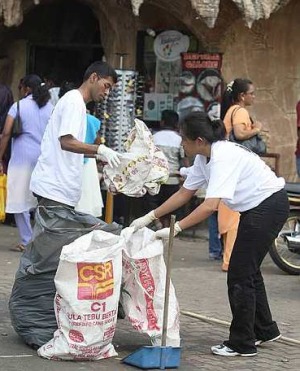

The group of volunteers under “Sampah Masyarakat” got together on Monday, the day after Thaipusam to help clean up the area. The initiative mooted by Shyam via email and Facebook saw abotu 30 volunteers sacrificing their holiday. Unfortunately, I was unable to join in on that day 🙁

Fellow blogger, Puvanan was caught on camera doing his bit. I think few other MindsBlog members also took part:

Puvanan at Batu Caves clean up by Sampah Masyarakat

No easy task: N.Puvanan, 24, (left) and Khairunisa filling up bags with rubbish.

THE Thaipusam celebration at the Batu Caves Temple in Selayang drew a big crowd and as such rubbish was found strewn about. To help clear this, a group of volunteers clad in white T-shirts took charge.

The group of volunteers, who call themselves Sampah Masyarakat, came armed with brooms, shovels and plastic bags and were kept busy from 7am on Monday.

Subscription manager M. Shyam Priah, 35, took the initiative to form the group by sending a global message through the social network Facebook to all her friends requesting for assistance for a massive gotong-royong.

It is Shyam’s way of creating awareness on cleanliness.

“We had about 30 volunteers in the morning and more by noon.

“We have divided the area to three zones from the main gate to the stairs. It is not just about cleaning up because nothing will come out of it.

“We are doing a study on how many times the bins gets filled and how long it takes to see how much rubbish people discard. We want to see if there are enough rubbish bins around the temple.

Big pile: Volunteers R. Rajendran, 42, and Dr Al Wee, 49, helping to clean up the coconut offerings at Batu Caves

“We want to create an awareness at a different level because when the attitude changes, it will last.

“I am glad to see that we have many Malay and Chinese volunteers who came to help in the clean-up,” she said.

Shyam said the Selayang Municipal Council (MPS), Alam Flora and temple committee members were also there to help them.

Student Ming Sing, 24, from Petaling Jaya left her home at 5.30am to volunteer her services in the clean-up.

“This will help create awareness on how we can save the earth.

“It is very surprising to see how people can throw rubbish indiscriminately,” she said.

Project manager Khairunisa Kamaruzaman, 30, decided to join in the good cause after hearing about it from friends.

“I have never been to Batu Caves before. I think this project should continue for other festivals as well. We should focus on reactive measures instead of just using preventive measures,” she said.

Coach Sathianathan sacked for telling the truth

February 2nd, 2009
|  Subscribe in a reader | Subscribe to poobalan.com by Email


Can you believe this? Coach is sacked for telling the truth? For being brave?  I wonder why the FAM did not sack itself – starting from the very top itself.  They’ve been in power for decades and find it easy to blame everyone else except themselves. How convenient. How many chances do they need? Why are we forced to accept sub-standard management? Year after year we only get excuses and crap from FAM. Spending money on forums, seminars, workshops, etc – but end results same only. No wonder we are graded “D” by AFC on management. Why not we just get some of the league management team from other countries and pay them to run FAM and the whole football structure? At least we can blame the foreigners if things still fail!

I remember seeing angry Sathianathan on TV making the famous “M-League is not football” comment. Practically every expert who had done research/consultation have provided probable solutions. We have had foreign coaches, foreign players, different rules for practically every season of the football league etc. But we have had the same FAM leaders all this time. And our football team never did change for the better.

It doesn’t take a genius to realise that everything from the grassroot to the top must be revamped. Acts, rules and procedure must be reinvented. Players choosen without fear or favour. Scientific methods incorporated. Leagues to be started from pre-school itself – under 7 all the way till under-23. So many things can be learnt from practically every country who is about us in the footbal standing. That’s about 150 countries!

Year after  year we tend to hear the same problems – salary and EPF not paid, foreign players taking legal action, national team losing here and there, changes of coaches in state teams, players not fit, lack of funds and sponsorship, changes in league rules and regulation, stadium fees unpaid, matches postponed, etc. All this are pointing to failures in FAM itself – lack of willpower, enforcement and proper long-term strategy. Being weak and probably having some self-serving agenda.

Now the coach is being made scapegoat. Pity the guy. He could only work with the stuff he had. With only 3 fit players, we must be holding majlis kesyukuran for being trashed only 5-0.

If it was up to me, I’ll call the state of football in Malaysia as a criminal act. And the criminals are in FAM and state FAs.

FAM need to be man enough to take in the chin. Not be cowards. You can sack coaches. But you can’t sack the public who tells you “M-League is not football”!

The Football Association of Malaysia (FAM) today decided to terminate the contracts of national head coach B. Sathianathan and national team manager Datuk Soh Chin Aun.

FAM deputy president Datuk Redzuan Tan Sri Sheikh Ahmad said the termination of Sathianathan and Chin Aun’s contracts was to pave the way for new faces to head the national football team.

“The FAM executive committee meeting chaired by FAM president Sultan Ahmad Shah were unanimous in their decision to terminate Sathianathan and Chin Aun’s services. Sathianathan will be given a month’s notice while Chin Aun’s termination takes effect immediately,” Redzuan told reporters at Wisma FAM after a three-hour meeting here today.

Redzuan however, did not reveal the actual reasons for the termination of the duo’s contracts but football critics feel the 0-5 defeat to UAE in the Asian Cup qualifiers last Wednesday and Sathianathan’s comment about the M-League could have weighed heavily against him.

“The post of the new head coach will be discussed soon by the management committee for the national team headed by Sultan Ahmad Shah,” he said.

Redzuan added that FAM had identified a list of local coaches to replace Sathianathan who had guided the national Under-23 squad to win the Merdeka Cup in 2007 before being appointed head coach of the senior team in September 2007.

As for the post of team manager, Redzuan said Datuk Capt. Gulzar Mohamad, one of the four FAM vice presidents, would replace Chin Aun who was actually a stand in manager for FAM deputy president Khairy Jamaluddin Abu Bakar.

“Khairy was initially appointed team manager but since he could not fully commit himself, he had sought Chin Aun’s assistance,” he said.

He added that the committee also decided in today’s meeting that seven states and clubs that still owed players and coaches RM620,000 in arrears as wages, must settle the outstanding amount by Dec 31 or face drastic action.

“If they failed to settle the arrears, FAM will take drastic action, including barring them from competing in the M-League next season,” he said.

FAM has also picked a seven-member delegation to meet Datuk Seri Ismail Sabri Yaakob on Wednesday to discuss the direction and future of Malaysian football, he said.