Posts Tagged ‘Role Model’

interview with tan sri gnanalingam

January 6th, 2008
|  Subscribe in a reader | Subscribe to poobalan.com by Email


Voices’08: On the road to glory and unity
By : K.P. WARAN

source

Westports Malaysia executive chairman Tan Sri G. Gnanalingam has made a name for himself as an entrepreneur but he and is also a member of Pemudah, the special task force to facilitate business in Malaysia. He speaks to K.P. WARAN about everything, from the lack of interest in local sports among Malaysians to what local companies have to do to stay ahead in the age of globalisation » Read more: interview with tan sri gnanalingam

interview with mother mangalam

December 30th, 2007
|  Subscribe in a reader | Subscribe to poobalan.com by Email


Malaysia's 'saint of the poor'

SYIDA LIZTA AMIRUL IHSAN

.

Mother Mangalam focused her life on the Pure Life Society after a prayer was answered in 1976.

Datin Paduka Mother Mangalam Iyaswamy Iyer, 81, president of the Pure Life Society, is a relentless social worker bent on serving the less fortunate. This soft-spoken 'mother' to orphans and underprivileged children speaks to SYIDA LIZTA AMIRUL IHSAN about personal struggles, fellow Malaysians and the power of prayer

Q: The Pure Life Society was registered in 1950 to promote multi-religious, multiracial and multi-cultural understanding. Soon after World War 2, it was involved in rescue work and outreach programmes to help the poor. What lessons have you learned along the way?

A: The war was a very big lesson. Everyone had to struggle and start from scratch. I learned a lot from these struggles; to be resourceful, to be able to live with the bare necessities and to learn the feeling of satisfaction.

Those lessons made me what I am. The war displaced families and children. There were people dying from sickness. It made me think hard and got me to do what I do today.

I am, by nature, very much attached to things and people so I cannot handle unexpected deaths. But at this age I have learned to be more steady and stable.

Q: What are some of your personal highlights?

A: If that means something joyful, it was when I came up first in class in Standard Eight (also known as Junior Cambridge). I had worked hard and the results made me happy. The irony was, it happened in 1941, the same year World War 2 broke out in the country.

There have been more struggles than anything else in my life. Sometimes, I get really down. In 1976, for instance, at the time I needed to put up this building badly, my brother was medically boarded in Singapore. I was the eldest in the family and I was responsible for my siblings. So that took a toll on me. On one hand, I had my family and, on the other, the orphans of the society.

I prayed to God and asked that I be shown a way to continue with my work. A couple of weeks later, my mother called to say my dad won first prize in the lottery (so I didn't need to worry about my family). I could literally feel the burden lifting.

It was a change in my pattern of life and I focused on the society.

Q: What are some of the things you have learned about your fellow Malaysians?

A: Malaysians are really a wonderful lot. Somehow, they rise to the occasion every time help is needed. I just have to think about it and it materialises, whatever the needs are. Just the thought will do. Help comes from all races and it's not just in the form of money, but also in service.

Q: Over the years, do you think Malaysians have become more united or less united?

A: In the beginning, this was in the 1940s and 1950s, there were no differences among the people. It was all very inclusive. We didn't regard each other as Chinese, Malay or Indian.

Unfortunately, now, although people try their level best to come together during functions and events, I think it has become a little superficial, and unity is only on the surface. But as far as I am concerned, everyone is my friend.

This society is not a place that's exclusively for Indians. In fact, the first boy from the society to go to university was a Malay.

Before the 1970s, there were Malay kids here. I must say the situation is much better now.

We had three Malay kids here. We sent them to religious classes to learn more about Islam, cooked special food for Hari Raya and made sure they observed their religious practices like fasting.

We should all think that we are part of the human race. If you peel off the skin, we are all the same; same red blood, same bones, same flesh.

Q: What is it about Malaysia that you cannot find anywhere else? What do you love about this country?

A: It is peaceful and that's a fact. Other than war in the 1940s, this country is generally peaceful. Of course, there are bubbles here and there, but that is quite natural. When there is heat inside, there will be bubbles.

But in this country, if you work hard, you will survive and succeed.

Life is much easier now, a far cry from the time of war when I couldn't even find something as simple as aerated water.

And I love Malaysia for the generosity of its people. When (former prime minister) Tun Dr Mahathir Mohamad gave a boost to the Malaysian economy, people had more money to give.

Before that, it was quite difficult to get support. We had to do a lot of fundraising. When the economy got better, people could afford to help more.

Q: Who are your heroes?

A: There are many. Among them are the late Tun Tan Cheng Lock (founder and first president of MCA), the late Pendita Zaaba (educationist and thinker), the late Tun V.T. Sambanthan (former MIC president), the late Datuk Onn Jaafar (Umno founder), the late Tun Mohamed Suffian Hashim (former lord president), and the late Syed Hussein Alatas (founding member of Gerakan).

My heroes also include Raja Muda of Perak Raja Dr Nazrin Shah, Datuk Michael Chong (MCA Public Services and Complaints Department head) and Tan Sri Lee Lam Thye (National Service Training Council chairman).

These people are very broad in their views and understanding. There is an element of wisdom in the way they look at the future.

And I look up to Tun Dr Mahathir Mohamad. He really put Malaysia on the world map.

I also admire Toh Puan Dr Aishah Ong (Universiti Malaya pro-chancellor) and Tun Dr Siti Hasmah Mohd Ali. They stood by their husbands through thick and thin. I admire women who stick by their husbands through difficult times.

Q: You were recently conferred the Datuk Sultan Sharafuddin Idris Shah (DSIS) which carries the title "Datin Paduka" for women by the Sultan of Selangor, Sultan Sharafuddin Idris Shah. How do you feel about that?

A: I feel the same. I'm still the same Mother Mangalam. I hope this will be of help to the organisation though. The praise goes to the children, staff, people around me and the society. Without them I wouldn't be here. And of course, praise be to God.

Q: During the ceremony, the sultan asked you to advise the Indian community not to be extreme. What was your reaction to his request?

A: I believe it is bad for anyone to be an extremist. We must always be moderate in our approach. What the sultan says is correct. If it's extremism that these people pursue, it is not proper.

We already have enough problems in the world, so extremism by anyone, of any race, anywhere, is bad. But whether the people are really extremists is another question altogether, one that I am not in a position to answer.

Q: What do you think about the youth of today? Living in the post-independence era, do you think they have lost sense of the struggle? What do you think they want?

A: Sadly, I think today's youth just want money without having to work hard for it. They always think in terms of money, and they want to study a subject that gives them a lot of money, not what they are passionate about. They change jobs because they want more money. They must realise that money is not everything in life. I think they have become imbued by this sentiment because of the affluent period in the country.

Children demand a lot of pocket money from their parents these days. "Enjoyment" becomes a prominent word in their vocabulary. There is no end to their desires.

They must learn to be satisfied because that is the greatest wealth. Until you are satisfied, you can never be at peace with yourself.

The word "struggle" has no place in the lives of today's youth. They don't want to struggle, they want everything easy. When they go to university, they want loans and scholarships. Even then, some don't repay their loans.

Q: What is your wish for Malaysia as we enter 2008?

A: I hope the mindset of its people will change. I wish adults, from all levels and positions in society and whatever jobs they hold, will become role models to the young.

This is especially so with teachers and social workers because children imitate and follow them.

Q: What do you want to see improved in the country?

A: I think the first thing people must learn is how to maintain their toilets. Public toilets, school toilets, home toilets, anywhere. Once they know how to do that, everything else will follow.

I think the character of a person can be ascertained from how they manage their waste, how they dispose of rubbish, recycle and keep things clean. It's very important.

Q: Could you please share with us what you think is the quintessential Malaysian experience?

A: Food. We get all types of food here. Unfortunately, I'm diabetic so I usually stick to my diabetic bread and raw vegetables wherever I go. But I like food cooked with a lot of spices.

And the friendliness of the people is, I think, something also uniquely Malaysian.

Krishnamoorthy saves ferry passengers

October 24th, 2007
|  Subscribe in a reader | Subscribe to poobalan.com by Email

Samy Vellu Praises Courageous Youth In Tioman Ferry Tragedy

source

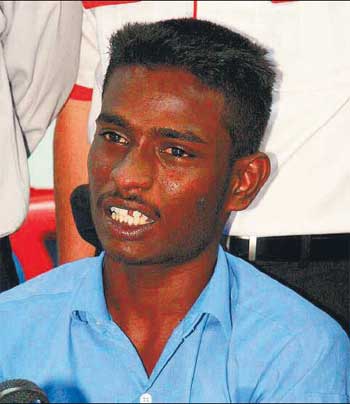
KUALA LUMPUR, Oct 20 (Bernama) — MIC President Datuk Seri S. Samy Vellu today praised S. Krishnamoorthy for rescuing several passengers from the ferry which caught fire and sank near Tioman Island on Oct 13. The Works Minister congratulated the 19-year-old wireman for saving the lives of the survivors. "He is a very courageous young man who deserves to be made a role model by Malaysians, especially the youths," he said in a statement.

Krishnamoorthy was showered with accolades for his heroism by 18 survivors of the "Seagull Express 2" ferry during a press conference in Klang yesterday. The teenager who saved dozens, including six children, also received RM800 from businessman M. Pandian, and was garlanded by survivors, politicians, and Group of Concerned Citizens co-ordinator Charles Santiago.

One of the survivors, Ng Soon Tiong, saw Krishnamoorty handing out life jackets to passengers and helping children off the burning ferry. He also said Krishnamoorthy repeatedly dived into the water to pull others to safety. Ng, 41, said Krishnamoorthy saved the lives of his two sons, aged 7, and 9, as well as the lives of his other relatives. "Many of us are alive today because of him. We are greatly indebted to him," Ng added.

Samy Vellu said he would ask the MIC Youth to contact Krishnamoorthy to make him a role model for the youths to emulate. "There is a lot they can learn from this young man. He has touched the hearts of many Malaysians through his heroic act," he added.

Krishnamoorthy the hero who saved dozens

source

Krishnamoorthy

Krishnamoorthy, 19, was praised for his heroism in saving dozens of passengers during the fire on board the Seagull Express 2 ferry.

KLANG: Wireman S. Krishnamoorthy, 19, was showered with accolades for his heroism by 18 survivors of the Seagull Express 2 ferry fire during a press conference yesterday. 

The teenager who saved dozens, including six children, also received RM800 from businessman M. Pandian, and was garlanded by survivors, politicians and Group of Concerned Citizens co-ordinator, Charles Santiago. Santiago said the youth’s heroism was a shining example to all Malaysians.

A survivor, Ng Soon Tiong, 41, said he saw Krishnamoorthy selflessly handing out lifejackets to other passengers and helping children off the burning ferry.He also said Krishnamoorthy repeatedly dived into the water to pull others to safety.Ng added that Krishnamoorthy saved the lives of his two sons, aged 7 and 9, as well as the lives of several other relatives. “Many of us are alive today because of him. We are all greatly indebted to him,” he added. Krishnamoorthy said his main concern was for the children. “I tried my best to save as many as I could, but I found myself struggling to stay afloat because my jeans had become saturated with water,” he said.Despite this, however, he still managed to help many board other vessels which arrived during the rescue.He said that besides not having enough life jackets, the ferry crew failed to deploy the life rafts hung on the upper decks of the vessel. The crew abandoned the passengers, he added.

Young electrician helped fellow passengers stay afloat

source

MERSING: For what seemed like an eternity, C. Krishnamoorthy struggled in the choppy waters of the South China Sea, helping fellow passengers to safety. Krishnamoorthy, 19, was among the 106 people who had jumped overboard when the ferry they were in caught fire. 

Krishnamoorthy
Krishnamoorthy: ‘I had to swim back and forth to bring the ropes to some passengers’

“Not everyone managed to get hold of a life vest, so I tried to keep those who were struggling to stay afloat,” he said. About 30 minutes later, passing ferries and boats went to their aid. “The people on board threw ropes and floats to us, but we were too far away because they kept a distance as they were  afraid our ferry would explode. “So I had to swim back and forth to bring the ropes to some passengers so that they could be pulled to safety,” said the electrician. 

The lad from Klang said he jumped three times into the sea after he was pulled to safety to help those who were on the verge of drowning. What was remarkable was that Krishnamoorthy never underwent swimming lessons . 

National Plan on Unity and Integration – What’s Missing

May 13th, 2007
|  Subscribe in a reader | Subscribe to poobalan.com by Email


Below are the important points in the Plan launched yesterday. Let’s see what’s missing?
– places of worship for the second class citizens not mentioned – plan to implemented by ministries and govt agencies – which are 90% of one race. How can it be successful when the implementors are not well balanced in terms of racial composition? Should be implemented by independent commission. – most programs are already in place for long time, so nothing new.
Positive inputs: – addition of Sabah/Sarawak culture and elements. more integration with them – proposal of teaching of language of major race groups in school
anything to add?

Spotlight: Breaking down the barriers By : ELIZABETH JOHN, TAN CHOE CHOE and R. YASOTHAI
http://www.nst.com.my/Current_News/NST/Sunday/National/20070513075342/Article/index_html
Malaysians have got their work cut out for them when it comes to making the National Unity and Integration Action Plan happen, write ELIZABETH JOHN, TAN CHOE CHOE and R. YASOTHAI
Something sweeter than an ice-cream is in the offing. The plan is an attempt to break down barriers between races and close the divide among regions in Malaysia.
FROM classroom to concert hall, there will be a single recurring theme over the next four years — national unity.
It will appear in schools, in subjects about Malaysia’s many cultures and customs. It will be clear in the look and content of television and radio programmes.
And it will be fostered through the efforts of 18 ministries, state governments and 22 public agencies up to the year 2010. This is the National Unity and Integration Action Plan, which took effect after the cabinet approved it in May last year.
The ambitious plan is an attempt to break down the barriers between races, Malaysians in the penisula and Sabah and Sarawak, and close the divide among regions in the peninsula It recommends almost 200 strategies and lists hundreds of activities that agencies could implement.
The most commonly recommended activities for all ministries and agencies are old favourites — talks, forums and campaigns.
These are employed for every purpose from creating a better understanding of cultures to stressing the importance of national unity.
Much of the plan’s focus is on increasing the public’s knowledge and appreciation of cultures and customs, the federal constitution and the Rukun Negara.
Many of the programmes, like the Social Action Master Plan and Local Agenda 21, have been in place for years.
The action plan now expects agencies to get serious about making them work and bring people together.
Some like the Human Resources Ministry will basically continue doing what they have been all the while, which is creating a workforce responsive to changes and helping to maintain harmonious relations between employers and employees.
But many new ideas have also been put forward and they include inter-faith dialogues, social impact assessments of government policies and educating parents and teachers on multi-racialism.
The lead agency — the National Unity and Integration Department — bears the biggest burden under the plan.
It will have to realise a vastly diverse set of programmes ranging from food festivals to creating role models in society.
Some of its work will overlap with those of the Education, Higher Education, Information and Culture, Arts and Heritage ministries.
Where it differs the most from other agencies is in its focus on fostering neighbourliness.
It will set up a task force to identify local issues and find solutions, hold direct dialogue with communities and launch a “My Neighbour, My Family” campaign.
The department will expand and increase volunteer neighbourhood patrol schemes to help fight crime in housing areas nationwide.
All these are aspects of the 2006-2010 Rukun Tetangga Action Plan meant to complement the unity plan. Under the action plan that will ring up a bill of RM257 million over five years, the department proposes to:
• Triple the number of volunteer patrol schemes, from 498 last August, to 1,700 in 2010.
• Increase the number of Rukun Tetangga (RT) areas by 200 a year. Till last August, there were 3,272 RT areas in the country.
• Raise the allocation for each RT to RM10,200 — close to double of what it has been given so far.
• Equip community and RT leaders with mediation skills to help them resolve problems.
• Get communities to share information and grow closer by expanding the RT Net programme.
• Set up new economic opportunities at the RT level.
• Get RTs to host exchange students from other states.
• Build new activity centres, unity complexes and RT centres.
The plan also recommends practical strategies like setting up more federal government agency branches in districts and standardising the administration system in the Peninsular Malaysia and Sabah and Sarawak.
Ministries are also expected to focus development in margi-nalised districts and increase the income sources for those in the rural areas to close the income gap.
It has several agencies working on an early detection system for conflicts and discourages the setting up of organisations that champion only one race or religion to the detriment of national unity.
Some actions have also been proposed to ensure companies’ policies and programmes contain elements of national unity and all races are employed in every field of work.