
Archive for the ‘BornInMalaysia’ category

Malaysia ranks high in peacefulness and safety

June 20th, 2011
|  Subscribe in a reader | Subscribe to poobalan.com by Email


Two, yes TWO, good news recently that puts us high on the positive side.

First, we are among the top countries in the Global Peace Index, number 19th to be exact. Let’s see what our DG of National Unity and Integration Department says:

Malaysia leads Asean countries and ranks second in Asia, after Japan, in the list of countries which succeed in maintaining unity among their people.

National Unity and Integration Department director-general Azman Azmin Hassan said that based on the list issued by the Global Peace Index, Malaysia was at 19th position among the countries in the world.

“The country’s success in fostering unity has attracted the world to learn how Malaysia does it.

“This is due to the capability of the country’s leaders in maintaining unity among the people of various races, resulting in Malaysia being invited by the United Nations to table a working paper on unity in New York next month.”

He told this to reporters after the opening of the state-level Unity Week 2011 celebration at the Air Tawar Beach Resort in Besut today by State Health, Unity and Consumer Affairs Committee chairman Dr A Rahman Mokhtar.

Azman said that with such a recognition given to Malaysia, there was no doubt about the peaceful situation in the country.

Hence, he advised the people to maintain racial harmony in the country and to cooperate with the government to avoid any incident that could jeopardise the harmonious situation.

source: http://www.malaysiakini.com/news/167333

Readers should then head to http://en.wikipedia.org/wiki/Global_Peace_Index to read about this index.

The GPI’s website is at http://www.visionofhumanity.org/gpi-data/#/2011/conf/ and Malaysia’s details is at http://www.visionofhumanity.org/gpi-data/#/2011/scor/MY/detail as below:


PEACE INDICATORS SCORE
Number of external and internal conflicts fought 1
Estimated number of deaths from organised conflict (external) 1
Number of deaths from organised conflict (internal) 1
Level of organized conflict (internal) 1
Relations with neighbouring countries 1
Level of perceived criminality in society 2
Number of displaced people as a percentage of the population 1
Political instability 1.5
Level of disrespect for human rights 2
Potential for terriorist acts 2
Number of homicides per 100,000 people 2
Level of violent crime 2
Likelihood of violent demonstrations 3
Number of jailed population per 100,000 people 1.5
Number of internal security officers and police 100,000 people 2
Military expenditure as a percentage of GDP 1.5
Number of armed services personnel per 100,000 people 1
Exports of major conventional weapons per 100,000 people 1
Imports of major conventional weapons per 100,000 people 1.5
Funding for UN peacekeeping missions 1
Aggregate weighted number of heavy weapons per 100,000 people 1
Ease of access to small arms and light weapons 1
Military capability/sophistication 3


Malaysia has been improving steadily over the years. This due to mainly our non-involvement in wars (external or internal) for the citizens, lower values for defence/military related indicators (except military capability).

As mentioned in the article above, we are number 2 (just behind Japan) in Asia and 19th in the world.

Next good news, The World Justice Project’s Rule of Law index says :

The World Justice Project’s (WJP) Rule of Law Index 2011 report revealed that Malaysia was ranked first among 19 upper-middle income countries for safety, putting the country on par with other nations such as France and Belgium.

Malaysia attained 12th position, one position ahead of United States which ranked 13th and Britain ranked 14th in country’s safety.

WJP Rule of Law Index director Juan Botero said the index measures implementation and enforcement of laws in practice and their effects on people’s lives.

The report showed that Malaysia scored 1 for effectively limited civil conflicts and 0.5 for the absence of crime and people not resorting to violence.

The Index score range is between 0 being the lowest and 1 being the highest.

WJP executive director Hongxia Liu said that acquiring the rule of law was an ongoing challenge and a continuous work in progress in all countries.

Liu added the Index is not designed to shame or blame but to provide helpful benchmarks for other countries in the same regions that had similar legal cultures and income levels.

source: http://www.thestar.com.my/news/story.asp?file=/2011/6/20/nation/8925273&sec=nation

You can read the report of this index at http://worldjusticeproject.org/sites/default/files/wjproli2011_0.pdf (Malaysia’s statistics is on page 78).


Yes, we are 1st among the 19 countries with similar income, but overall we are somewhere in the middle.

??
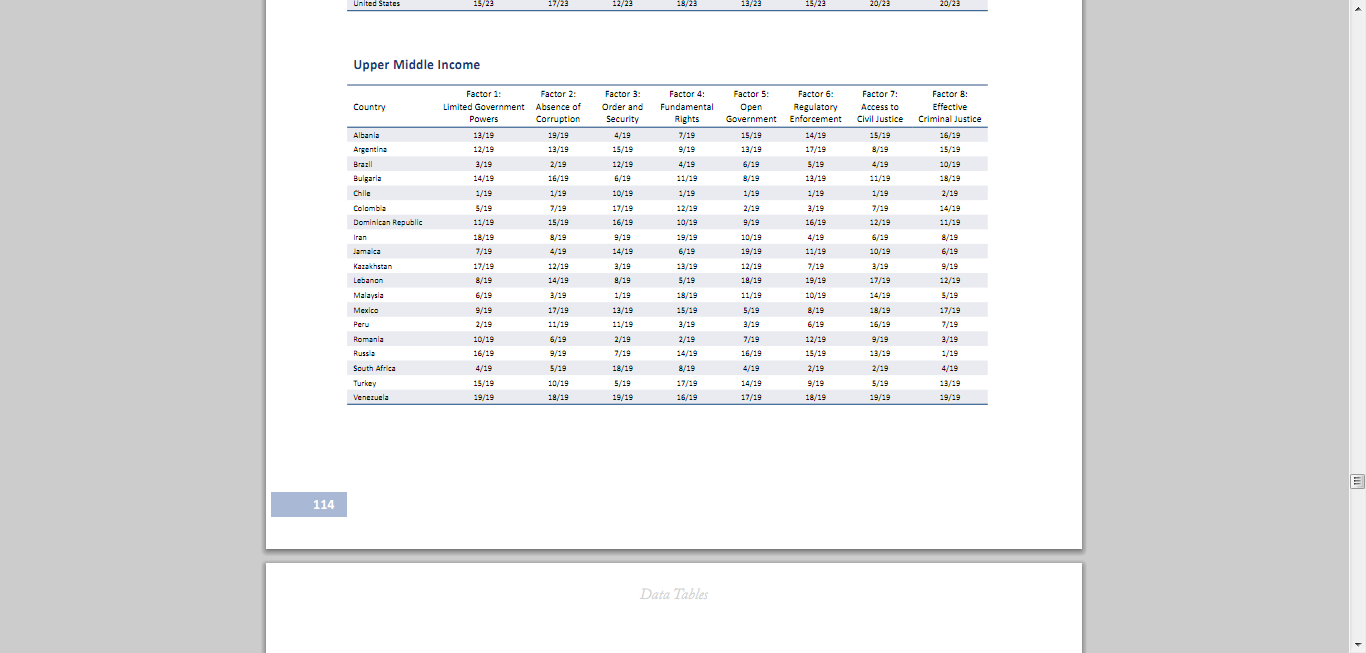
Oh, you may want to read page 29 of the report as well:

As with many other countries in the region, Malaysia  presents a contrasting view. Compared with other upper-middle income countries, Malaysia’s government is relatively accountable, although corruption, political interference, and impunity still exist. The efficiency and transparency of government agencies can still improve, and efforts should also be made in the area of access to justice (ranking 44th globally, and 14th in the upper-middle income group). The country is safe, ranking 1stamong 19 income peers and on a par with countries such as France and Belgium. However, abuses by the police still occur. Of particular concern is the situation posed by violations of fundamental rights, where Malaysia ranks 59th out of 66 countries.

So we are doing not bad, but why Jobstreet survey says nearly 80% of the interviewees (700 of them) would work abroad if got the chance:

An online recruitment company said results from a survey on local jobseekers confirm that money, career growth and children’s education are the main factors behind the country’s brain drain.

JobStreet.com today released the results of their survey of 700 over respondents – over 80 percent of whom are in middle to senior positions – on their interests in working abroad, and the reasons behind it.

The survey revealed just under a third (33 percent) of the respondents are already actively seeking overseas employment while 30 percent are passively looking. Another 30 percent are still weighing the pros and cons of working abroad.

42 percent cited better income as the key reason for their choice, while 24 percent cited career advancement, and 13 percent were thinking of their children’s education. 

Unfortunately for the government and the Talent Corp, only 2.4 of the respondents said they were staying in the country to “contribute to national interest”.

Over half said they were not working abroad mainly because of their families.

Top in destinations for job seeking was Australia (24 percent) followed by Singapore (16 percent), followed by UK (15 percent), US (10 percent), Far East (8 percent) and New Zealand (7 percent).

The survey, conducted in May, comprised 40 percent senior executives, 29 percent managers and 16 percent senior managers, with junior executives making up the rest. 

Jobstreet said 60 percent were male and 40 percent female, while ethnic breakdown was not cited.

source: http://www.malaysiakini.com/news/167446

I guess the indices may not translate into a good environment in terms of wealth accumulation or career opportunities for those interviewed.

PS: I guess it will be similar next year.


Pos Malaysia to withdraw stamps over Tamil blunder

June 19th, 2011
|  Subscribe in a reader | Subscribe to poobalan.com by Email


The issue is about recent Nilai-Nilai Murni (Virtues) stamps edition missing the Tamil version while other languages were prominently figured. At least Pos Malaysia took the step to recall the stamps and rectify the oversight.


WITH reference to “Group angry that Tamil not used in first day covers” (The Star Online, June 15), we acknowlege that the words featured in the stamp, depicting Kesyukuran (Thankfulness), included English, Bahasa Malaysia, Mandarin and Hindi.

Pos Malaysia would like to clarify that the inclusion of the Hindi word featured in the stamp depicting Kesyukuran was an inadvertent error on the part of the issuing committee.

Therefore, Pos Malaysia will be recalling all the Nilai-Nilai Murni (Values) stamps and will reissue the stamps to include the Tamil word forKesyukuran.

DATUK ROHAIZA HASHIM,

Group Head, Corporate Communications,

Pos Malaysia Bhd.

source:  http://thestar.com.my/news/story.asp?file=/2011/6/18/focus/8925416&sec=focus

No Tamil word on POS Malaysia virtues stamp

June 15th, 2011
|  Subscribe in a reader | Subscribe to poobalan.com by Email


Interesting question. There’s some sort of Hindi-like characters in the stamp. Probably a case of mistaken identity or Hindi movie influence? Maybe they don’t have any Indian (Tamil) staff.

So, will guardian of Indian community follow up on this obvious gross negligence of the 1Malaysia concept?


[click to enlarge]


Tamil Nesan reported that the Taiping Tamilar Sangam had voiced dissatisfaction over Pos Malaysia Berhad’s failure to include Tamil in its recent release of first day covers promoting noble human values.

Its president M.S. Mayadevan said that he was surprised that one of the 10 stamps released had the words terima kasih in Bahasa Malaysia and the same word in other languages like English, Chinese and Hindi but not a single word in Tamil.

He said that Pos Malaysia should have accorded proper recognition to the role of Tamil.

He urged MIC to highlight the matter.

source: http://thestar.com.my/news/story.asp?file=/2011/6/15/nation/8899723&sec=nation


Who stays in PPR flats?

June 14th, 2011
|  Subscribe in a reader | Subscribe to poobalan.com by Email


I passed by few of the low cost flats in KL area. Indeed, some of them have really expensive cars parked in their compounds. Maybe its time some sort of occupant audit is done to verify if they are eligble for these flats.

Part of the problem is due to relocating squatters or those displaced from plantations. I guess you have to discount these type of occupants. Not sure if the government informed them that they need to pay after being relocated. Or maybe they think since they were displaced, they need not pay any rent in the new place.


MERCEDES Benz, LCD television sets, laptops, computers, air-conditioning, wallpaper, wall-to-wall carpeting, marble tiles, these and more can be found in numerous units of people’s housing schemes (PPR) in Kuala Lumpur.

The low-cost housing schemes are built to re-house squatters and for the urban poor, however about 70% of those living in the units do not fall below the poverty line.

Thousands of residents living in these government housing schemes are living in luxury with some owning cars like Mercedes and Honda Civic.

A check by StarMetro at many of the public low-cost flats in the city revealed that at least 80% have Astro, while many have air-conditioners installed.

In the units at PPR Seri Alam in Sungei Besi, owners had made extensive renovations.

The floors have been re-tiled with marble, the toilet doors were changed to foldable ones, while the kitchen area was upgraded to a dry and wet kitchen.

In another unit the owner had installed air-conditioning for both of the rooms. Both rooms also had computers. Some units had been decorated with wallpaper while there is even a unit which had wall carpets installed.

A resident, who did not want to be named, said he was waiting for the government to offer the units for free.

A tenant renting a shop in the same PPR owed DBKL RM15,000 in rental. The shop has since been shut down with the owners no where in sight.

“I have not paid a single month’s rent since I moved into a PPR 10 years ago,’’ said a tenant from PPR Desa Tun Razak.

A PPR Kg Muhibbah resident, who owed City Hall about RM7,000 in rental, said: “I have not paid for years and they (DBKL) will never kick me out.’’

“DBKL offered me a unit on condition that I pay up all rental owed to them. But why should I? It’s been free all along and why would I want to take a loan and buy it now,’’ he added.


source: http://thestar.com.my/metro/story.asp?file=/2011/6/14/central/8886425&sec=central

It costs DBKL lots of money obviously!


Residents living in government low-cost housing owe City Hall millions of ringgit in rent. Kuala Lumpur mayor Tan Sri Ahmad Fuad Ismail said 70% of these recalcitrant tenants can easily afford to pay yet refuse to do so.

ERRANT tenants living in public low-cost flats owe Kuala Lumpur City Hall (DBKL) more than RM57mil and the figure does not include the RM25mil which is written off as bad debt because the local authority is unable to collect rental from those who absconded.

The highest owed by a tenant from PPR Kg Limau is RM35,581 — rent accumulated since the early 1980’s, while another who is renting a shoplot in PPR Desa Tun Razak owes RM36,171.

About 2,000 tenants of Desa Rejang low-cost housing in Setapak owed the highest amount in rental and water arrears of RM4,566,517.

KL mayor Tan Sri Ahmad Fuad Ismail said 70% of those owing rent were recalcitrant tenants who could afford to pay, yet refused to do so.

A total of 52,851 low-cost units are being rented out and 36,995 tenants have rental arrears.

Ahmad Fuad said most of these tenants were squatters relocated from various slum areas in the city into government low-cost flats.

“The government has good intention when they re-housed these people under the zero-squatter policy, but the squatters do not appreciate their new environment where their mindset is used to having everything for free,’’ he said.

Fuad added that Malaysia was the only country in the world where the government provided homes for poor residents at a low rate of between RM90 and RM124 per month.

“You will never get such comfortable units with basic facilities like this in Tokyo or Taiwan,’’

“The government is even selling these flats located at prime areas at only RM35,000 when the units are easily valued between RM80,000 and RM90,000.

“This is the sacrifice our government is making and people still don’t appreciate their blessings,’’ he said.

Fuad also said about 20,000 poor families had been deprived of buying or renting these low-cost units because they were not eligible as the units had been allocated for squatters.

Some families have been on the waiting list since 2004.

DBKL has about 4,000 vacant units which are offered to squatters pending their relocation exercise.

“There are many families who want to buy and rent these units yet we cannot give it to them because they are not squatters.

“The squatters on the other hand refuse to take up the units as they want the government to give them houses.

“In the end, there are no winners yet DBKL is accused for not being sensitive to the needs of the people,’’ he said.

Perhaps the lack of action against errant tenants has proven to be a disincentive.

The situation is made worse by the fact that residents can still have a place to sleep comfortably even when they fail to pay the monthly rental.

The scenario is only getting worse as the figures of unpaid rental is increasing each year.

Last year, the figure of unpaid rental had reached an all-time-high of RM17,326,663.

For the first three months this year, RM6,709,319 in rental is owed to DBKL.

According to figures provided by DBKL, revenue from rental of PPR units last year is RM78.6mil while maintenance cost was a whopping RM158.5mil.

It costs DBKL more money to maintain the units than to rent them out. The rental per unit is RM124 while it costs them RM250 to maintain one unit per month.

Clearly, the city has to find a solution soon to resolve the problem or else it is the taxpayers who will continue to bear the brunt.

source: http://thestar.com.my/metro/story.asp?file=/2011/6/14/central/8886166&sec=central


Curfew for those below 18

June 13th, 2011
|  Subscribe in a reader | Subscribe to poobalan.com by Email


I agree with the suggestion. Sometimes coming back home late, I notice kids cycling in groups and I wonder what are they doing out of their homes at late night. I see kids hanging out near 7-11 shops, burger stall, along the roadside, near monsoon drains, at bus stops. Where are the parents or guardian? Are these street kids? Or lack attention from parents? Or rebellious? Or bored at home? (I remember reading about Mat Sikal in Malacca recently).

Well, even if you have a valid reason – like coming back from tuition class – its still better to have guardian to fetch you or accompany you.

Of course, this won’t reduce crime rates drastically, but I believe it will help in deterring increase in social ills and crimes. Crime happens all the time, yes, but having our kids safely indoors by certain time reduces their possibility of being involved in criminal activities or accidents.  It goes without saying that you need someone at home to keep an eye. If not, the crime can happen at home! In other words, the parents or guardian need to be constantly monitoring their brood, which in our currently lifestyle and economic pressure, is difficult.

This reflects the kind of place we are living in – a dangerous place. Safety is a big concern due to organised crimes, gangsterism, foreigners, local folks aiming for a fast buck, drug addicts, snatch thieves, rapists, molesters, acid splashers, straying husbands (and wives who caused it, according to OWC – OK, I’m straying off-topic here) etc.

The curfew would be similar with the current practice of hauling up students loitering in cybercafe or shopping centers during school time.

Question is, do have enough enforcement capability? Most of the time the police busy manning roadblocks, or breaking up protests or helping out at by-elections.  Rela? Not sure if can trust them fully with children and teenagers. Perhaps Jabatan Kebajikan should set up a new division for this purpose. Or mobilise Rukun Tetangga, mosque/temple/church committees, RAs to be “enforcers”.


Kalabakan MP Ghapur Salleh wants the federal government to impose a curfew on teenagers under 18 for their own safety.

He said that teenagers under 18 years should be banned from hanging out in public places after 10pm without parental guidance.

He said that it would help reduce crimes and social ills.

“I have already tabled the proposal in Parliament but I have not received a definitive answer yet,” he said.

Expressing his concerns over the current lifestyles of teenagers, he said the high numbers of those caught for crimes and social ills was worrying.

“Banning teenagers from loitering outside their homes after 10pm would be helpful.

“Our country has no monitoring system to prohibit teenagers from going out at night. Introducing a curfew system will help curb social ills.”

Educating parents

Ghapur cited Australia which had successfully introduced the curfew system banning teenagers, aged 13 to 16, from leaving their homes without being accompanied by their parents.

Teenagers found flouting the rule, introduced in the early 2000s, are hauled up by the police and taken to the station. They would only be released when their parents come to fetch them.

The Australian government has said the move was aimed at countering the increasing number of teenagers who were found “drinking, using drugs and sniffing glue”.

A similar order was also issued in Thailand in 2007. Bangkok’s metropolitan police reportedly issued a directive prohibiting children under 18 from leaving their homes after 10pm without justified reasons.

The ban was aimed at preventing youths from hanging out at night and committing crime or becoming crime victims.

Teenagers caught hanging out at night in Bangkok without valid reasons would be taken to the police stations where their statements would be recorded. Their parents would be called to pick them up.

Ghapur, however, felt that the Australian system was sufficient to educate parents and control the teenagers.

“I believe we need a system like the one in Australia… it will help educate parents to be more sensitive.

“Teenagers who are brought to the police station would only be released once their parents come,” he said, adding that parents must be alert to their children’s movement.

Frightening reality

In August last year, an online report quoted Bukit Aman CID chief Bakri Zinin as saying that in 2009, police recorded 6,048 juvenile criminal cases compared with 5,114 in 2007.

Staggering still was the fact that 208 rapes cases and six murders were committed by teenagers between 13 and 15 years old.

Teenagers, aged between 16 and 18, committed 616 rapes and 47 murders, according to the statistics, and these numbers are known to be just the tip of the iceberg.

Social workers note that many incidents of rape go unreported in Malaysia for fear of the perpetrators.

Many also believe that delinquencies begin at school in the form of truancy, smoking and vandalism.


source: http://www.freemalaysiatoday.com/2011/06/04/slap-curfew-on-teenagers-to-keep-them-safe/