
Posts Tagged ‘Economy’

Plantation workers earn higher than poverty line

July 17th, 2008
|  Subscribe in a reader | Subscribe to poobalan.com by Email


This is an interesting news because last year May, there was an increment of about 9 percent in the plantation workers’ wage under new collective agreement signed between NUPM and MAPA. The lowest a field worker can earn will be between RM500 and RM600.

Now, senator Kohilan who is the Plantation Industries and Commodities Deputy Minister says, on average an oil palm or rubber plantation general worker now earned RM750 a month while an oil palm harvester about RM1,100 a month, which is above the rural poverty line of RM740.

Actually poverty rate in Peninsular is RM691 and as far as I know have not been reviewed yet. for rural area, poverty line was found to be RM698. There are some others who indicate poverty rate to be about RM680. Some states also calculate their own poverty line, like Selangor who increased it to be RM1500. This means that workers are earning higher than the poverty line of RM691.

He further adds that:

Most plantation workers also do not have to spend on house rental,
medical charges (at the clinics) and pre-school education for their
children as all these facilities are provided by the plantation
management

What he says is true, but plantation workers (locals) have to think about the future – means they have to buy a house and service the loan. Groceries and education cost increases. These workers, like any other, must consider taking insurance for their children. Traveling, clothing, vacation and entertainment cost increases. I consider these new “expenses” as necessity since we are moving towards developed, progressive, and knowledge-based society.

I hope to see poverty line to be increased to a suitable amount that considers the need of 5 family members in current economic and social settings. Maybe to RM1200 or 1800 even.
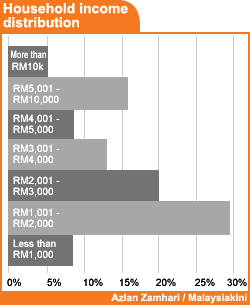
Household income distribution

July 9th, 2008
|  Subscribe in a reader | Subscribe to poobalan.com by Email


Dr Michael J Devaraj (conqueror of Samy Vellu), MP for Sungai Siput was praised by the Assembly Speaker recently as among the MPs who ask good questions. He asked the following today:

My question is, why did the government stress the disparities between ethnic groups while staying silent on the inequalities between the rich and the poor within every ethnic group which contributes by far to inequalities generally?

This was in response to MP Amirsham’s reply on the income distribution for households.

householdincome.gif

Taken from Malaysiakini.
– 8.6 percent of households earn below RM1,000
– 29.4 percent of households earn between RM1,000 and RM2,000
– meaning, 38 percent of households in Malaysia earn RM2,000 and below.

– 19.8 percent of households are in the RM2001-RM3,000 income bracket
– RM3,001-RM4,000 (12.9 percent)
– RM4,001-RM5,000 (8.6 precent)
– meaning, 41.3 percent are in the RM2000-RM5000 bracket

– about 20.7 percent of households earn more than RM5,000 a month
– RM5,001-RM10,000 (15.8 percent)
– above RM10,000 (4.9 percent).

The source and period of the statistics is not provided, but it should be not before 2004 and not later than 2007. The number of households is also not provided.

Looking at the results, we have 38% of household earning RM2000 and below. If a household has 4 people, it will be diffcult to live in urban area. Nearly 58% of the households earn RM3000 and below.

With poverty line set at RM600-RM700 range, we can understand why the poverty rate is low. Unfortunately, the income is always insufficient to match the ever increasing cost of living. If poverty line is increased to RM1000, then 8.6% of the households will be poor. However there have been calls to increase poverty rate to RM1500, which may reveal that up to 24% of the household are poor.

Another issue is that many are resorting to part-time or second (and even third) jobs to supplement income. These are usually not revealed or reported in order to avoid taxation, punishment (by employer), or to purposely show their “poverty”.

Anyway, I’m not sure if household income is a good parameter. Individual income statistics should be tabulated as well.

single mothers forced to put children in orphanages

July 8th, 2008
|  Subscribe in a reader | Subscribe to poobalan.com by Email


More of these cases will come to light soon, not only in Penang but all over the country.  MHS and other organizations will be facing more such requests, and hopefully they will be able to generate more funds. Even the expenses for the family paid for by UMIC has increased quite substantially.

MHS should also provide feedback if they approached the EXCO in charge of welfare and the response. The article states Prof Ramasamy’s reply to MHS’s suggestion to set up ration shops, but no indication if MHS approached him or the media interviewed him separately.

The rising cost of living has forced three single mothers in Penang to find help to place six of their children in orphanages. Last week, the three – two from the island and one from Butterworth – approached the Malaysia Hindu Sangam to find a home for their children.

“Each woman has between three and five children and each is sending two children to an orphanage to lighten her financial burden,” the organisation’s Penang branch Social and Welfare Committee head P. Murugiah told The Star yesterday.  He said one mother was jobless, another was earning RM350 a month doing odd jobs while the third earned RM600 a month as a factory worker.

Murugiah said some heads of hardcore poor families have also approached the association for help to place their parents in old folks home.  “They are having problems providing meals for their parents and taking care of their medical expenses,” he said.

Murugiah said the hardcore poor have been severely affected by the recent hike in fuel and food prices.  Citing examples, he said the price of atta flour has increased from RM1.80 per kilo in December to RM2.80 while cooking oil (2kg bottle) has gone up from RM4.50 to RM6.20.  Murugiah said the price of dhal has increased from RM2.80 to RM4.60 per kilo while a brand of the cheapest milk powder has increased from RM9 in January to RM19.50.

He proposed that the state government open ration shops such as being practised in some countries to lighten the burden of the hardcore poor. “The prices of food items sold in ration shops can be subsidised up to 80% by the government. Penang should set up such outlets in line with the Penang Leads tag,” he said.

Deputy Chief Minister II Dr P. Ramasamy said the state would consider the proposal. “It is a good suggestion but we will have to consider the financial implications.  “The state is already helping hardcore poor families by giving free rice. We are planning to give water rebates to this group and studying other means to help them,” he said.

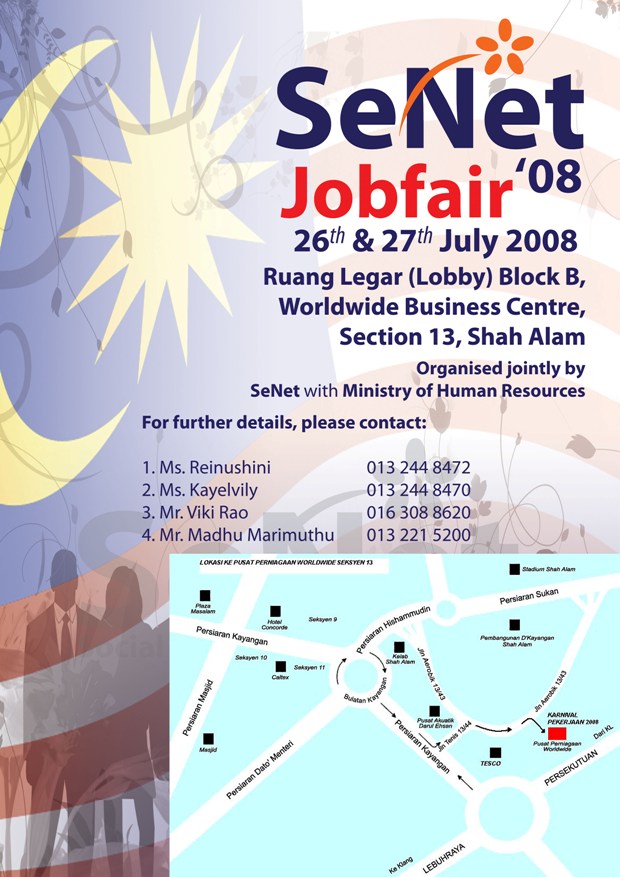
SeNet Job Fair at Shah Alam

July 7th, 2008
|  Subscribe in a reader | Subscribe to poobalan.com by Email


Click for bigger image

Senet Job Fair Shah alam 2008

Barber training by Giatmara

July 6th, 2008
|  Subscribe in a reader | Subscribe to poobalan.com by Email


We can see that many Indian barbers are actually foreigners. Just like the many food stalls being operated by Indonesians, Vietnamese, Filipinos, Myanmar, Nepalese, and China and Indian nationals. Due to the link between job and caste in the Indian culture, not many will easily venture into this occupation. However, times are changing and hopefully more youths take up this job – the income is good, especially if one can provide more than just basic haircut.

Due to the dominance of foreign Indian barbers and lack of participation by locals, Giatmara is planning to start courses for youths to be barbers. If I remember correctly, certain amount of places are allocated for Indian community, so those interested should make use of this opportunity. However, what worries me is the statement below:

We hope to produce qualified Malay barbers who can later expand their business which is now dominated by Indians,” Ayub said at the graduation ceremony of 325 Giatmara students from 10 centres in Penang at its Permatang Pauh centre here on Wednesday.

Ayub is the Curriculum Development Department head, Ayub Hamat. He added that:

He said the income of barbers was very lucrative and this had prompted many foreigners, especially Indian nationals, to take up the job. Ayub said a barber who owned a shop can earn up to RM5,000 monthly.

So, not sure if these courses will be opened to Indians. Secondly, whether Indian youths will be impeded by their cultural beliefs even if these courses are opened up.

Meanwhile, the Penang Maruthuvar Sangam (Penang Hairdressers Association) is also providing free training to Malaysians to help overcome the shortage of local Indian barbers.