
Posts Tagged ‘Economy’

Merdeka Center survey shows lowest rating for Prime Minister

August 4th, 2008
|  Subscribe in a reader | Subscribe to poobalan.com by Email


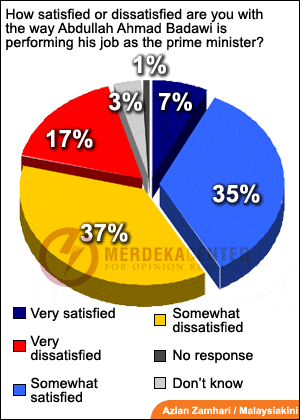
Previous Merdeka Center’s opinion poll results will usually come out in the Star or NST, but this time I did not read about it. This news was covered in Malaysiakini. Not surprising that it was missing in main stream media because it shows that only 42% of the polled people said that approved/satisfied with Prime Minister Badawi. This is even lower than pre-elections times and a huge drop from the 91% popularity he had in 2004. This means more people are unhappy than happy.


Few areas were covered in the poll, among them Najib’s suitabilty as next PM, satistifaction with BN and PR government fulfilling election promises, view on economy, and general outlook on the country’s direction.


The opinion poll, 2nd Quarter 2008 Peninsular Malaysia Voter Opinion Survey was between 4th and 14th July 2008 to gauge voters’ perceptions of current issues, the state of the economy and leadership. Some extracts from the summary:

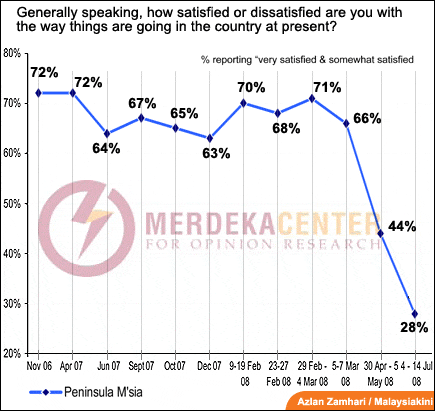
The survey reveals a large majority also indicated that they perceived the country was going in the wrong direction – based on only 28% who felt satisfied with the way things are going in the country. This may be in part due to a deepening concern over the state of the economy as a majority (59%), were worried over economic related issues followed by 10% who cited political issues as being most important.

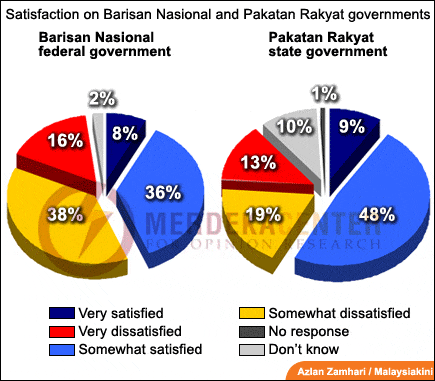
With respect to views on political parties and leaders, in two mutually exclusive questions, the survey found 44% of Peninsular Malaysia voters were satisfied with the Barisan Nasional while 57% report being satisfied with Pakatan Rakyat.

The poll also found 42% of voters reported satisfaction with Dato’ Seri Abdullah Ahmad Badawi’s performance as prime minister.

With respect to Dato’ Seri Anwar Ibrahim, the survey found that only 11% believed in the allegation of sexual misconduct while 66% agreed that it “was a politically motivated action to disrupt Anwar Ibrahim’s political career”. The survey also found that public confidence towards institutions likely to be involved in handling the matter to be
relatively low with not more than 33% citing confidence.

According to the center, the Peninsular Malaysia wide telephone survey of 1030 randomly selected Malaysian registered voters was carried out between 4th and 14th July 2008, and funded via internally generated resources. Respondents were selected using the random,stratified sampling method and structured along the national electorate profile and specifically proportional to gender, ethnicity, and state of residence.


Merdeka Center’s press release (PDF) is available on their website, but for those who are more visually inclined, Malaysiakini provided some nice graphics, but its good to read the full report to get a proper insight. So let’s have a look at them:


pollpmjuly.gif


That means total of satisfied (very and somewhat) respondents (7+35) is 42%, total of dissatisfied  (very and somewhat) respondents is (37+17) is 54% and the balance 4% is no response/don’t know category.


pollbnpr.gif


That means for federal BN, total of satisfied (very and somewhat) respondents (8+36) is 44%, total of dissatisfied (very and somewhat) respondents is (38+16) is 54% and the balance 2% is no response/don’t know category.

For state PR, total of satisfied (very and somewhat) respondents (9+48) is 57%, total of dissatisfied (very and somewhat) respondents is (19+13) is 32% and the balance 11% is no response/don’t know category.



polleconomyjuly.gif


That means only 24% of respondents have positive things to say about the economy. 1 in 4 Malaysians surveyed by the poll.


pollgeneraljuly.gif


Less than one third of the respondents are happy with the current situation. Those unhappy can be due to actions of both ruling government and the opposition.

Reader should note that the sampling is only 1030 and from Peninsular Malaysia.

How many RM3 millions for Indians?

July 31st, 2008
|  Subscribe in a reader | Subscribe to poobalan.com by Email


Today, Star reported that TEKUN has allocated RM3 million for young Indians (reproduced at the end).

The Government has allocated RM3 mil to provide financial aid to young Indian entrepreneurs, MIC president Datuk Seri S. Samy Vellu said.

He said that assistance would be channelled through Tekun Nasional, a body under the Ministry of Entrepreneur Development and Cooperatives and the MIC-owned Social Strategic Foundation (YSS).

On 4th June this year, Samy Vellu mentioned that TEKUN had allocated RM3 million as well. Is it the same RM3 million? At that time only 10 out of 300 students from INSKEN had applied for it.

If we go back to 3rd March this year, RM3 million is part of a special allocation by Economic Planning Unit, Prime Minister’s department. This RM3 million had been used as a revolving micro loan fund with Yayasan Tekun. I didn’t say that, Samy Vellu did.

In December 2007, Samy says this: “the Government provided business-training programs to Indian youths through the National Entrepreneur Skills institute while RM3mil has been allocated for business loans for Indians through the Tekun foundation”.

The RM3 million was first mentioned in July 2007 – “The government will also provide a special loan fund totalling RM3 million through Yayasan Tekun for 500 Indian youths to obtain micro business loans”. Yup, by Samy Vellu.

Hmmm…that’s quite a number of “RM3 millions”. Hope they are not the same. If not, it is the same RM3 million being rerun for last one year. But if not many applied, then it doesn’t make much difference does it?

According to TEKUN head Abdul Rahim, Tekun, which was set up in 1998, has already disbursed RM90 mil to bumiputras to develop their business and was expanding it to provide assistance to the Indian youths. He said a decision of the applications would be made within 14 days if all the documents were in order, compared to the previous period of three months.

Tekun would request additional allocation from the government if the RM3 mil allocation was inadequate.

The rest of the articles as follows:

Speaking to reporters after a briefing by Tekun managing director Datuk Abdul Rahim Hassan here Thursday, he said loans of RM10,000 each had been approved for three applications to develop their businesses so far.Samy Vellu said Indians below 40 should use the opportunity to seek the financial assistance from Tekun to upgrade their businesses.

“No one should come and say that the government has not done anything for the Indian community. There are opportunities available,” he said.

Samy Vellu said the MIC and YSS would also organise workshops in the respective states to disseminate the information on Tekun to the youths over the next two months.

inflation is at 7.7 percent

July 24th, 2008
|  Subscribe in a reader | Subscribe to poobalan.com by Email


Our inflation rate used to be the lowest in the region if we used the official value of 2.8 percent. After the fuel price increase and its domino effect across the consumer sector, it was estimated that inflation will double to about 6%. Warning came in the form of May’s inflation which was 3.8% and some like Aseambankers expected it to be between 7.5 and 8 percent for the period July to December.

Today’s major headlines brought the bad news – 7.7 percent for June, and its expected to be the same in July due to increase in electricity tariff. This value is a 27-year high, since 1981’s 10.8 percent.

The substantial rise in the price of petrol and diesel announced by the
Government beginning June 5 is the main reason for the surge, said
Domestic Trade and Consumer Affairs Minister Datuk Shahrir Abdul Samad.

Other figures announced by the minister:

  • CPI for January to June this year had also increased by 3.7% compared
    with the same period last year, which was from 105.1 to 109.
  • Index for food and non-alcoholic beverages for June compared to the
    same month last year showed high percentage change of 10.0% while the
    index for non-food increased by 6.7%.
  • From January to June,
    index for food and non-alcoholic beverages increased by 6.1% and
    non-food 2.6%, while among the groups with high weights were transport
    (+4%), and housing, water, electricity, gas and other fuels (+ 1.4%).
  • The
    6.1% increase in the index for food and non-alcoholic beverages was the
    result of increases in the index for items such as milk, cheese, eggs,
    rice, bread, cereals, meat, vegetables, seafood, fruits, sugar, jam,
    honey, chocolate, confectionary and fats.
  • Among the food items
    that recorded notable increase in the June index were tomatoes, chicken
    eggs, rice, glutinous rice, imported beef, beehoon, dried noodles,
    watermelon, carrots, chicken and wheat flour.

Poverty line index to be calculated annually

July 21st, 2008
|  Subscribe in a reader | Subscribe to poobalan.com by Email


The government had decided that the poverty line index (PLI) will be updated annually
instead of every five years. This is due to changes in the spending
habits of consumers affected by the rise in consumer goods prices and
inflation. This news was announced by Minister in the Prime Minister’s Department Tan Sri
Amirsham Abd Aziz in Dewan Negara. The Consumer Price Index will also be recalculated.

Good news indeed as this information can be used to provide suitable assistance to the poor and the middle class. Currently, poverty line is set at RM 691 and hardcore poverty is set at half of that amount (following international standards). Some states had recently revised the poverty rate, like Selangor which set it to RM1500. Poverty line can different among states, and area (urban/rural).

I estimate a ball park figure of at least RM1200 to be the poverty line in urban area, with Klang Valley, Penang, Kuching, Kota Kinabalu and Johor Bahru poverty line set at RM1500. Rural areas may be around RM800 – RM1000.

Semenyih Estate workers plight

July 17th, 2008
|  Subscribe in a reader | Subscribe to poobalan.com by Email


There was a interesting article in Star (Metro section) reproduced below on the plight of the Semenyih estate workers. There were some photos too. Thanks to Then for pointing out.

Few things I want to say:

1. Estate workers must think about owning a house and not be in comfort of living in quarters thinking its free for life. We can’t compare with Malay community who own lands. Thus estate workers have to put in triple or quadraple effort to own a house and provide education for children.

2. Some of the displaced workers, women especially, in Prang Besar and surrounding areas are now working as cleaners in Putrajaya. The maintenance companies hire these local people

3. I wonder who these people voted for, if they could vote.

BEFORE Putrajaya came into existence, there was the Prang Besar Estate.

While the country’s new federal administrative capital was still a design on the drawing board, hundreds of estate workers had toiled daily in Prang Besar. They tapped rubber and worked in the oil palm plantation, savouring the simple life as they knew it. The creation of Putrajaya opened a new chapter in the nation’s history but closed another. The dramatic change in the landscape from that of a rural estate to a modern city with towering structures best embodies the high price we pay for development.

It also acquainted us with the ugly term known as displacement.

According to statistics from the National Union of Plantation Workers (NUPW), the number of estates in Selangor dwindled from 150 in 1986 to 95 in 2006. Besides Putrajaya, former estates converted to mega development projects include Cyberjaya, the KL International Airport (KLIA), Bernam Valley and the Guthrie Corridor.

With Prang Besar Estate no longer in existence, a majority of the former estate workers were relocated to low-cost flats in Dengkil. The estate they had called home for decades was no more and the close community living is all but a fond memory now.

Rubber tapper Subramaniam Munusamy, 45, of Semenyih Estate, firmly believes that they should be compensated with permanent homes. “Semenyih has been my home for nearly three decades. Following the notice of termination of employment from the landowners five years ago, we were offered flats in Nilai,” he told StarMetro during a recent interview at the estate workers quarters. “But this means starting all over again. We have asked for low-cost houses in Semenyih in recognition of our blood, sweat and tears for a commodity which is fetching high prices in the world market,” Subramaniam said.

Since they stopped working for the Semenyih Estate, Subramaniam and his wife Anjalai Devi Chinalagan, 43, have been tapping rubber on a plot of land belonging to a smallholder for daily wages. Their combined monthly income is barely RM1,300. The couple, who have four children, said they could not retire for at least 20 more years. Like everyone else, they hope to enjoy the comforts of living in a house of their own in the near future. The struggle to gain a permanent roof over their heads began five years ago with little progress to show since.

For retirees like Mariayee Palaniappa, 59, and Munichy Muniandy, 53, their meagre incomes come from picking flowers for which they are paid RM8 per tin.

Estate resident Devi Ganie, 30, meanwhile, takes on odd jobs, leaving her five-year-old son B. Mathialagan in the care of neighbours.

Life is hard but the women share some little joy and comfort through communal living.

Back when it was a functioning estate, the Semenyih Estate was home to 100 Indian families. There are only 16 families left now. The others have left to seek their fortunes elsewhere after obtaining their dues from the landowners.

Meanwhile, a looming threat of displacement currently hangs over the Dunedin Estate workers. Dunedin, located 3km from Semenyih town, is still functioning as an oil palm plantation and, like the Semenyih Estate, was established around a century ago.

According to plantation worker Arumugam Subramaniam, 51, and his wife Sarojini Paramasivam, 44, there is talk of the plantation being sold for development but they have yet to receive any notice from the landowners. “There used to be over 100 families here but only a fraction are left now since the rumours began. If the landowners want us to move, we hope to be provided with houses nearby,” Arumugam said.

“As far as income goes, we are paid daily wages, base pay, cost of living allowance (Cola) and other allowances. It is hard to make sense of the pay slip but basically, my wife and I jointly earn around RM1,250 a month,” he said. “In view of the surge in commodity prices and inflation, the Malaysian Agricultural Producers Association (Mapa) should increase the Cola while the NUPW should push for a higher minimum wage,” he said.

Retiree Baby Angamuthu, 57, in reminiscing how life in the estate was 50 years ago, said that little had changed in the estate community all these years. “We are still living in deplorable conditions although oil palm is a priceless commodity. Some of the quarters are infested with termites, the drainage system is poor and dengue is a constant threat,” she said, cuddling her seven-month-old grandson Thinakaran Murugan.

At present, the future looks bleak for the young generation but parents like Subramaniam and Arumugam realize the importance of education and have sent their children to school. They hope that their children, armed with an education, could leave the estates to work, and break the cycle of poverty.

Parti Sosialis Malaysia (PSM) estate liaison officer Ramalingam Thirumalai can identify with the estate workers struggle concerning displacement. “We at the Sungai Rinching Estate fought for 10 years for our houses. The struggle was long and difficult but we emerged victorious and we also realised that it was better to stand together,” he said.

There is strength in numbers which is why PSM secretary-general and Kajang Municipal councillor S. Arutchelvan wants to mobilise together the estate workers of Semenyih, Dunedin, Bangi and Glengowrie to demand for housing. “Breaking up the communities of estate workers leads to a negative impact on their psyche as they already feel neglected and cast aside,” Arutchelvan said. “With a proper area set aside for housing, displace estate workers can ask for a school, hall and places of worship,” he said.

During his recent visits to the estates, Selangor health, plantation workers and caring government committee chairman Dr Xavier Jeyakumar gave the landowners a timely reminder. Land status conversion for estates with 40ha and above will only be approved if the landowners agree to provide housing for displaced estate workers. This is the condition imposed by the state government,” Xavier said. At present, there are 113 estates in Selangor seeking land status conversion. Xavier also urged estate owners to give preference and priority to locals when hiring workers and not only employ foreigners.