
Posts Tagged ‘Economy’

Cost of living and purchasing power

April 28th, 2011
|  Subscribe in a reader | Subscribe to poobalan.com by Email


Forget about buying luxury or branded item. Even basic stuff cost has increased.

I used to have breakfast (2 set roti bakar and tea) at small chinese shop near the house for last 3 years. It costs RM2.80 for last 1 year. After Chinese New Year, it costs Rm3.20 (40 sen increase = 14%)

Go to hypermarket or supermarket or the minimarket chain stores, can find prices increased.

Among the prices before and after:

Dutch Lady chocolate drink 6-pack: RM5 to now RM7

5kg Fab: Rm18 to now RM23

Egg (in 12 or 18 pack): 25 t0 30 sen to now 33-40 sen

That’s just 3 products that came to my mind. The list is much longer: chicken, fish, Chipsmore cookies, bread, cooking oil, Maggi mee, tissue paper (!), sardine, Ridsect, and the list can go on. From “branded” name like Maggi, Dutch Lady, Ayam’s, Fab, Premier,  etc. we now have to consider buying in-house brands like Tesco or Jusco products.

I can say that household expenses (groceries and stuff) has increased nearly two-fold.

Forget about KFC, Secret Recipe etc.  Even eating in Indian restaurant costs much more. 10 years ago, a good meal (rice, vege, chicken) can cost about Rm5 to Rm6, now can easily cost RM8 to Rm12.

Of course, price of food increasing due to various factors like global climate, lack of agricultural land, increased consumption and population, increasing cost of raw material, and so on.  But problem is, the income is not increasing in tandem. Rm3000 five years ago is not same as RM3000 now.

Yeah, easy for politicians to say that we have to buckle up, spend smart, be thrifty, buy non-branded products etc. But for how long this strategy can work? Another 5 years? 2 years?

Let’s not even talk about houses and cars.


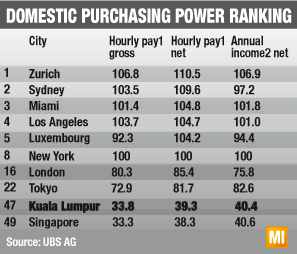
Malaysians who find themselves affording less than their contemporaries overseas have distorted and inefficient markets, lack of competition, low wages and a weak ringgit to thank for their poor purchasing power, which in the case of KL, is only 34 per cent that of New York.

Despite government assurances stating that inflation is under control, Malaysians are becoming increasingly restive over the cost of goods in relation to wages, especially those who are able to compare the corresponding price-to-wage ratios in developed economies.

Malaysians who have experienced working and living abroad often experience sticker shock when they come back and see prices in KL.

“Oh my God, a Tiramisu is RM15!” said Calvin Lee, a Malaysian who has lived in Sydney, Singapore and now London, referring to what cafes in KL are charging for a slice of cake as compared to about GBP5 (RM25) in London.

Aidi Zalman, a consultant who studied in the UK, told The Malaysian Insider that salaries in London could go much further than KL.

He had worked part-time as a waiter in London and noted that a single day’s wages of about GBP50-60 was already enough for him to buy a pair of branded shoes and even a low-end iPod, a concept unthinkable for local waiters.

“GBP100 can feed two apartments of students for a week,” he said. “Here you can spend RM100 and get hardly anything.”

“I hate it when politicians make stupid statements like Malaysia is cheap,” said Edward Seah, an engineer who has previously worked in Singapore and the US. “Prices might seem cheap when you convert it to US dollars yes, but then we should also convert our salaries to US dollars.”

Victor Wong, a Malaysian expat in Sydney, said that Australians get more mileage out of their money.

He gave the example of clothes where he said he can get a good quality shirt for about AUD100 but would need to spend about RM200 to get similar quality in KL.

Wong pointed out that even Asian food could be more affordable for those living in Sydney than KL.

“You pay RM15 for a bowl of soup noodles in KL shopping centres but only AUD10 in Sydney shopping centres,” he said.

The 2010 Prices and Wages report by Swiss bank UBS AG show that residents in KL have only 33.8 per cent the purchasing power of their counterparts in New York, 42 per cent that of London, 33.7 per cent that of Sydney, 32.6 per cent that of Los Angeles and 31.6 per cent that of Zurich.

The same study showed that on average, KL residents have to work 22 minutes to afford a loaf of bread as compared with 18 minutes in Los Angeles, 16 minutes in Sydney, 15 minutes in Tokyo and 12 minutes in Zurich.

The figures grow much worse for imported items. To buy an iPod Nano, a KL worker would have to labour a whopping 52 hours as compared with just 9.5 hours in Los Angeles and Sydney, 12 hours in Tokyo and nine hours in Zurich.

A check on salaries and prices in selected developed country cities by The Malaysian Insidershowed that despite being touted as one of the world’s least expensive cities, KL residents pay as much or even more for chicken, broadband, cars and mobile phones as a percentage of their income.

Communications, for example, is one area where Malaysians are paying notably more than residents in developed countries even after currency conversion.

A 5Mbps broadband package costs RM149 in KL while in London, a 10Mbps package would cost GBP13.50, in Melbourne a 5-8Mbps package costs AUD40 and in New York, a 7Mbps service costs USD41.95.

Those who want to buy an iPhone 4 in KL, meanwhile, would have to pay RM1990 with a basic 24-month contract while in London, residents can get an iPhone 4 for just GBP199 with a basic 24-month contract and in Singapore, it costs just SGD210 with a basic contract.

Maybank Investment Bank chief economist Suhaimi Ilias said that what is important is local perception and not official inflation figures which claimed that the inflation rate in Malaysia was only 1.7 per cent last year.

“I think on the ground, not many people feel we are cheap,” said Suhaimi. “They feel that the cost of living is high regardless of what the inflation figures are.”

He added that inefficiency and lack of competition are contributing to the higher prices in Malaysia.

“I can’t understand why a motorcycle should have to cost RM6,000-7,000 and a car like the Perodua Viva should cost over RM30,000,” he said.

RAM Holdings chief economist Dr Yeah Kim Leng said that cars are one of the sectors where the Malaysian market suffers the heaviest distortion.

A Honda Civic in KL costs about RM115,000, or 20 times the average monthly salary of an auditor.

In Melbourne and London by comparison, a Honda Civic costs AUD25,000 and GBP19,000 respectively, or only about three times the average salary of an auditor in those cities.

The high cost of cars is part of the reason that Malaysians have leveraged themselves to a record 76 per cent of the country’s GDP.

Bank Negara statistics show that at the end of last year, 20 per cent of Malaysian household debt was due to cars, an asset which depreciates over time.

Yeah also said that the ringgit is undervalued and distorts the country’s purchasing power for imported goods.

“We need to ensure prices are right and that there are no market distortions, no subsidies and allow market prices,” he said.

But even if the ringgit is allowed to rise, there is no guarantee that savings would be passed on to consumers. The ringgit is now hovering at RM3.02 to the US dollar but Goldman Sachs predicated yesterday the currency could hit RM2.98 to the US dollar in the next three months.

When The Malaysian Insider contacted the director of wholesale and retail at government think tank Performance Management and Delivery Unit (Pemandu), Ravidran Devagunam about the higher prices Malaysians pay for branded goods, he acknowledged that some retailers will maximise profits on luxury items not readily available in Malaysia but said that the government is “unable” to compel them to discount their prices even after the abolishment of import duties as luxury goods and apparel are not controlled items.

“However, we believe that market forces and consumer education will eventually force a price reduction of these goods over time,” he said.

The Federation of Malaysian Consumers Associations Secretary General Mohd Shaani Abdullah said people should question the prices that they are currently paying.

“Consumer protection will only come about when people make noise,” he told The Malaysian Insider when contacted. “Only then will politicians act.”
 

source: http://themalaysianinsider.com/malaysia/article/malaysians-plagued-by-poor-purchasing-power/

JICCI Women Entrepreneur Division Training Workshop

March 11th, 2011
|  Subscribe in a reader | Subscribe to poobalan.com by Email


THE newly-formed Johor Indian Chamber of Commerce and Industry (JICCI) Women Entrepreneur Division was aimed at producing more Indian entrepreneurs in the state.

Its new chairperson Dr K. Tasha Sulosana said the division would encourage more women entrepreneurs through various programs and workshops.

“We are also targeting single mothers and the division will organise programs to allow these women to be financially independent and helping them set up their own businesses,” she said.

The division was launched by Malaysian Associated Indian Chamber of Commerce and Industry president (MAICCI) Datuk K.K. Eswaran.

Dr Sulosana said some 30 women are registered under JICCI but the division was hoping to increase the number.

She added that the first training workshop will be held on March 13 at the Dato Wahid Hall in the JICCI office in Jalan Dato Jaafar 1 here.

“During the workshop, attendees would be able to attend various workshops including workshops on flower arrangements, ice-cream making, make-up, hair do, nail art, making accessories with beads,” she said.

She added that the workshop conducted would be free of charge and open to women of all ages.

For further information and registration for the free program, readers can contact the JICCI secretariat at 07-222 5210.

source: http://thestar.com.my/metro/story.asp?file=/2011/3/10/southneast/8201877&sec=southneast

Salary increase for banking, financial services, accounting, sales, logistics and ICT sectors

February 28th, 2011
|  Subscribe in a reader | Subscribe to poobalan.com by Email


Thinking about jumping jobs? Or about increment? See how things are shaping up for those in banking, financial services and ICT. Can’t believe the numbers below. Must be the top companies, not the SME or SMIs. Full article from The Star below.


PETALING JAYA: Professionals from the information and communication technology (ICT) sector, accounting and finance industry, banking, logistics and sales have a lot to cheer about this year – their salaries are set to rise by as much as 30% compared with last year.

The Robert Walters Global Salary Survey 2011 for Malaysia has revealed that a wage increase of between 5% and 30% would sweep across these industries this year, partially influenced by inflation rates and market conditions.

The take-home salaries could, in fact, be much higher as these figures are exclusive of bonuses, other benefits and allowances.

Highly-qualified employees with five to 10 years’ experience are expected to benefit from this salary increase as firms in these industries are scrambling to hire and retain the best talents.

“The job market has gradually moved to become more employee-driven. Some firms are even willing to offer premiums to attract good local and foreign talent with niche skills,” Robert Walters country manager Sally Raj told The Star yesterday.

“Salary reviews can range from 5% to 15% depending on market conditions.

“The real jump in salary scale can be seen among sought-after talent – going from 10% to 30%,” she said.

For example, a 29-year-old top investment banker with some six years of working experience can earn up to RM180,000 per annum on his basic salary, she added.

Robert Walters, which has a presence in 20 countries, is among the world’s major professional recruitment consultancies.

It is to release the findings of the survey today.

According to the survey, the banking sector will see the biggest salary boom as the wage bracket for investment bankers with five to eight years of work experience increased from RM180,000 to RM288,000 per annum this year, compared with RM157,000 to RM240,000 last year.

Private equity bankers with the same number of years in work experience also saw their salaries upped from RM160,000 to RM264,000, compared with RM126,000 to RM240,000 last year.

In the ICT industry, software, voice and network engineers are expected to see up to a RM5,000 increase in their annual earnings and business application specialists, up to RM10,000 this year.

In the accounting and finance sector, cost controllers and auditors may stand to earn up to RM10,000 more while wages for account managers in charge of taxation and pricing may make some RM20,000 more.

Malaysian Employers Federation executive director Shamsuddin Bardan said while the average wage increment was expected to be around 5.5%, sectoral increases would be evident as these key industries had been given emphasis by the Government.

“Talents, especially in the 12 National Key Economic Areas (NKEA), will be in demand,” he said.

National ICT Association of Malaysia (Pikom) chairman Wei Chuan Beng said the ICT sector, which is one of the NKEAs, would see expansion with demand for highly-qualified and experienced talents to grow rapidly.

The Malaysian Institute of Accountants (MIA) estimates that about 2,500 locally-recognised accounting graduates with an estimated 1,200 members of professional accountancy bodies recognised by the Accountants Act will join the workforce this year.

“Present development which is taking place in various industries, especially changes and development in corporate governance, tightening of accounting regulations, pressure of globalisation and technology advancement across industries are contributing factors towards this trend of expansion,” the MIA said in a statement.

National Housing Policy

February 10th, 2011
|  Subscribe in a reader | Subscribe to poobalan.com by Email


I’m sure this news will be music to many peoples’ ears. Those in the RM2500-4000 bracket would find it difficult to purchase a house, especially a landed property in KL. A double storey terrace of decent size (20×70) would easily cost RM350k if located in some corner of Klang Valley. Those in high-value areas can reach RM650k.  Want to buy apartments, may be too small and mostly rented to college students, foreign worker etc. Not exactly conducive environment once expects a graduate in a city to live in.

I just hope that houses (be it landed or high-rise) be of suitable size with enough rooms. I’ll say 1200-1600 sqft with 3-4 rooms should be the minimum.

Next will be the quality of the materials used. Hopefully there will be proper monitoring and enforcement. That’s a big IF.

Finally, not only the house, but the surrounding infrastructure is important too. No point building houses that are affordable but located far from everything. There should be access to public transport, medical services, schools, business/commercial areas, green spaces and places of worship. There should be community halls, enough lifts (for highrise), enough car parks too.

Oh ya, yet another concern is the financing. Wonder how the terms would be. Maybe combined loan, longer tenure and lowest deposit (government to provide some sort of guarantee).

BTW, would there still be discounts for certain community? Or can we consider all of them need help equally?

As it is, this is a policy. We all know how thing turn out when implemented in due time. Hope this policy works out well.

The Najib administration launched the National Housing Policy (NHP) today, focusing on houses for sale or rental to those earning between RM2,500 and RM3,999 a month, or the middle-income group that is growing to be a major urban vote bank.

Deputy Prime Minister Tan Sri Muhyiddin Yassin said today that the policy would ensure that every income group would be able to afford to purchase homes through affordable public housing (APH).

He said the policy was a follow-up to the 10th Malaysia Plan, where the government has set a target to construct 78,000 units of affordable public homes throughout the country by 2015.

“At this moment, the two challenges concerning the housing sector are the preparation for affordable homes for all segments of society and the need for a safe and comfortable housing environment in line with the country’s socio-economic status.

“The government is now working on the distribution of affordable homes as well as to strengthen our efforts in providing high quality homes,” said Muhyiddin(picture) today.

The DPM said the NHP was needed to provide direction and basis for the planning and development of the housing sector by all relevant ministries, departments and agencies at the federal, state and local levels as well as the private sector.

The NHP will be under the purview of the Ministry of Housing and Local Government, which is headed by minister Datuk Wira Chor Chee Heung.

The three key objectives of the NHP are:

• To provide adequate and quality housing with comprehensive facilities and a conducive environment

• To enhance the capability and accessibility of people to own or rent houses

• Setting a future direction to ensure the sustainability of the housing sector.

Under the NHP, the government and private sector will provide affordable houses for sale and rental especially for the low-income group, and also for the disabled, senior citizens and single mothers.

The policy outlines the role of the private sector as it is encouraged to develop medium-cost houses for the middle-income group with a monthly household income of RM2,500 to RM3,999.

It is understood that the national policy will enhance the role of state governments and their agencies, as they will be given flexibility in determining the quota of low-cost houses to be built in mixed-development areas based on the sustainability of the location and local demand.

“We will be engaging the state governments, so that they will set a quota or a percentage for medium-cost houses to be built so that middle-income earners can also purchase houses,” said Chor today.

He said the NHP was not really “new” as policies on housing had existed prior to the creation of the policy.

“It’s just that it is more systematic and proper now, and it will be easier for reference,” he added.

The NHP also outlines ways in ensuring that the lower-income group can afford to purchase homes which include providing financial support for the group and setting a realistic rental rate for low-cost houses.

Prices will also be set for low-cost houses and its ownership and sale will be controlled to avoid speculation.

Impact of Menara Warisan Merdeka

October 29th, 2010
|  Subscribe in a reader | Subscribe to poobalan.com by Email


I’m sure fellow Malaysians would have been bored to death hearing about the 100-storey tower proposal costing RM5 billion as unveiled by PM Najib in his Budget 2011 speech. The project is to be financed by Permodalan Nasional Malaysia (PNB) hence considered private funding.  Its not even investor’s money but PNB’s own money.  So, what can non-investors complaint about. Some details about the location:

PNB paid RM310mil or RM220 per sq ft to buy the 36-acre land from Pengurusan Danaharta Nasional Bhd in 2000. Hamad said the market value of the land was estimated at RM800 per sq ft today. Of the 36 acres, around 17 acres are occupied by Stadium Merdeka and Stadium Negara, which have been identified as a national heritage site. Conservation works have been undertaken to restore their heritage characteristics and the two stadiums are now being managed by the National Heritage Trust.

The project is supposed to have shopping complex and condominiums as well.

Some of the benefits/supporting statement for the project, as mentioned in many reports and speeches are:

– spillover effect to other industries [but for how long?]

– an icon for developing Malaysia [hmm…]

– attract foreign companies to set up office here. [possible of course]

– boost economy [ can other things boost better?”]

– provide 5000 jobs [make KL more crowded!]

– not involving government money [thank God!]

– KLIA, KLCC and Penang bridge was also protested, but now is being used by everyone or by the protestors and brings much benefit to people. [true, but two of them are public infrastructure. Not sure how KLCC is doing]

The reasons given by protestors:

– already have many unleased space in KL area. [but in this case, PNB is going to occupy some of tower]

– congestion [which part of KL got no congestion la?]

– can utilise money in other areas like transportation, poverty eradication etc. [PNB is not doing charity, OK!]

– can relocate to Kg Baru [Can be considered].

– if project fails, government may need to spend public fund to bail out PNB [now, this is worrying!]

– its just a personal icon for PM [well, don’t we all need to be remembered for something?]

– no guarantee that locals (read: bumiputras) will benefit [of course la. Its a global village. You want be jaguh kampung, sorry la].

For me, its PNB’s money and PNB’s land. As long as government can guarantee won’t bail out, should be OK. BUT, since its a development project, there should be proper study and impact assessment done. In this way, public can voice out how the project will cause positive/negative impact to the surrounding area. Can suggest to improve transportation in tandem with the building development, for example.

If given a choice, I would prefer if the project is carried out away from KL city centre area. Reason is that it can spur more development. For example, can set up the tower in Sepang, Hulu Selangor, Kuala Langat, (oops, all PR area! No Go area for the moment) or Negeri Sembilan. This will provide decongestion, spur secondary and tertiary industries, and more job opportunities. The areas mentioned are still relatively near to airport and city centre, so not a big problem to attract tenants.

What do you think?