
Posts Tagged ‘Statistics’

Plantation workers earn higher than poverty line

July 17th, 2008
|  Subscribe in a reader | Subscribe to poobalan.com by Email


This is an interesting news because last year May, there was an increment of about 9 percent in the plantation workers’ wage under new collective agreement signed between NUPM and MAPA. The lowest a field worker can earn will be between RM500 and RM600.

Now, senator Kohilan who is the Plantation Industries and Commodities Deputy Minister says, on average an oil palm or rubber plantation general worker now earned RM750 a month while an oil palm harvester about RM1,100 a month, which is above the rural poverty line of RM740.

Actually poverty rate in Peninsular is RM691 and as far as I know have not been reviewed yet. for rural area, poverty line was found to be RM698. There are some others who indicate poverty rate to be about RM680. Some states also calculate their own poverty line, like Selangor who increased it to be RM1500. This means that workers are earning higher than the poverty line of RM691.

He further adds that:

Most plantation workers also do not have to spend on house rental,
medical charges (at the clinics) and pre-school education for their
children as all these facilities are provided by the plantation
management

What he says is true, but plantation workers (locals) have to think about the future – means they have to buy a house and service the loan. Groceries and education cost increases. These workers, like any other, must consider taking insurance for their children. Traveling, clothing, vacation and entertainment cost increases. I consider these new “expenses” as necessity since we are moving towards developed, progressive, and knowledge-based society.

I hope to see poverty line to be increased to a suitable amount that considers the need of 5 family members in current economic and social settings. Maybe to RM1200 or 1800 even.

Dr Subra on PSD scholarship, government jobs and cabinet committee

July 14th, 2008
|  Subscribe in a reader | Subscribe to poobalan.com by Email


Dr. S.Subramaniam suggests that the interview and extra-curricular criteria to be abolished when handing out PSD scholarships. He says:

No matter how good you are at your ECA or your interview performance, you should not be eligible for a scholarship for tertiary education with low academic results

In other words, scholarships awards should be purely on academic results. This may be problematic since generally those from affluent families have better chance of doing better. Why not do it like this – minimum 9A for those family income below RM3000, minimum 12As for those with family income between RM3001 and RM8000, and minimum 14As for those from family earning above RM8001.

However, he goes on to say that all Indians students who score 9As and above in the Sijil Pelajaran Malaysia will be given government scholarships, starting this year, to pursue their studies in local government universities and four local private institutions — Monash, Swinburne, Curtin and Nottingham universities. MIC had also asked the government to include the Asian Institute of Medicine, Science and Technology in this scheme. This was decided during the first meeting of the Special Committee for Indian Related Affairs chaired by Najib. Human Resources Ministry is the secretariat for the committee.

“Deputy Prime Minister Datuk Seri Najib Razak has agreed in terms of policy and we are now in the process of formalising it.”

The problem with this suggestion is that the other communities may demand the same. After all, we are moving towards equal rights. Unless of course, the privileged community gets scholarship for much lower results, in which case they won’t complain. But the Chinese community will be upset that their students who get 9As don’t get similar deal.

Rest of the committee members are: MIC president Datuk Seri S. Samy Vellu, Dr Subramaniam, MIC deputy ministers, finance and education ministers, Public Service Department director-general, representatives from ministries related to problems faced by the Indian community and multi-agency committees.

Some of the outcomes of the first meeting has been highlighted before, but some new ones are below:

– University intake for Indian students in critical courses to be increased. Eight per cent of PSD scholarships were given to
Indians to study medicine and law. The committee was seeking more
places for Indians wishing to pursue programmes in dentistry, pharmacy,
accountancy and architecture

– A relook at the appeal of Indian students who achieved about 3.0 CGPA grading but did not get university places.

But remember, Najib said that university intake for this year will not be reviewed. He advised students to study harder. Not sure which is which now.

Another area Dr. S.Subramaniam ventured is the civil service. He said of the 16,000 Indians who applied for government jobs last year, only 1,500 were offered postings.

“It’s not true that non-Malays are not applying for civil service posts,” he said, adding that the percentage of Indians in the civil service should be increased from the five to eight per cent.

“We want Indians not only in lower-category jobs but also in higher categories. PSD has been cooperative in furnishing the MIC with information on vacancies in the civil service,” said Dr Subramaniam, who is also MIC secretary-general.

Perhaps PSD will publish such statistics – breakdown by job category, state, age, gender etc.

The next statement filled my heart with joy!

Dr Subramaniam said MIC was also working hard to improve Indian equity in the capital market from 1.1 per cent to 1.5 per cent within the next three years.

While the government is aiming for 1.5 percent in 2020, MIC is planning to turbo-boost it in 3 years. That is indeed a great challenge and one that can revive the community’s faith a bit. The easiest way is to get a big allocation from government, like maybe RM5 billion and offer it to the community via PNB. Immediate cash injection and the equity will be boosted. Just left with a small matter of asking for allocation.
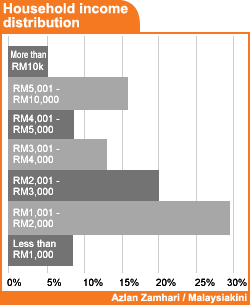
Household income distribution

July 9th, 2008
|  Subscribe in a reader | Subscribe to poobalan.com by Email


Dr Michael J Devaraj (conqueror of Samy Vellu), MP for Sungai Siput was praised by the Assembly Speaker recently as among the MPs who ask good questions. He asked the following today:

My question is, why did the government stress the disparities between ethnic groups while staying silent on the inequalities between the rich and the poor within every ethnic group which contributes by far to inequalities generally?

This was in response to MP Amirsham’s reply on the income distribution for households.

householdincome.gif

Taken from Malaysiakini.
– 8.6 percent of households earn below RM1,000
– 29.4 percent of households earn between RM1,000 and RM2,000
– meaning, 38 percent of households in Malaysia earn RM2,000 and below.

– 19.8 percent of households are in the RM2001-RM3,000 income bracket
– RM3,001-RM4,000 (12.9 percent)
– RM4,001-RM5,000 (8.6 precent)
– meaning, 41.3 percent are in the RM2000-RM5000 bracket

– about 20.7 percent of households earn more than RM5,000 a month
– RM5,001-RM10,000 (15.8 percent)
– above RM10,000 (4.9 percent).

The source and period of the statistics is not provided, but it should be not before 2004 and not later than 2007. The number of households is also not provided.

Looking at the results, we have 38% of household earning RM2000 and below. If a household has 4 people, it will be diffcult to live in urban area. Nearly 58% of the households earn RM3000 and below.

With poverty line set at RM600-RM700 range, we can understand why the poverty rate is low. Unfortunately, the income is always insufficient to match the ever increasing cost of living. If poverty line is increased to RM1000, then 8.6% of the households will be poor. However there have been calls to increase poverty rate to RM1500, which may reveal that up to 24% of the household are poor.

Another issue is that many are resorting to part-time or second (and even third) jobs to supplement income. These are usually not revealed or reported in order to avoid taxation, punishment (by employer), or to purposely show their “poverty”.

Anyway, I’m not sure if household income is a good parameter. Individual income statistics should be tabulated as well.

RM428 million for mosques and RM8 million for others

July 3rd, 2008
|  Subscribe in a reader | Subscribe to poobalan.com by Email


In a 60/40 population, 428 million versus 8 million doesn’t look balanced no matter how you cut it. And that is just for the period between 2005 and 2008.


Let’s do the maths:


428/ 42 months (from Jan 2005 until June 2008) = 10.19 million per month.


8/42 months = 190,000 per month.


That means mosques get 53.63 times more than other places of worship month-wise. Over the said period, its 53.5 times more than the allocation for temples and churches.


And bear in mind that this amount is to be shared between temples (Hindus, Buddhists, Taoist?) and churches.


The deputy minister for Internal Security also said that the government has been disbursing RM1 million per year for temples/churches and Hindu temples respectively for physical construction projects.

Unit trust scheme to reverse Indian equity drop

June 26th, 2008
|  Subscribe in a reader | Subscribe to poobalan.com by Email


The hottest news among the concerned Indians surely have to be the news that Indian equity DROPPED to 1.1% from previous 1.2%. This is a big blow to MIC, and if used properly, will spell the end of Samy Vellu and MIC. For all they claimed on stages and advertised in papers, what we ended up with is a drop in equity. When everyone else registered positive growth, ours went the opposite way. Even though the value of investment increased (by/to?) RM575.2million or 9% within the period 2004-2006.
Unless there is proof that from 2006 to 2007, some sort mini miracle happened to improve the percentage…it will be a body blow for MIC.

Yeah, equity may not be all, but as it is an indicator fondly used by other races, so I guess its fair that we too treat it as an important indicator.

The non-privileged, normal Malaysians share increased from 40.6 percent in 2004 to 43.9
percent in 2006, meaning the Chinese community’s hold increased 3.3%, far more than the privileged and Indians communities.

For non-bumiputeras, it increased from 40.6% in 2004 to 43.9% in 2006. Chinese ownership group saw an increase from 39.6% to 42.4%, while for Indians it showed a slight decline from 1.2% to 1.1%.

However, there was a decline in foreign ownership from 32.5% to 30.1% while for nominees, it fell from 8.0% to 6.6%.

Also, the contentious “privileged’ people equity is being put at 19.4% whereas alternative figures quote more than 45% (google for ASLI’s report on bumiputra equity), increasing from 18.9% in 2004. ?During the period, individual ownership increased from 15.0% to 15.1% while for institutions, including Permodalan Nasional Bhd, it increased from 2.2% to 2.6%. The government’s target under the 9MP is to attain bumiputera equity ownership between 20% and 25% by 2010, which excludes government companies like Petroliam Nasional Bhd and Khazanah Nasional Bhd. The equity ownership is based on the par value of the shares and not on market capitalization.

The irony is privileged people’s equity increased 0.5% and below are among the measures to reach the target of 20 to 25% being introduced by PM:
» Read more: Unit trust scheme to reverse Indian equity drop