
Posts Tagged ‘temples’

Maran Marathandavar Temple Kumbhabishegam

January 21st, 2008
|  Subscribe in a reader | Subscribe to poobalan.com by Email


Sunday was quite hectic since we planned to visit Maran Maranthadavar temple for its kumbhabishegam (consecration) ceremony.

Left home around 6am, taking LDP highway, passing by Batu Caves and entered Gombak to access KL-Karak highway. The whole journey to the temple took about 2.5 hours. The drive was cautious due to foggy road conditions between Karak and the Chenor/Jengka exit. The roads were clear and for most strecthes, we could only see one or two cars at a time.

We reached within 500 metres of the temple, passing by nearly a kilometre of road lined up with vehicles on both sides of the road.

We were stopped at at a roadblock and asked to divert to the oil palm estate on the right side for parking. We were guided to a parking spot, and the chinese guy collected RM10 as parking fee. Wonder if the police were in cahoots with the guy or not. 🙂 There was not much way to u-turn, so one have to pay for parking. No wonder the other cars parked along the roadside leading to temple.

We walked a short distance to temple. Outside the temple, there were stalls set up – from free medical checkup to vegetarian food. There were many traders selling souvenirs, praying items, religous knick-knacks by sitting down along the roadsides, just like pasar malam or fivefoot pavement style.
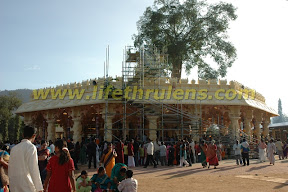
We entered the temple and bought the prayer receipt. It cost RM4. The kumbhabisegham prayers were being held under a temporary shed next to the temple. It was led by Muthukumara Gurukkal with another 10 or so assistants. The weather was getting hot and it was difficult to find a nice spot to stand. From time to time, the PA system announced sale of magazines and special religous items.

The temple was yellow in color, with dabs of pink at certain places. I felt that it could have been given a better color combination. 🙄 It had some chandelier style lights as well. No fans, since the breeze will be cooling enough on normal days.

Many people were buying yellow cloth (with coins in it) to be tied around the tree.

The crowd numbered about 2000 – 3000 people in my estimation. Very much less than what I anticipated.

The prayer went on till 10.30am. Then, the procession went around the temple and finally the procession went up the temple via the temporarily construction staircase. There were some confusion as not all were allowed to go to the top by the security people. Some prayers were recited and the ambishegam was done. Then, the security people were allowed to ask the devotees to go up as well. About 40 people managed to take this opportunity to go on top of the temple. I was too slow to react because unsure of what was happening.
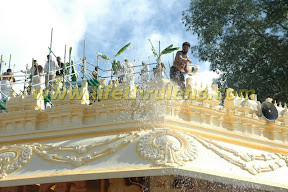
At about 10.45am, the moment many devotees had been waiting for finally appeared. The workers threw buckets of the prayer water down on to the devotees. Many were drenched, including myself. Some devotees took out their water bottles and plastic bags to collect the water. It was quite hectic for the next 10 minutes or so as the crowd pushed in front and jostled for better positions.

After that, we went back into the temple to do “archanai” (prayer). There were some prayers going on, which lasted for about 15 minutes. The microphones also failed from time to time, due to dead batteries. The crowd was large, and there was no system or guide on the movement or flow of the crowd. Took us nearly 20 minutes to reach the front of the queue, only to realise that the priests were giving out vibuthi (sacred ash). “archanai” have to wait” one of the priests told me, he himself unsure how long.

We waited for another 10 minutes before queueing again. This time we stood near the Vinayagar deity side (right side of temple) together with about another 30 people. The queue was not moving at all. The priests were still doing the prayers and handling the temple donors/sponsors first. The crowd start to become agitated. Some began to shout at the priests.

Amidst this, two priests were busy peddling their wares, right in front of Vinayagar statue. Selling strings to be tied around the wrists for RM1 per string. I was really pissed off. Here the crowd is getting tired of waiting, no one is guiding or doing anything, but these two guys are busy being entrepreneurs! Luckily, another priest scolded them and they stopped selling.

The donors and sponsors were a lot and it was time consuming. There was no system at all on how to enter and exit the queue. The temple committee was no where to be seen. The priests were left on their own, earning abusive words from the crowd. Some of the priests helped to collect the archanai receipts first. I was fed up of waiting and passed the receipts with the gifts to Lord Muruga to the priest and asked them to do it later. We got out of the queue at about 12.35pm. Queueing up took up more than one hour from the time we went to the main deity’s area.

In my opinion, the organisers made a mess out of the function. The PA system was not properly utilised for crowd management. Instead they were busy announcing sales of magazines. The voice was also not clear enough. They may need to invest on proper PA system.

There were no people/volunteers to control/guide the crowd. People don’t know where to go and when to go. They just queue up and wait with the rest. This caused lots of unhappiness with the devotees.

The priests also refused to attend to the devotees, and were trying to settle the sponsors/donors first quickly. There were at least 10 priests, but not sure how they helped to reduce the problem. I think the organisers should have set out proper lines and paths using ropes or signboards so that the devotees know where to queue. They should also announce that “archanai” can be done after certain time, so that devotees won’t be left standing for so long.

Anyway, we left at around 1.15pm, tired.


Penang Silver Chariot

January 20th, 2008
|  Subscribe in a reader | Subscribe to poobalan.com by Email


Silver chariot gets cleaned and polished

source

PENANG: Every year without fail, the 114-year-old silver chariot undergoes cleaning and polishing one month before the Thaipusam festival begins.

Managing trustee of the Nattukotai Chettiar Temple Trustees Datuk N. Ramanathan said yesterday A. Veerapathiran, 73, and his two sons V. Kajendrakumar, 39, and V. Sugumar, 38, have started cleaning and polishing the chariot housed in a shed opposite the Kovil Veedu (Temple House) in Penang Street. Veerapathiran has been carrying out the task for the past 40 years without any charge, as he considers it a service to God.

Ramanathan said a special prayer to Lord Muruga would be conducted at Kovil Veedu at 2am on Jan 21, before the deity was placed on the chariot. The chariot is expected to leave the Kovil Veedu on its journey to the Nattukotai Chettiar Temple in Waterfall Road at 6am.

The 7.3m-high chariot was brought by ship from India in 1894, and was made of wood and is silver-plated. The Chettiar community here commissioned for the silver chariot after the original wooden chariot started showing signs of decay. The new chariot parts, made in Karaikudi, India, arrived here in different shipments and were assembled locally. The wooden chariot was subsequently “sold” to a Lord Muruga temple in Medan, Indonesia.

Ramanathan said a VCD featuring the significance and importance of the Thaipusam festival with a voice-over done in English and Mandarin would be available by end of the year. “We produced one in Tamil in 2005 but found the need to do it in English and Mandarin for the benefit of non-Tamil speaking devotees,” he said. He said among others, the one-hour documentary touched on the rituals and prayers that began one month before Thaipusam.

Hindraf ISA detainees stay united

January 15th, 2008
|  Subscribe in a reader | Subscribe to poobalan.com by Email


However, the statement did not mention anything (agree/deny) about the police report made by Vasantha Kumar. So, is there such a report?

Hindraf 5 deny split in ranks
http://www.malaysiakini.com/news/77057
Syed Jaymal Zahiid | Jan 15, 08 5:26pm

The five detained leaders of the Hindu Rights Action Force (Hindraf) detention have denied that there is a split in their ranks.

Malaysiakini reported yesterday that Hindraf secretary T Vasantha Kumar had lodged a police report against legal adviser P Uthayakumar over supposed allegations of misuse of funds. However, the latter’s lawyer N Surendran had urged caution over placing too much faith in such information. 
 
The two, along with V Ganabatirau, M Manoharan and R Kenghadharan, are being held under the Internal Security Act (ISA) at the Kamunting camp in Perak.

Their joint denial was issued when they met today with their lawyers – M Kula Segaran, Karpal Singh, A Sivanesan, S Ponnumugam, M Manogran, T Kumar and Ram Karpal Singh.

In a statement signed by Kula Segaran, the five said: “We are not disunited, we will continue our fight (for betterment of the Indian Malaysian community) and will fast (from Jan 21-28).” 

Specifically, the denial covers any suggestion that they are no longer on talking terms with one another or that “one or more of them will admit to (alleged terrorism charges)”.

“They are resolved to fight (on) and have not wavered in any way from their demands to the government,” Kula Segaran noted in the statement.

“Their detention without trial has put Malaysia on the world map as (a country) which does not respect human rights values. We hope the government will take steps to release (them) unconditionally as soon as possible.”

According to the statement, the ISA Advisory Board met in Kamunting today to discussion the alleged terrorism charges against the Hindraf leaders, but adjourned the hearing to Feb 12.

Yusuf Sam (whose designation was not stated), who presided over the closed- door meeting, was assisted by two assessors. The internal security ministry was represented by legal adviser Abdul Wahab, while lawyers for the Hindraf 5 were present.

Complaints about conditions

The Hindraf leaders further protested the conditions under which they are being held, calling for immediate attention to their complaints that:

• They are being locked up in their cells for nearly 16 hours daily “like common criminals”;

• The keys to their cells are kept some distance away in the administration block, thereby leading to potential delay in assistance in case of emergencies like a fire;

• They do not have access to television, computers or up-to-date books and magazines in the resource centre; and

• Vegetarians like Kengatheran do not get appropriate meals.

They also demanded more time with their families, who are only allowed a maximum of 45 minutes per visit and, even then, only in the presence of guards. Apart from wanting food from outside the camp, they want access to a temple for prayers.

The five reiterated their reasons for their forthcoming hunger strike, saying it is to protest their “unlawful and unconstitutional detention” since Dec 13, as well as to seek restoration of Indian rights and to “seek divine intervention”. 

Penang Hindu Endowments Board replies

January 15th, 2008
|  Subscribe in a reader | Subscribe to poobalan.com by Email


The Hindu Board replies to attacks on its status.

Said Kumaraendran: "The board has never been a political tool of the ruling coalition. (Its) commissioners and temple management committee-members have always been appointed based on merit and (their) credentials, (not) political affiliation as alleged."


They are all appointed by the state governor on the advice of the state government based on their track-record as persons of high esteem in the society.”

– wonder how they define merit and credentials. Based on the track record?

Penang Hindu Board 'not BN political tool'
http://www.malaysiakini.com/news/77039
Athi Veeranggan | Jan 15, 08 2:37pm

The Penang Hindu Endowments Board has defended itself against allegations that it has become a political tool of the MIC and Gerakan in Penang and that it is acting beyond its powers.

K Kumaraendran rebutted the claim that political considerations have been the yardstick for the appointment of commissioners and committee- members, who manage the five temples in the state. 

A commissioner and lawyer, he was commenting on a Malaysiakini report last Friday, in which United Hindu Religious Council president G Mugunthan had alleged there is rampant political meddling in the annual appointments. 

Said Kumaraendran: "The board has never been a political tool of the ruling coalition. (Its) commissioners and temple management committee-members have always been appointed based on merit and (their) credentials, (not) political affiliation as alleged.

"They are all appointed by the state governor on the advice of the state government based on their track-record as persons of high esteem in the society.”

Hindu endowments belonging to the hilltop Waterfall Temple – Sri Balathandayuthabani Kovil (photo) – Sri Ramar Kovil in Dhoby Ghaut, Sri Kunj Bihari Krishan Mandir, Sri Maha Mariamman Kovil in Lebuh Queen and Sri Maha Mariamman Kovil in Butterworth are administered by the board.

Under the Hindu Endowment Ordinance, the state governor on the advice of the state executive council appoints a board of commissioners, one of whom must be a government officer.

The board then sets up an endowment management committee consisting of members of public professing the religion applicable to the endowments – in this case, Hinduism.

'Orderly festivals'

According to Mugunthan, political-based appointments of commissioners have become a norm since the 1980s.

Even the board chairperson is a politician, he said, referring to former MIC state chairpersons T Suppiah and K Rajapathy, and current state deputy chairperson PK Subbaiyah.

Over the years many MIC division leaders and prominent Gerakan Indian leaders have been appointed as commissioners. 

Reliable sources had claimed that Penang Chief Minister Dr Koh Tsu Koon (photo ) has insisted on "his men from Gerakan" being appointed.

Kumaraendran also refuted the allegation that the board had overstepped its jurisdiction.
The board is entrusted with managing the temples and their endowments and to organise their religious festivals, he noted.

In this respect, it has a legal obligation to ensure that religious festivals are celebrated in correct and orderly manner.

This involves implementing measures to regulate tanneer panthal (refreshment booths) and installing a centralised system to control the type of music played during Thaipusam each year.

"Various quarters have commended the board for its actions to bring more order into Hindu religious festivals," he added.

Interview with MHS President

January 14th, 2008
|  Subscribe in a reader | Subscribe to poobalan.com by Email


However, we disagree that there are too many temples/shrines in the country.

– anyone keeps a record? MIC, MHS, or state govt/municipal councils?

 I would like to state categorically that Hindus should not build a temple or shrine at their home or compound.

– hmm…wonder how many people will agree with him on this.

Except for the recently established Malaysia Hindu Council, the rest are affiliated to us. There is no problem in their numbers as long as we take a common stand and champion the same cause. Malaysia Hindu Sangham is in the forefront when comes to matters relating to Hinduism, much to the fact that it is the earliest Hindu organization established in the country, that is in 1965,and is well represented throughout the nation.

– so, if anyone to be blamed, it is MHS and its affiliates?

Practicing Hinduism, or any other faith for that matter, is no problem in Malaysia. …We must appreciate the fact that the Malays (Muslims) being the majority have accommodated us in many ways. … MHS is of the opinion that this should not be happening in a society that boasts for liberal attitude in religiosity and blames the lack for inter-faith dialogue for this poor state of affairs.

– meaning need to establish Inter-Faith committee/panel etc? I thought PM clearly said no need to have such things.

…Beforehand, one must understand how these temples ended up in such predicament. This is very much an inherited problem from the colonial past when the Indians were brought here by the British to work in plantations and build railway lines. These people built temples … that exist till today in the plantations that they toiled and along the railway lines that they built.
However, it is most unfortunate that the British failed to alienate or gazette the land occupied by these temples. It is also most unfortunate the fate of the places of worship was not taken into consideration during the bargaining process for independence. Today when estates make way for progress and railway lines are expanded, everyone blames the temples for standing on the way. Another thing to be noted is that while the British gave the Indians in Malaya a free hand to build temples wherever they wanted, they imposed strict prerequisites in Singapore from the onset. Thus, the temples in Singapore are free from problems like what we are facing today.

– blame it on the British. So, can we sue them ala Hindraf? Then, blame it on independence negotiators. Now blame development.

In fact MHS had launched the 2004-2008 Hindu Renaissance Action Plan to get the temples involved in their community. Under this plan we have established 22 pre-schools in temples and are encouraging them to improve and modernize their administration. We also want to see temples being accountable and the public has the right to know how their donations are being spent. Temples should not exist in isolation, they should be seen as part of the institutions of a society. Thank you Datuk.

– perhaps MHS can provide details of the progress of the plan so far. I’ve heard of such kindergarten classes in temples. How about other measures in the plan?

source

THERE IS LIGHT AT THE END OF THE TUNNEL     

KUALA LUMPUR, 12 January (Bernama) – What is the future of Hindus in the country and their temples? Is freedom to practice one’s faith is very much alive? Is there a solution to the host of woes faced by Hindu temples? These are the questions that linger in the mind of an average Hindu in the country today.

Bernama’s writer Ravichandran D.J Paul speaks to Malaysia Hindu Sangam’s (MHS)President and the man who has been at the forefront in advocating Hinduism affairs in the country for the last 50 years, Datuk A.Vaithilingam.

Q: Datuk, your hopes for the Malaysian Hindus in 2008.
A: Hindus in Malaysia welcomed 2008 after an unprecedented emotional upheaval. The demolition of a temple in Kampung Jawa served as a wakeup call for Hindus in particular and Indians in general over their rights and position in a plural society. The incident also, inadvertently, diverted them to the problems plaguing the community. I see the year 2008 being pivotal for the Hindus in determining the way forward not only in their faith but in their socio-economic standing as well.

Q: Datuk, is there any statistics on the number of Hindu adherents in the country and the number of temples and shrines? Do we have too many temples/shrines?
A: Our estimate points that there are about 1.5 million Hindus in Malaysia but we are not sure on the number of temples and shrines, and I would not give any figures to add to the current ambiguity on their numbers. However, we disagree that there are too many temples/shrines in the country.

Q: But Datuk, there are some who even build temples/shrines right at their home and are they accounted for?
A: I would like to state categorically that Hindus should not build a temple or shrine at their home or compound. It is only proper to have a prayer room or an altar at home to be strictly used by the family members only and not outsiders. If they are keen to invite outsiders to pray along, then it’s only proper that they organize a special prayer (oobayam) at a temple.

Q: Though Hindus are a minority why do we have so many organizations representing the religion – MHS, Malaysia Hindu Dharma Mamandram, Malaysia Hindu Council and Malaysia Hindu Youth Council. Does this reflect the lack of unity among Hindus? Anyway who do the Hindus consider the formidable front when comes to advocating Hinduism in the country?
A: Except for the recently established Malaysia Hindu Council, the rest are affiliated to us. There is no problem in their numbers as long as we take a common stand and champion the same cause. Malaysia Hindu Sangham is in the forefront when comes to matters relating to Hinduism, much to the fact that it is the earliest Hindu organization established in the country, that is in 1965,and is well represented throughout the nation.

Q: Looking at the case of R.Subashini over the divorce and her rights over her children when her husband converted to Islam, the tussle over the body of Everest team member Maniam Moorthy (Mohammad Abdullah), the demolition of non-Muslim worship places to make way for development and the other legal conflicts between Muslims and non-Muslims that we have seen over the years, do you feel non-Muslims are still free to practice their faith in this country?
A: Practicing Hinduism, or any other faith for that matter, is no problem in Malaysia. I don’t see it being a problem now and also in the future. Despite the differences in our belief system, Malaysians remain tolerant to one another and respect each other’s faith. Remember, each year we celebrate our religious festivals freely and major celebrations are accorded public holidays. And getting a permit for religious procession or congregation is no problem as long as they stick to the guidelines. We must appreciate the fact that the Malays (Muslims) being the majority have accommodated us in many ways. Nonetheless problems do crop up from time to time testing the tolerance limit of the freedom of religion enshrined in the constitution. MHS is of the opinion that this should not be happening in a society that boasts for liberal attitude in religiosity and blames the lack for inter-faith dialogue for this poor state of affairs.

Q: It is obvious that there are many temples/shrines all over the nation built on someone’s land and when they are demolished controversies are bound to arise like what happened in Kampung Jawa.
A: I beg to differ on this point. Beforehand, one must understand how these temples ended up in such predicament. This is very much an inherited problem from the colonial past when the Indians were brought here by the British to work in plantations and build railway lines. These people built temples (especially Maha Mariamman, Kaliamman and Muneswarar temples) that exist till today in the plantations that they toiled and along the railway lines that they built.
However, it is most unfortunate that the British failed to alienate or gazette the land occupied by these temples. It is also most unfortunate the fate of the places of worship was not taken into consideration during the bargaining process for independence. Today when estates make way for progress and railway lines are expanded, everyone blames the temples for standing on the way. Another thing to be noted is that while the British gave the Indians in Malaya a free hand to build temples wherever they wanted, they imposed strict prerequisites in Singapore from the onset. Thus, the temples in Singapore are free from problems like what we are facing today.

Q: Datuk, is there a solution to this problem?
A: I personally feel that the best solution would be to gazette the land occupied by the worship places and this must be done fast. This problem is prevalent in Selangor and Kuala Lumpur much to the rapid development. It seems that nowadays the authorities are doing all for the satisfaction of the developers and not the people. Places of worship demolished and dwellers resettled in low cost flats that I could only best describe as no more than pigeon-holes all in the name of development. The emphasis is on physical and not spiritual development and this is probably why our society today is plagued by social woes. I personally believe demolishing places of worship should be avoided altogether or an amicable solution sought through dialogues with all parties concerned. A good example will be the Federal Territory, after the incident where three temples/shrines were demolished on the same day about two years ago, and the following outcry, a special committee was established involving representatives of MHS, MIC, MCA, Taoism Federation, Dewan Bandaraya Kuala Lumpur and other relevant departments. Since then the fate of 65 temples, including about 20 Taoists temples, that were on the demolition list to make way for the KL-Batu Caves double tracking and other development projects were settled in an amicable manner. That is why compared with Selangor, we don’t see much problems relating to temples in Kuala Lumpur.

Q: Lastly Datuk, temples in this country seem to solely serve as a prayer avenue but what is their contribution to the society?
A: In fact MHS had launched the 2004-2008 Hindu Renaissance Action Plan to get the temples involved in their community. Under this plan we have established 22 pre-schools in temples and are encouraging them to improve and modernize their administration. We also want to see temples being accountable and the public has the right to know how their donations are being spent. Temples should not exist in isolation, they should be seen as part of the institutions of a society. Thank you Datuk.